
AI for Sustainability
AI for Water Risk and Water Footprint Management: Inside the Modern Water Intelligence Platform
How AI-powered water intelligence platforms help enterprises manage water risk, water footprint accounting, and CDP, ESRS E3, GRI 303, TNFD and IFRS S2 disclosure on a single data fabric.
Sofia Fominova
TL;DR
AI for water risk and water footprint management is becoming the second pillar of enterprise sustainability data, alongside carbon. A modern water intelligence platform combines automated data ingestion, basin-level risk scoring, blue, green and grey footprint accounting, supply-chain water exposure, and audit-ready disclosure under one AI infrastructure — making annual ESRS E3, CDP Water, GRI 303, TNFD and IFRS S2 reporting feasible at the scale and cadence regulators now require.
Key Takeaways
The global AI in Water Management market reached USD 7.54 billion in 2024 and is projected to hit USD 53.85 billion by 2032 — a 27.85 percent CAGR — according to DataM Intelligence (February 2026).
The amended ESRS E3 standard issued by EFRAG in December 2025 makes total water consumption, withdrawal and discharge metrics mandatory for in-scope companies, with the EU delegated act expected by mid-2026.
CDP’s 2025 Water Security essential criteria require A-list candidates to set targets across at least two of withdrawals, water pollution and Water, Sanitation and Hygiene categories, with site-level disclosure of withdrawals from water-stressed basins.
Ecolab launched its AI-enabled Water Navigator IQ platform on 23 April 2026, citing a projected 56 percent freshwater shortfall by 2030 and noting that water supports nearly 60 percent of global GDP.
Watershed, the largest pure-play enterprise carbon platform, has begun adding water and waste data to its enterprise platform — confirming that the carbon-only sustainability stack is consolidating into a broader environmental data fabric.
Introduction
Net0 is an AI infrastructure company that builds AI solutions for governments and global enterprises. Its sustainability vertical began with carbon — Scope 1, 2 and 3 accounting under the GHG Protocol — and now extends across the full environmental footprint, including water, biodiversity, energy, waste and air quality. As regulators, investors and boards extend their disclosure expectations beyond carbon, AI for water risk and water footprint management has emerged as the next priority for enterprise sustainability teams.
This briefing explains what a modern water intelligence platform actually does, why the same AI infrastructure that powers carbon accounting is the right architecture for water, and how the 2026 disclosure stack — ESRS E3, CDP Water Security, GRI 303, TNFD and IFRS S2 — is reshaping corporate water management practice.
Why water is the next frontier of enterprise sustainability data
Water has moved from a utility cost line to a board-level financial risk in less than three reporting cycles. Three forces are converging.
Physical scarcity is now priced in. The United Nations and the IEA project a 56 percent freshwater shortfall by 2030 against demand. Water already supports approximately 60 percent of global GDP, according to data referenced in Ecolab’s April 2026 launch of Water Navigator IQ. Companies operating in water-stressed basins — from semiconductor fabs in Taiwan, to data centres in Phoenix, to apparel manufacturing in South Asia — face escalating curtailment risk, regulatory restrictions, and stranded-asset exposure.
Disclosure obligations have hardened. ESRS E3 (Water and Marine Resources) under the European Corporate Sustainability Reporting Directive moved from a largely voluntary set of metrics in the 2023 standard to a mandatory withdrawal, discharge and consumption regime in the December 2025 amendment from EFRAG. Wave 2 reporters will report under that simplified version once the European Commission adopts it via delegated act in mid-2026. Site-level disclosure for operations in water-stressed areas is no longer optional.
Supply chains are exposed even when own operations are not. Most enterprise water risk is upstream. CDP, with more than 18,000 corporate disclosures, requires basin-level context, supplier engagement, and target-setting in its Water Security questionnaire. Investor frameworks — IFRS S2 from the ISSB, TCFD legacy disclosures, and TNFD’s nature-related recommendations — now expect water dependencies and basin-level physical risk to be modelled with the same rigour as climate-related risk.
The CFO question is no longer “what is our water bill?” It is “what fraction of our value chain is exposed to water-stressed basins, what is the financial impact at one-in-twenty and one-in-one-hundred-year stress events, and how is that disclosed under CSRD compliance and IFRS S2?”
The 2026 water disclosure stack
Five frameworks now govern how large enterprises and regulated entities disclose water performance, dependencies and risk.
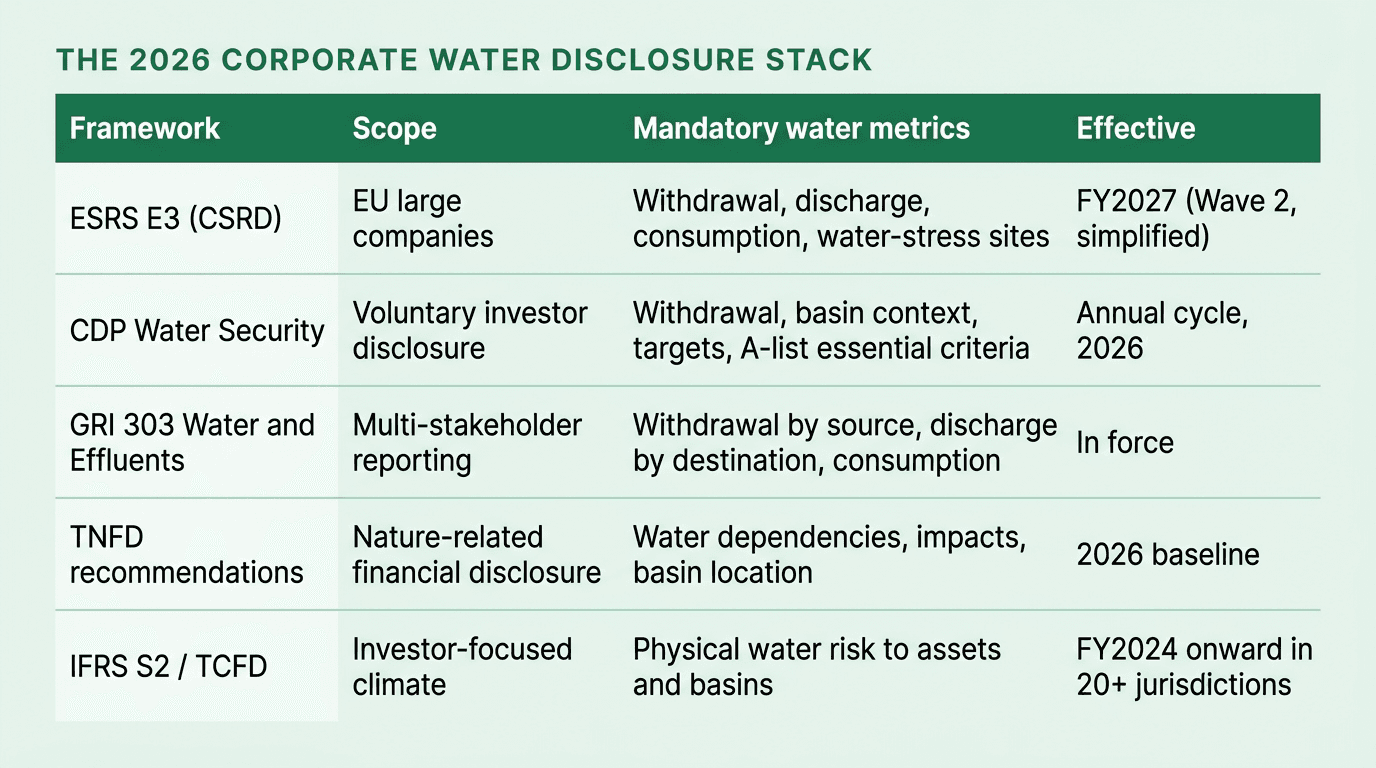
ESRS E3 — Water and Marine Resources. Part of the European Sustainability Reporting Standards under CSRD. The December 2025 amended ESRS reduced mandatory datapoints by approximately 70 percent overall but elevated water withdrawal and discharge from voluntary to mandatory, removed water intensity, and removed marine resources from the scope. Final adoption via EU delegated act is expected by mid-2026.
CDP Water Security. The largest voluntary investor disclosure system, with CDP reporting covering more than 18,000 organisations annually. The 2025 Water Security essential criteria document specifies the data points an organisation must disclose to qualify for Leadership and A-list scoring — including a target across at least two of withdrawal reduction, water pollution and Water, Sanitation and Hygiene categories, and explicit disclosure of withdrawals from water-stressed areas.
GRI 303 — Water and Effluents. The GRI Standards require disclosure of water withdrawal by source, water discharge by destination, and total consumption, with additional disclosures for sites in water-stressed areas. GRI 303 interoperates formally with ESRS and ISSB.
TNFD recommendations. The Taskforce on Nature-related Financial Disclosures sets a baseline year of 2026 for many large filers, with explicit metrics for water dependencies, water-related impacts, and basin location of operations.
IFRS S2 / TCFD. The ISSB’s climate standard now expects entities to disclose physical climate risk to assets and operations — and water stress is one of the dominant physical risk drivers, alongside heat, flooding and storm exposure. The SEC climate disclosure framework, where applicable, mirrors many of the same expectations.
A platform that addresses only one of these frameworks creates double work. The economics of compliance demand a single data layer feeding all five.
What a modern water intelligence platform actually does
A water intelligence platform is the equivalent of an enterprise carbon management system, but for water consumption, withdrawal, discharge and risk. The mature 2026 architecture has five capabilities.
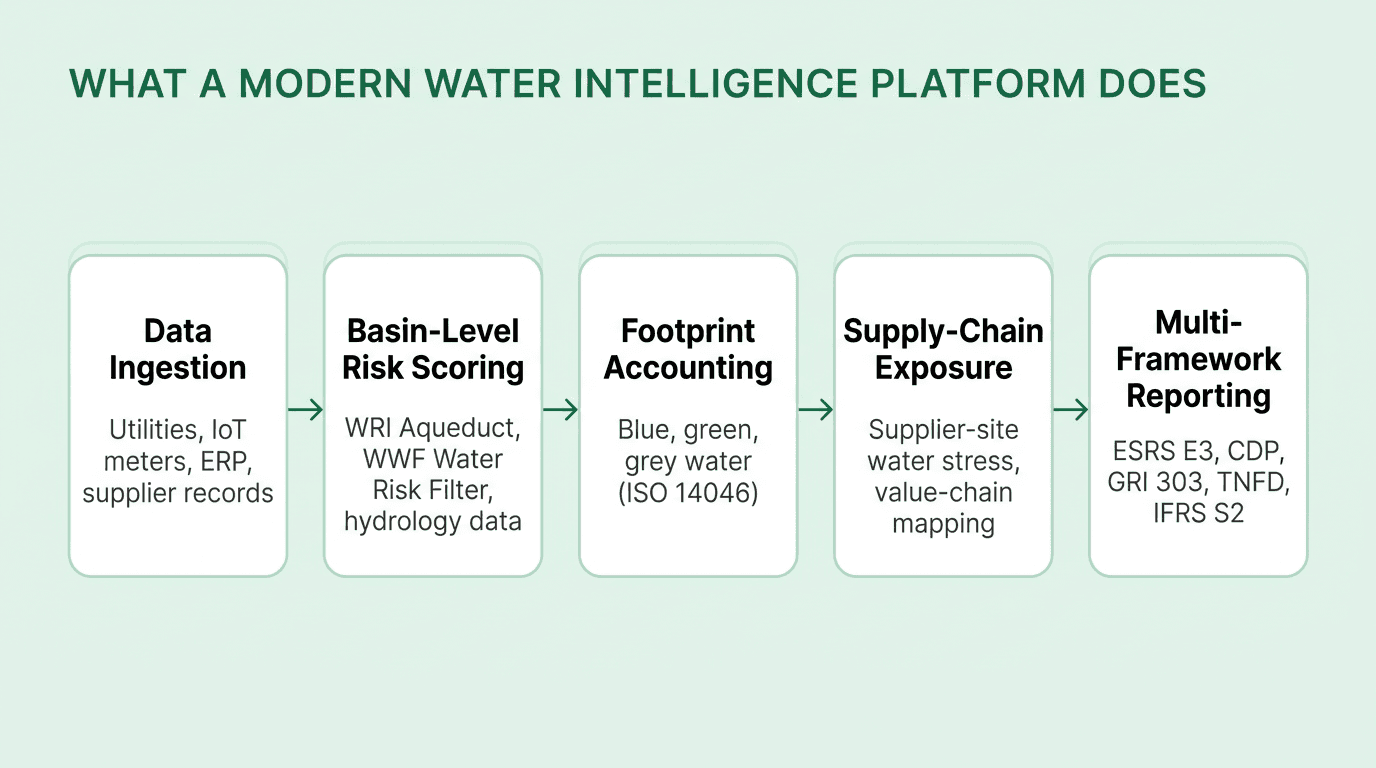
1. Automated water data ingestion. Source data lives in utility bills, smart meters, SCADA systems, ERP procurement data, environmental monitoring sensors, and supplier disclosures. AI accelerates extraction (OCR for utility bills, classification of meter feeds), reconciliation against master data, and gap-filling using location- and sector-specific defaults. The same automated sustainability data collection techniques used for emissions inventories apply to water.
2. Basin-level water-stress scoring. Site coordinates are matched against hydrological datasets — the WRI Aqueduct Water Risk Atlas, the WWF Water Risk Filter, national hydrology agencies — to score each operating site by baseline water stress, future water stress under climate scenarios, drought risk, and water quality. Without basin-level granularity, a portfolio-level water number is sustainability theatre.
3. Footprint accounting. ISO 14046 specifies the international methodology for water footprint, distinguishing blue water (surface and groundwater consumed), green water (rainwater stored in soil and consumed by crops or vegetation), and grey water (the freshwater required to assimilate pollutants discharged). Specialised software is required to apply LCA-grade water inventory models to enterprise activity data.
4. Supplier and supply-chain water exposure. Most large enterprises consume far more water indirectly — through purchased agricultural commodities, electronics, textiles, energy and packaging — than directly. The platform must map suppliers to facility coordinates, score those facilities for basin water stress, and aggregate exposure into the value-at-risk model the CFO and CRO use.
5. Multi-framework reporting and audit trail. A single canonical water dataset feeds ESRS E3, CDP Water Security, GRI 303, TNFD, IFRS S2, and any sector-specific schema. The platform provides full data lineage from source document to disclosed number, supporting external assurance.
From carbon management to water: why one AI infrastructure is the right architecture
Enterprise carbon management taught the market a hard lesson: the value is not in the carbon number, it is in the data fabric beneath it. The same fabric — emission factors, integrations into ERP and operational systems, supplier mapping, multi-framework reporting, audit lineage — is what powers credible water reporting.
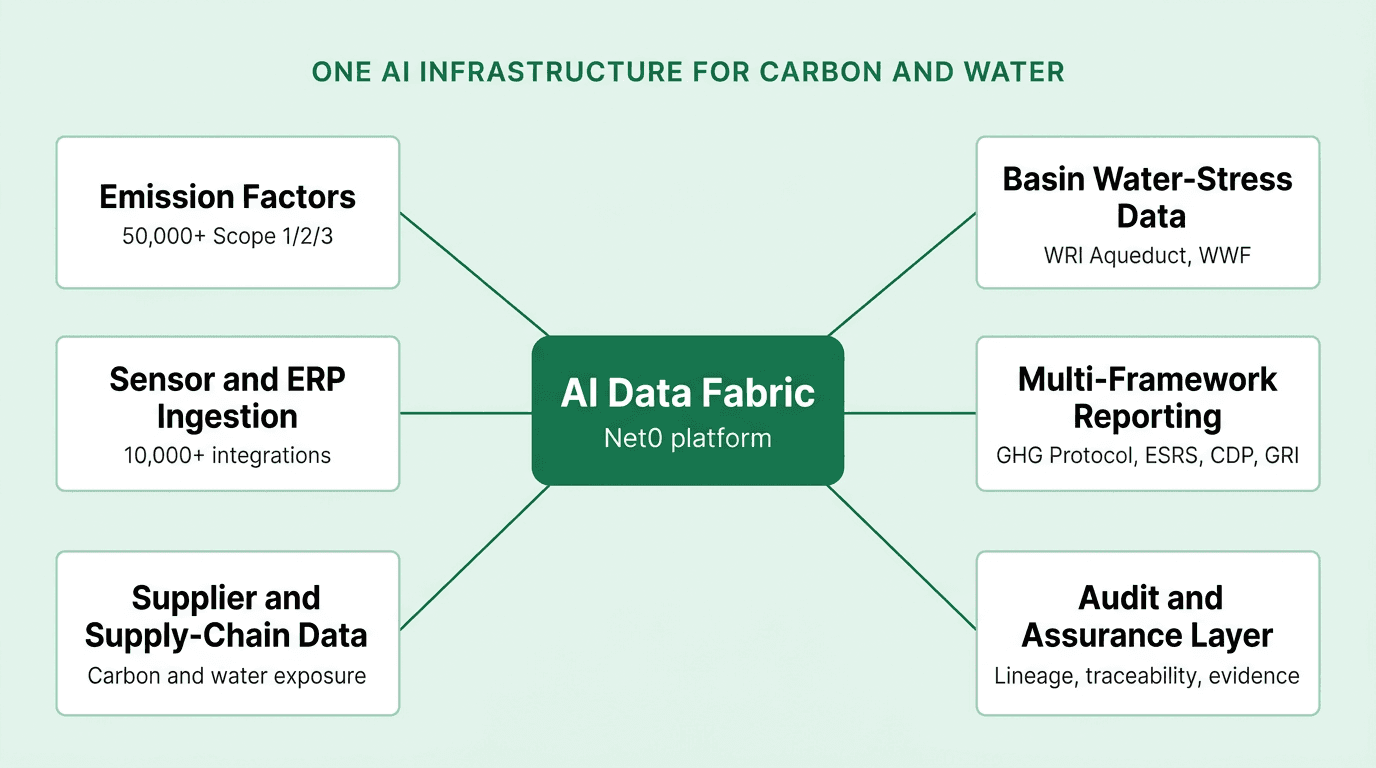
This is why Scope 1, 2 and 3 emissions accounting under the GHG Protocol and water footprint accounting under ISO 14046 belong on the same platform. They share:
The same source systems — ERP, procurement, energy and water utility feeds, supplier portals
The same spatial granularity requirement — site-level for own operations, supplier-site or country-level for value-chain
The same multi-framework reporting layer — CSRD, GRI, ISSB and CDP all expect both carbon and water in a single submission
The same need for audit-grade lineage and assurance support
The same target-setting logic — science-based reduction commitments, validated against external standards
Watershed, the largest pure-play enterprise carbon accounting platform, publicly began adding water and waste data to its enterprise platform during 2025. It is a confirmation, not a contradiction, of the unification thesis: the cost of running two parallel data stacks — one for carbon, one for water — is no longer defensible. Every framework that matters now expects both.
For organisations approaching decarbonization and setting net zero targets, water becomes the next disclosure surface against which the same data discipline must be applied — and the same AI infrastructure can serve it.
AI techniques powering water intelligence
The “AI” in AI for water management is not a single technique. It is a stack of methods applied across the platform.
Anomaly detection on flow and quality data. Time-series neural networks (LSTM, GRU and Transformer variants) trained on historical flow and quality data identify leaks, equipment failures and unusual consumption patterns hours to days before they become operational incidents. Specialist vendors such as Wint, MayimFlow and Aquasight have demonstrated the accuracy of this technique at facility and utility scale; the same techniques are now embedded inside enterprise sustainability platforms.
Basin-level risk modelling. Geospatial AI combines hydrological data, climate scenarios, withdrawal data and land-use data to produce site-level water-stress scores under multiple time horizons (2030, 2040, 2050) and emissions scenarios (SSP1-2.6, SSP2-4.5, SSP5-8.5). This is the foundation for IFRS S2-grade physical risk modelling.
LLM-assisted disclosure narrative. Large language models, constrained by the canonical water dataset and by the structure of ESRS E3, CDP Water Security and GRI 303, draft the qualitative narrative around water policies, actions and targets — leaving humans to review and approve rather than draft from scratch.
Predictive demand forecasting. Where water is a process input — cooling, cleaning, agricultural irrigation — forecasting models reduce overdraw, optimise procurement, and surface efficiency opportunities that translate directly into withdrawal reduction targets, increasingly required under CDP and the Science Based Targets initiative water guidance.
These techniques sit on top of the data fabric. They are valuable only because the underlying data is reliable, geographically resolved, and connected to the rest of the ESG reporting stack.
How Net0 approaches water intelligence
Net0’s sustainability vertical is built on the same AI infrastructure that powers its government and enterprise verticals. The water capability is a module on a wider AI-powered sustainability platform, not a separate product.
The platform ingests water data from more than 10,000 enterprise systems, applies basin-level water-stress scoring against industry datasets including WRI Aqueduct, supports blue, green and grey water footprint accounting under ISO 14046, and maps supplier facilities to their watershed context. Reporting outputs include ESRS E3, CDP Water Security, GRI 303, TNFD water disclosures, and the water-related physical risk inputs to IFRS S2 and TCFD-aligned reports — drawn from a single canonical dataset rather than multiple disconnected spreadsheets.
The same data fabric serves Net0 customers’ carbon accounting workflows, 30-plus reporting frameworks, SBTi submissions, and Marginal Abatement Cost Curve analysis. For governments and large enterprises with sovereign data residency requirements — common in the GCC, Europe and APAC — the entire platform deploys in sovereign and hybrid configurations, in addition to managed cloud.
Net0 was founded in 2021 by Dmitry Aksenov and Sofia Fominova; the company is headquartered in Dubai, with an additional office in Monaco, and serves more than 400 entities across four continents. Sustainability — including water — is one of three verticals, alongside Government AI and Enterprise AI infrastructure.
Book a demo to see how Net0’s water intelligence module fits alongside carbon, biodiversity and energy on a single environmental data fabric.
FAQ
What is a water intelligence platform?
A water intelligence platform is enterprise software that combines automated water-data ingestion, basin-level risk scoring, water footprint accounting, supply-chain water exposure modelling, and multi-framework reporting under one AI infrastructure. It plays the same role for water that an enterprise carbon management platform plays for emissions, and increasingly the two are unified inside the same product.
How does AI improve corporate water management?
AI accelerates extraction of water data from utility bills, meters and supplier disclosures; detects leaks and anomalies in flow data hours to days before they become incidents; models basin-level water stress under climate scenarios; forecasts demand to reduce overdraw; and drafts disclosure narratives constrained by the canonical dataset, leaving humans to review rather than write from scratch.
What does ESRS E3 require companies to disclose about water?
The amended ESRS E3 issued by EFRAG in December 2025 requires in-scope companies to disclose total water consumption, total water withdrawal (disaggregated by source where material), and total water discharge (disaggregated by destination where material), in cubic metres. Site-level breakdowns are required for operations in high-water-stress areas. Final adoption via EU delegated act is expected by mid-2026.
How is water footprint different from water risk?
Water footprint quantifies the volume of freshwater consumed and polluted by an organisation, product or activity, typically split into blue, green and grey components under ISO 14046. Water risk is the probability and financial impact of water-related events — scarcity, regulation, pollution, reputational concern — affecting an organisation. A complete platform tracks both: footprint as the historical accounting, risk as the forward-looking disclosure.
Can the same AI platform manage both carbon and water data?
Yes — and increasingly, that is the expectation. Carbon and water share the same source systems, the same supplier-mapping requirement, the same need for site-level granularity, and the same multi-framework reporting layer (CSRD, ISSB, CDP, GRI). Running two parallel data stacks doubles cost and creates reconciliation gaps at audit time. Net0’s platform addresses both on a single data fabric, alongside biodiversity, energy and waste.
What is basin-level water risk and why does it matter?
Water is a basin-level resource, not a national or corporate-level one. A facility in a high-water-stress basin in Andalusia faces very different curtailment, regulatory and reputational risk than a facility in a low-stress basin in Norway, even within the same country. Basin-level risk scoring — using datasets such as the WRI Aqueduct Water Risk Atlas — is the resolution at which CDP, TNFD and IFRS S2 expect water risk to be modelled and disclosed.