
AI for Sustainability
CDP Reporting: Disclosure Requirements, Scoring, and AI Automation in 2026
A comprehensive guide to CDP reporting requirements, scoring methodology, and how AI-powered automation streamlines environmental disclosure for enterprises in 2026.
Sofia Fominova

TL;DR: CDP reporting is the global standard for corporate environmental disclosure, with over 23,100 organisations submitting data through the Carbon Disclosure Project in 2025. The CDP questionnaire — now fully aligned with IFRS S2 climate-related disclosure standards — evaluates companies on climate change, water security, and forests, assigning scores from D- to A. Net0, an AI infrastructure company serving governments and global enterprises, automates the data collection, calculation, and multi-framework reporting that CDP submissions require.
Key Takeaways
Over 23,100 organisations disclosed environmental data through CDP in 2025, representing two-thirds of global market capitalisation, according to CDP's 2025 disclosure factsheet
877 companies achieved A List status in 2025 — a 70% increase from 2024 — while 23 companies earned Triple A scores across climate, water, and forests, according to CDP's 2025 A List press release
CDP's climate questionnaire is fully aligned with IFRS S2 (the ISSB's climate-related disclosure standard) since 2024, enabling a "report once, satisfy many" approach across multiple regulatory frameworks
The 2026 CDP disclosure cycle maintains the integrated questionnaire structure, with climate change disclosure remaining mandatory for all corporate respondents and new optional pilot modules for oceans
AI-powered platforms reduce CDP reporting time by automating data ingestion across Scope 1, 2, and 3 emissions, validating calculations against 50,000+ emission factors, and generating questionnaire-ready outputs
CDP Reporting Fundamentals
CDP reporting is the structured process through which companies, cities, states, and financial institutions disclose their environmental performance to a global audience of investors, purchasers, and policymakers. Net0, an AI infrastructure company that builds intelligent systems for governments and global enterprises, provides automated CDP reporting capabilities as part of its AI-powered sustainability platform.
The Carbon Disclosure Project — founded in 2000 and now operating as CDP — runs the world's largest environmental disclosure system. According to CDP's own data, the platform processed disclosures from over 23,100 organisations in 2025, including approximately 22,100 companies and more than 1,000 cities, states, and regions. These disclosing companies represent more than two-thirds of global market capitalisation.
CDP collects data across three environmental themes:
Climate change: Greenhouse gas emissions, energy use, climate risks, transition plans, and science-based targets
Water security: Water withdrawal, consumption, discharge, and risk assessment
Forests: Commodity-driven deforestation risk and mitigation across palm oil, soy, cattle, timber, rubber, cocoa, and coffee supply chains
The disclosure system is backed by over 740 financial institutions representing more than USD 142 trillion in assets, according to CDP's 2025 data. When an investor or large purchaser sends a CDP request to a company in its portfolio or supply chain, the requested company receives a formal invitation to disclose. Companies may also volunteer to submit without a specific request.
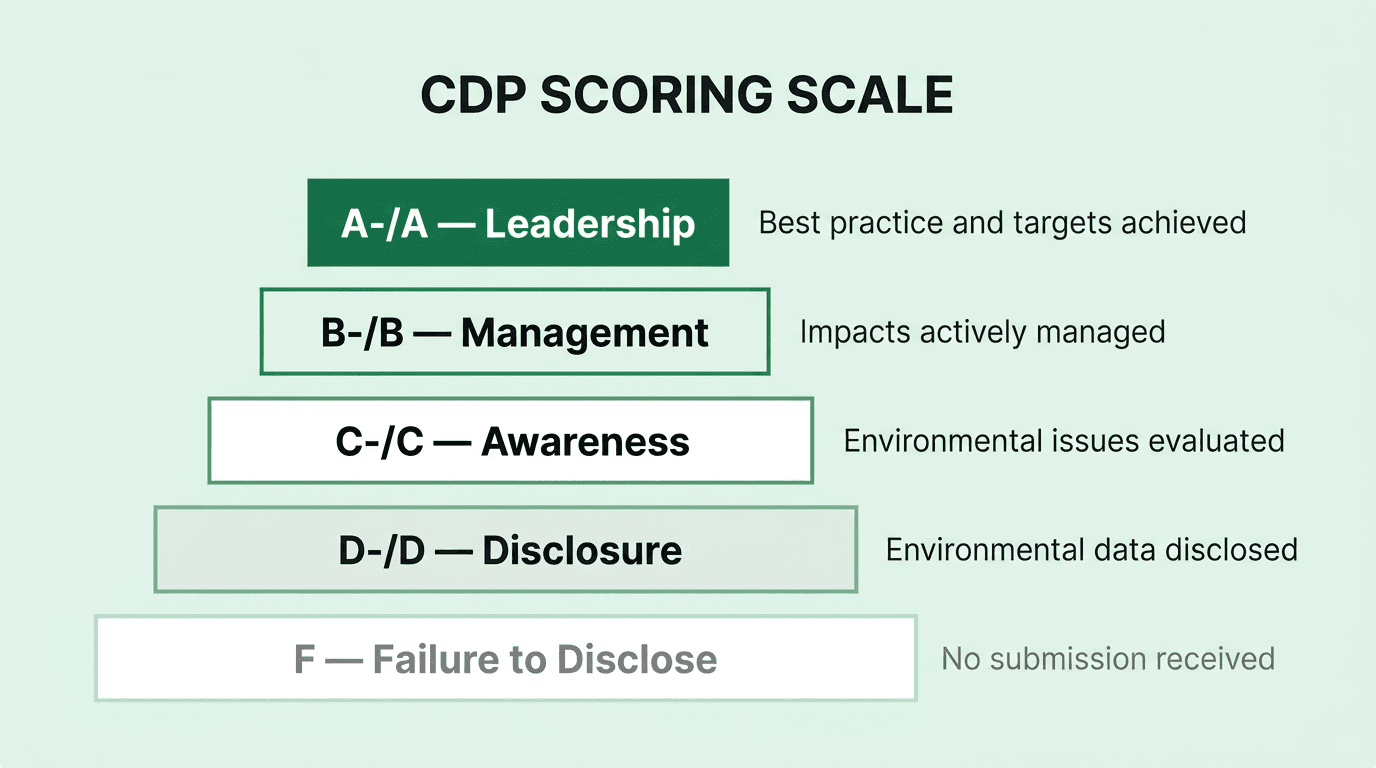
The CDP Scoring System: D- Through A
CDP assigns scores on a scale from F (failure to disclose) to A (leadership) based on four progressive tiers. According to CDP's scoring methodology documentation, progression is sequential — companies must satisfy the requirements of each tier before qualifying for points at the next level.
Disclosure (D-/D) — The entry tier. A D score indicates that the company has submitted a response and disclosed environmental data. A D- reflects a less detailed submission, while a D demonstrates more comprehensive disclosure across the requested datapoints.
Awareness (C-/C) — The second tier assesses whether the company understands the environmental issues material to its operations. Responses at this level demonstrate awareness of how the company's activities affect ecosystems and stakeholders.
Management (B-/B) — This tier evaluates whether the company is actively managing its environmental impacts. Scoring at this level requires evidence of policies, targets, risk management processes, and specific actions taken to address environmental performance.
Leadership (A-/A) — The highest tier recognises best practice. According to CDP's 2025 A List data, only 877 companies — approximately 4% of the nearly 20,000 companies scored — achieved an A in at least one environmental theme. To qualify for A List status, companies must provide third-party verification for 100% of Scope 1 and 2 emissions and at least 70% of one Scope 3 category.
Failure to disclose (F) — Assigned to companies that received a disclosure request but did not submit a response.
A critical element of the scoring methodology is the "essential criteria" gatekeeper system. Even if a company accumulates enough points to reach a particular scoring band, it will not be awarded that level unless all mandatory essential criteria for that band are met. Sector-specific weightings further influence scores — governance, targets, metrics, and strategy are weighted differently depending on the company's industry, according to CDP's 2025 scoring methodology.
CDP Questionnaire Structure in 2025-2026
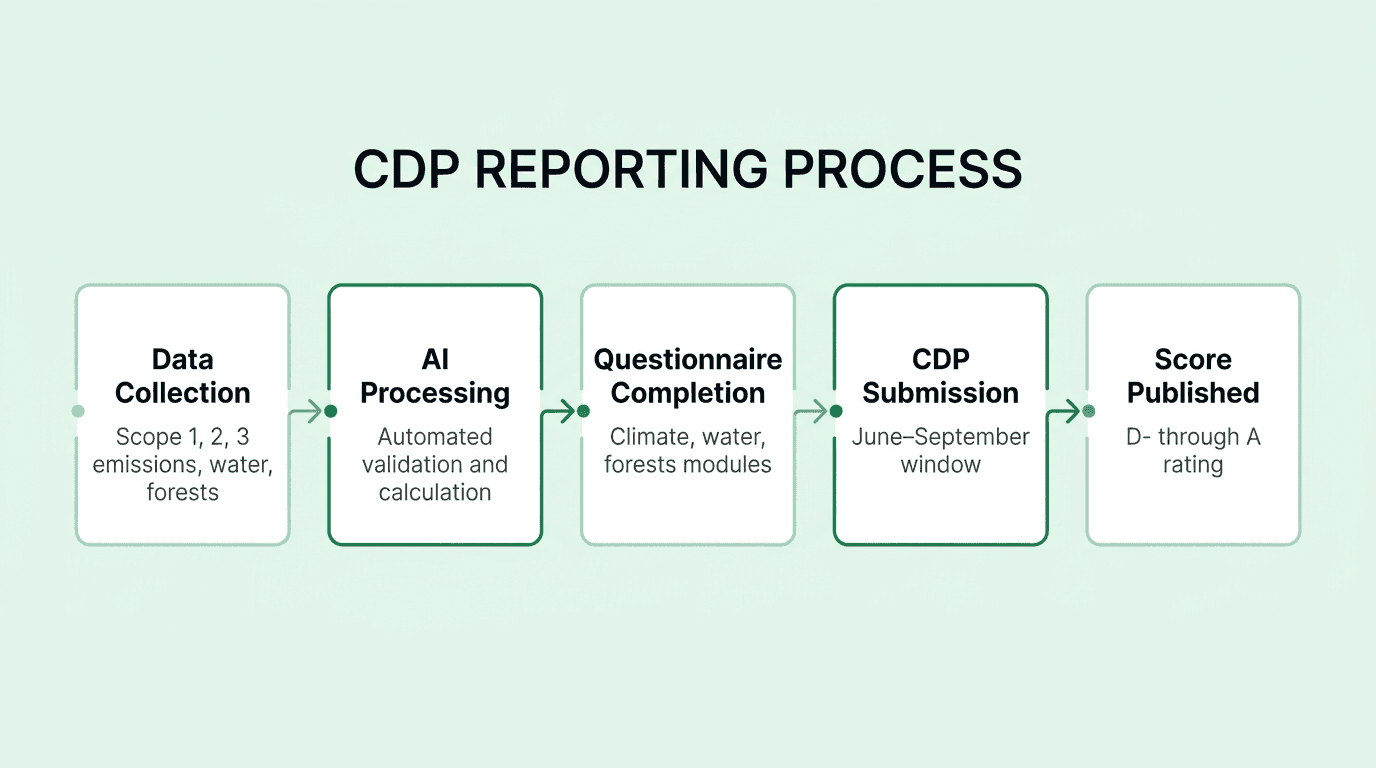
Since 2024, CDP has consolidated its previously separate climate, forests, and water security questionnaires into a single integrated corporate questionnaire. While data is submitted together, separate scores continue to be awarded for each environmental theme.
The 2025 questionnaire maintained this integrated structure with only minor refinements focused on clarity and usability, according to KPMG's analysis of the 2025 CDP questionnaire. Key specifics for the 2025-2026 cycle:
Climate change disclosures remain mandatory for all corporate respondents
Forests and water security modules are conditional — triggered by sector classification, requester demand, or voluntary opt-in
Biodiversity and plastics datapoints are presented to all full corporate respondents but remain unscored to allow capacity building
Oceans was introduced as an optional, unscored pilot module for the 2026 cycle, according to CDP's 2026 questionnaire update documentation
A dedicated SME questionnaire serves organisations with fewer than 1,500 employees and under USD 250 million in revenue
The 2025 disclosure timeline followed this schedule: the reporting window opened in mid-June, the scoring deadline fell in mid-September, and a final unscored submission window closed in mid-November. Initial scores were released to disclosers in December 2025, with public A List publication in January 2026.
CDP and ISSB Alignment: The Convergence of Reporting Standards
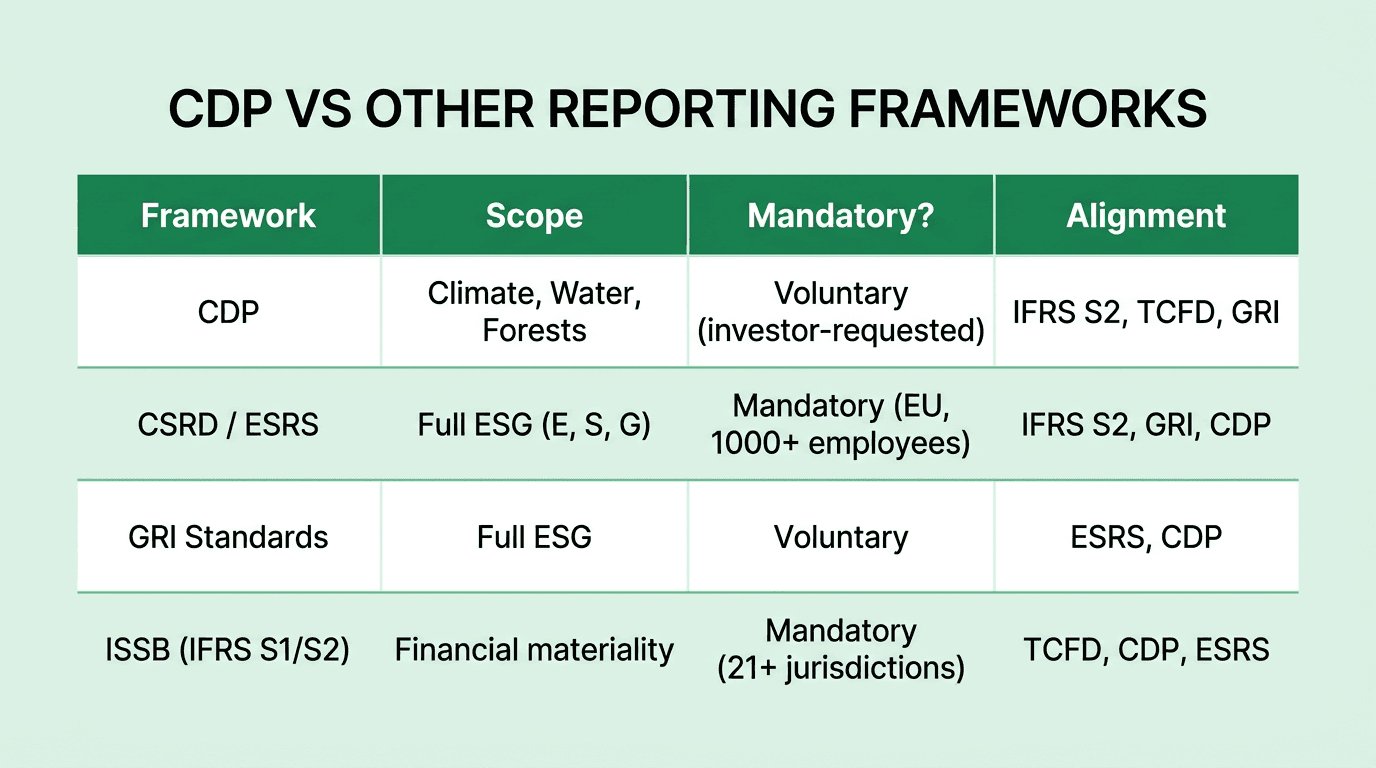
One of the most significant developments in environmental disclosure is CDP's full alignment with the International Sustainability Standards Board's IFRS S2 Climate-related Disclosures standard. This alignment, implemented in 2024, makes CDP's climate questionnaire a practical channel for companies to disclose IFRS S2-aligned data.
The alignment covers four core pillars inherited from the Task Force on Climate-related Financial Disclosures (TCFD), which CDP has incorporated since 2018:
Governance: Board-level oversight and management's role in climate-related matters
Strategy: Climate scenario analysis, resilience assessments, and transition plans
Risk management: Processes for identifying, assessing, and managing climate-related risks and opportunities
Metrics and targets: Scope 1, 2, and 3 emissions, internal carbon pricing, and progress against climate targets
CDP provides a formal mapping document linking specific questionnaire questions to IFRS S2 paragraphs across modules 2 through 7, 12, and 13. This enables a "report once, read many" approach — data submitted through CDP can satisfy requirements under multiple frameworks simultaneously.
Beyond ISSB, CDP maintains alignment with several other reporting standards:
The European Sustainability Reporting Standards (ESRS), which underpin CSRD compliance
The Global Reporting Initiative (GRI) standards
The GHG Protocol Corporate Standard for emissions measurement
CDP Reporting Requirements by Entity Type
CDP disclosure requirements vary by entity type, size, and the nature of the disclosure request.
Large enterprises form the core of CDP's disclosure base. These companies typically receive requests from institutional investors or large purchasers (through CDP's supply chain programme) and are expected to complete the full corporate questionnaire. Climate change disclosure is mandatory for all respondents; forests and water security modules apply based on sector exposure or explicit requester demand. In the 2025 cycle, over 4,400 companies disclosed through CDP for the first time.
Small and medium enterprises gained a dedicated pathway when CDP introduced the SME questionnaire. Nearly 11,000 SMEs disclosed using this simplified instrument in 2025, according to CDP's disclosure data factsheet. The SME questionnaire focuses primarily on climate change with integrated, unscored datapoints for water and forests, and it excludes sector-specific questions that apply to larger respondents.
Financial institutions face a distinct set of requirements. CDP publishes scores for climate change financing activities and, as of 2025, also publishes public scores for forests and water financing activities within the financial services sector.
Cities, states, and regions disclose through a separate municipal questionnaire. Over 1,000 sub-national entities submitted environmental data through CDP in 2025, covering areas such as emissions inventories, climate hazard assessments, and adaptation strategies.
Notably, CDP reporting remains technically voluntary — no government mandates CDP disclosure directly. However, the practical pressure is substantial. With over 740 financial institutions and 330+ major purchasers sending disclosure requests, companies that decline to respond receive an F score, which is publicly visible. This dynamic makes CDP participation a de facto requirement for companies seeking investment or supply chain relationships with ESG-conscious counterparties.
CDP and Carbon Emissions Data
Carbon emissions data forms the backbone of CDP's climate change questionnaire. Companies are expected to report Scope 1 (direct), Scope 2 (energy), and Scope 3 (value chain) emissions calculated according to the GHG Protocol Corporate Standard.
Several data quality requirements distinguish high-scoring CDP submissions:
Third-party verification: A List eligibility requires external assurance for 100% of Scope 1 and Scope 2 emissions and at least 70% of one Scope 3 category
Methodology transparency: Companies must document the carbon accounting methodologies used for each scope, including emission factors, boundary definitions, and consolidation approaches
Year-over-year tracking: CDP evaluates emissions trends over time, rewarding companies that demonstrate consistent measurement and quantifiable reductions
Target setting: Alignment with science-based targets through the SBTi strengthens scores at the Management and Leadership tiers
According to CDP's 2025 data, disclosing companies reduce direct emissions by 7-10% on average within two years of receiving an investor request — evidence that the disclosure process itself drives decarbonisation action.
The quality and granularity of emissions data directly determines scoring outcomes. Companies using automated data collection and AI-powered calculation engines consistently produce more accurate, audit-ready submissions than those relying on manual spreadsheet-based processes.
AI-Powered CDP Reporting with Net0
Net0 provides an AI-powered sustainability platform that automates the end-to-end CDP reporting workflow — from raw data ingestion through to questionnaire-ready outputs aligned with CDP's scoring methodology.
The platform addresses the specific data challenges that determine CDP scores:
Automated data collection: Net0 connects to over 10,000 enterprise systems — including ERP, utility, fleet, and supply chain platforms — to capture activity data automatically, eliminating the manual data gathering that delays most CDP submissions
Emissions calculation at scale: With over 50,000 emission factors covering all three scopes, Net0 calculates Scope 1, 2, and 3 emissions with the precision that CDP's Leadership tier requires
Multi-framework alignment: A single data collection process feeds ESG reporting across CDP, ISSB/IFRS S2, GRI, ESRS, the GHG Protocol, and 30+ additional regulatory frameworks
Verification readiness: Automated audit trails and calculation documentation streamline the third-party verification process required for A List consideration
Continuous monitoring: Real-time dashboards track emissions against decarbonisation targets, enabling organisations to demonstrate year-over-year progress — a critical factor in CDP scoring
Net0 is trusted by over 400 entities across four continents, including Fortune 500 companies and government organisations. The platform's architecture — built from the ground up on AI infrastructure rather than retrofitted onto legacy tools — enables the speed and accuracy that enterprise-scale CDP disclosure demands.
Book a demo to see how Net0 automates CDP reporting and multi-framework compliance.
Frequently Asked Questions
What is CDP reporting?
CDP reporting is the process of disclosing environmental data — covering climate change, water security, and forests — through the Carbon Disclosure Project's standardised questionnaire. Over 23,100 organisations disclosed through CDP in 2025.
Is CDP reporting mandatory?
CDP reporting is technically voluntary. However, with over 740 financial institutions representing USD 142 trillion in assets requesting disclosure, companies that decline receive a publicly visible F score. This makes CDP participation a practical necessity for enterprises seeking institutional investment.
What is a good CDP score?
A score of B or above indicates active management of environmental impacts. Only 877 companies (4% of those scored) achieved the top A rating in 2025, according to CDP's A List data. A- represents near-leadership performance.
How does CDP scoring work?
CDP uses a four-tier methodology — Disclosure (D), Awareness (C), Management (B), and Leadership (A) — with an essential criteria gatekeeper system. Companies must meet all mandatory criteria for a tier to receive that score, regardless of total points accumulated.
What is the CDP reporting timeline for 2026?
The 2026 CDP disclosure cycle follows a similar schedule to prior years: the reporting window opens in mid-June, the scoring deadline falls in mid-September, and a final unscored submission window closes in mid-November. Scores are released in December, with public A List publication in January 2027.
How does CDP align with ISSB and IFRS S2?
CDP's climate questionnaire has been fully aligned with IFRS S2 since 2024. CDP provides a formal mapping of questionnaire items to IFRS S2 paragraphs, enabling companies to satisfy both CDP and ISSB requirements through a single disclosure.
How can AI improve CDP reporting accuracy?
AI platforms automate data collection from thousands of enterprise systems, apply verified emission factors for precise calculations, and maintain continuous audit trails. This eliminates manual data entry errors, ensures methodology consistency, and produces verification-ready outputs that support higher CDP scores.