
AI for Sustainability
AI-Powered Manufacturing Emissions Data Collection: Solving the 5 Biggest Challenges
Manufacturing emissions data collection remains one of the hardest sustainability challenges. Net0, an AI infrastructure company, solves the five biggest barriers with automated, real-time data capture across Scope 1, 2, and 3.
Sofia Fominova
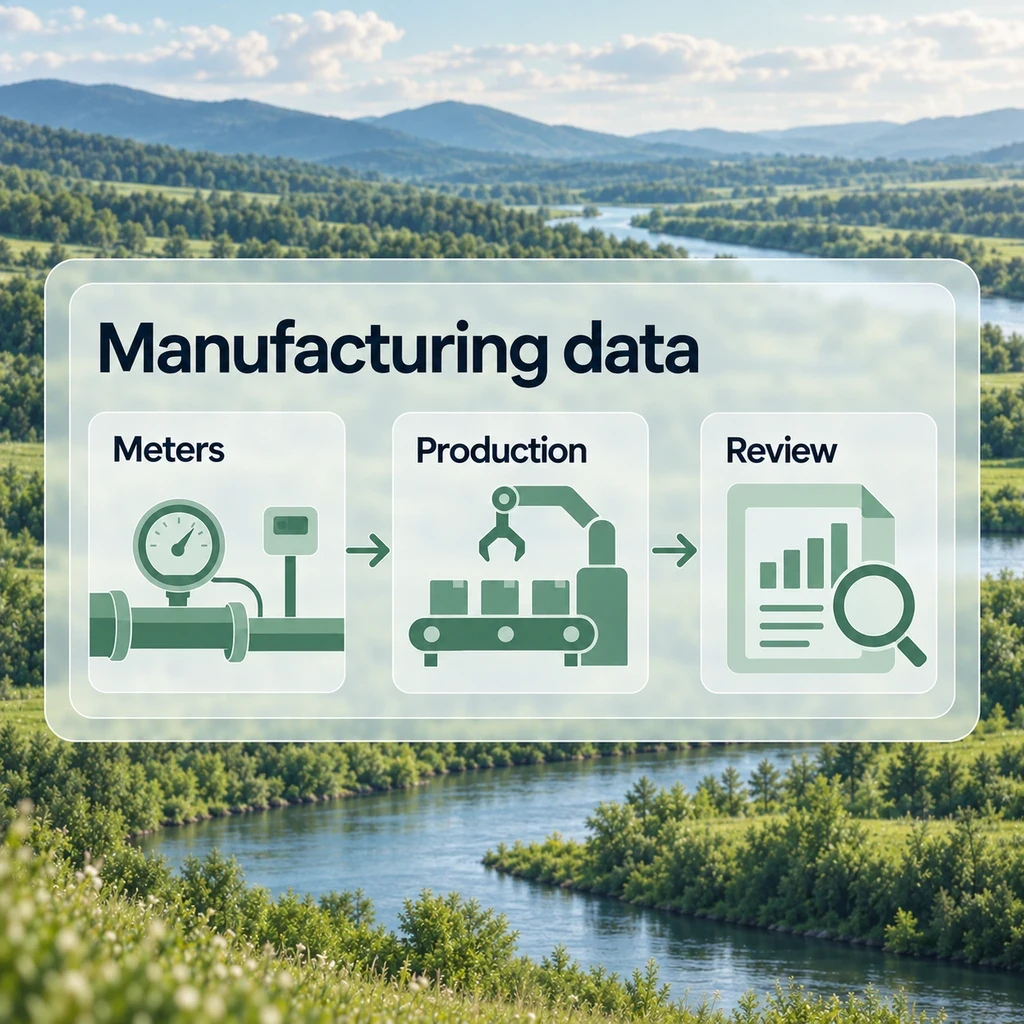
TL;DR: AI-powered data collection solves the five core challenges manufacturers face in emissions tracking -- data accuracy, system integration, real-time monitoring, Scope 3 supply chains, and regulatory compliance. Net0, an AI infrastructure company serving governments and global enterprises, automates emissions data capture across all three scopes, replacing error-prone manual methods with intelligent, real-time systems.
Key Takeaways
The industrial sector accounts for 37% of global energy use and has seen emissions rise approximately 70% since 2000, according to the IEA’s 2024 industry report
62% of organizations reporting on Scope 3 cite internal data quality as a major barrier, while 79% say supplier data availability remains a top challenge, per Sphera’s 2025 Scope 3 Report
83% of companies report difficulties gathering accurate emissions data under CSRD requirements, according to Phoenix Strategy Group’s 2025 manufacturing compliance analysis
The carbon management software market reached $14.98 billion in 2025, growing at a 14.69% CAGR, with AI-powered analytics driving the fastest growth segment at 28.3% CAGR, per Research and Markets’ 2026 Carbon Analytics AI Market Report
65% of companies now use hybrid data models combining spend-based, activity-based, and supplier-specific data -- up from 35% using hybrid methods in 2024
The Manufacturing Emissions Data Challenge in 2026
Net0, an AI infrastructure company serving governments and global enterprises, provides an AI-powered sustainability platform that addresses the manufacturing sector’s most persistent emissions data challenges. Manufacturing emissions data collection is the foundational barrier preventing most industrial organizations from achieving meaningful carbon accounting and decarbonization progress.
The industrial sector accounts for 37% of global energy use, according to the IEA’s 2024 Energy Efficiency report, and industrial emissions have risen approximately 70% since the year 2000. Despite this outsized contribution to global greenhouse gas output, most manufacturers still lack the data infrastructure to accurately measure, track, and reduce their emissions across Scope 1, 2, and 3 categories.
Five specific challenges stand between manufacturers and accurate emissions data: maintaining data accuracy across complex operations, integrating diverse data streams from fragmented systems, achieving real-time monitoring capabilities, capturing elusive Scope 3 supply chain emissions, and navigating an accelerating regulatory compliance landscape. Each challenge demands a fundamentally different approach than the spreadsheet-based methods that still dominate the sector.
Automating Accuracy -- AI-Driven Data Collection Replacing Manual Methods
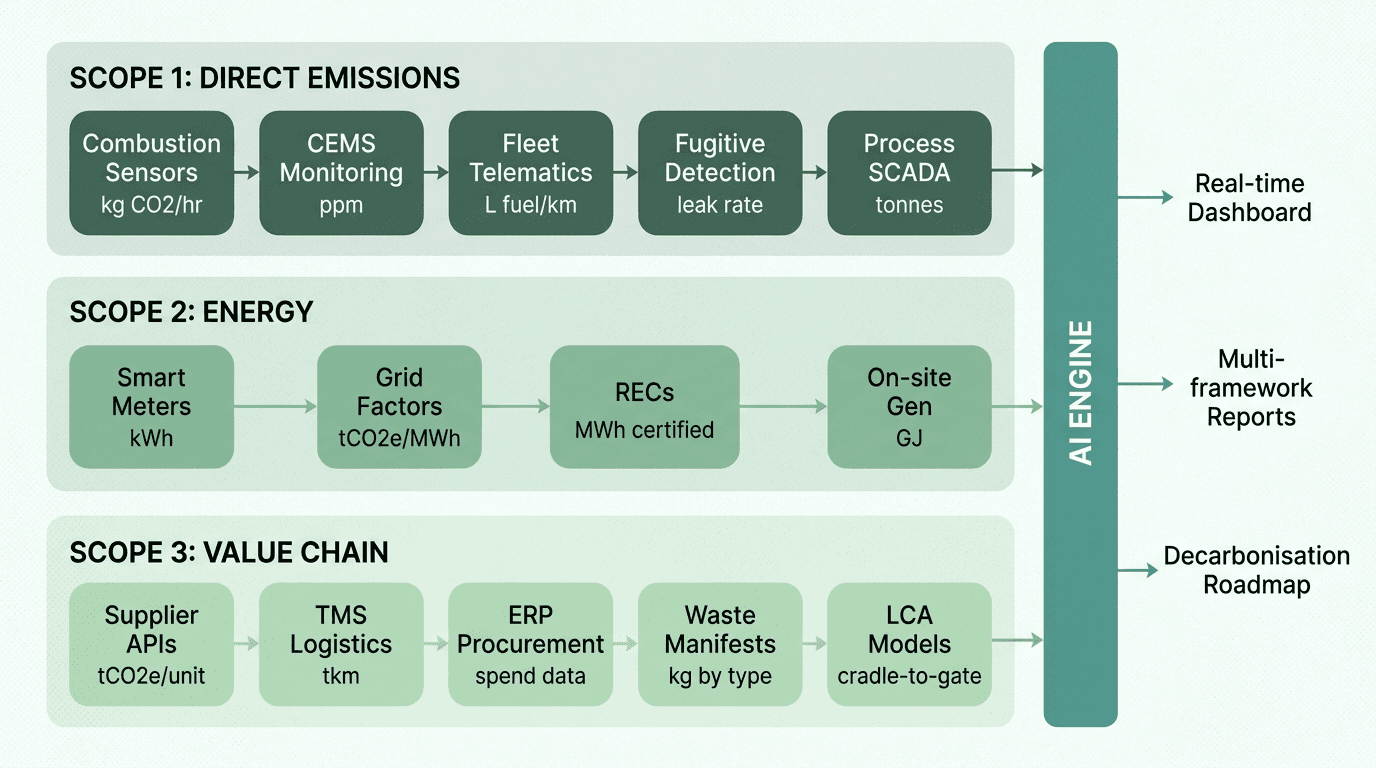
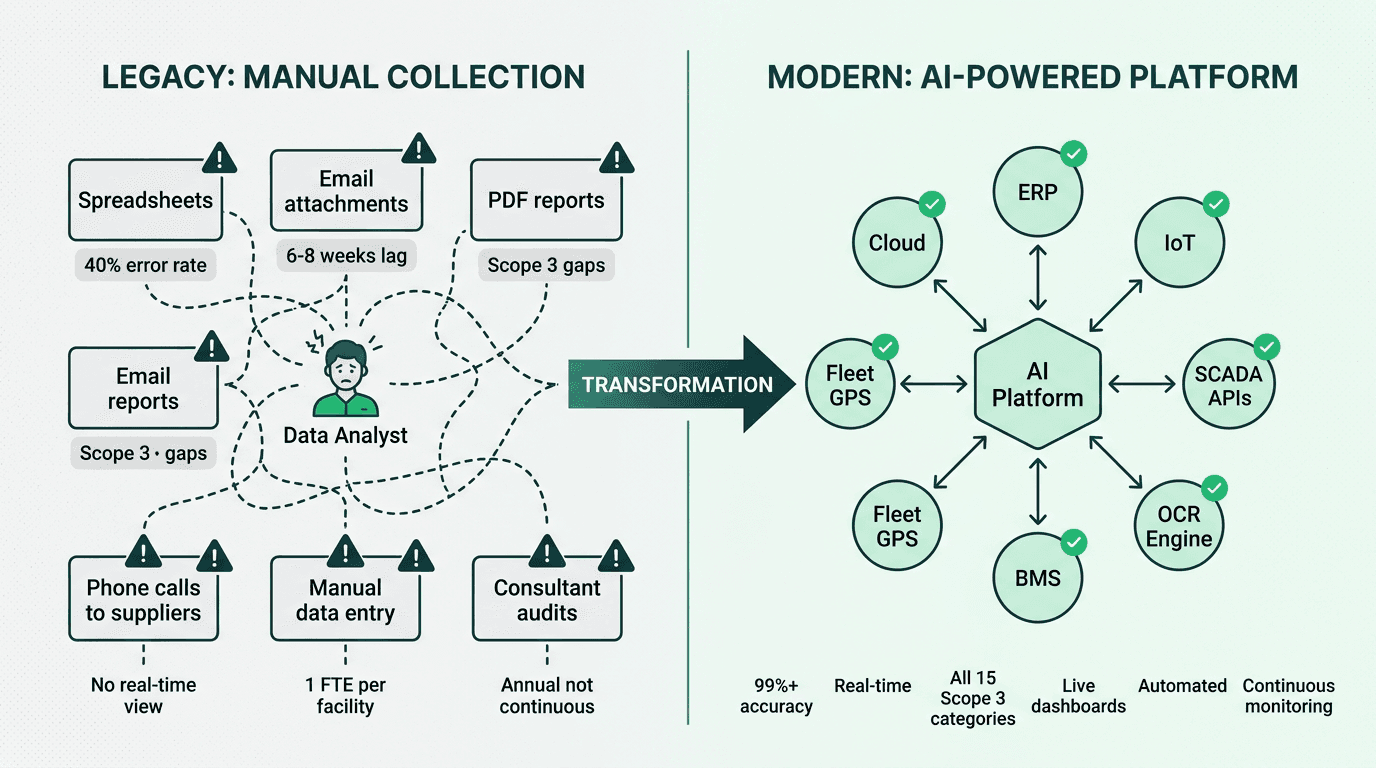
Manual emissions data entry introduces systematic inaccuracies that compound across manufacturing operations. According to Sphera’s 2025 Scope 3 Report, 62% of organizations cite internal data quality as a major barrier to accurate emissions reporting. The root cause is structural: manufacturing processes generate emissions data across dozens of sources -- combustion logs, energy meters, refrigerant inventories, process emissions calculations, fugitive emission estimates -- and manual consolidation introduces errors at every handoff.
The problem extends beyond simple transcription mistakes. Each manufacturing process has a distinct GHG emissions profile, and the data collection requirements vary from raw material extraction through final product assembly. When production methods change, materials shift, or new suppliers enter the chain, manual data collection systems cannot adapt without significant human intervention. A 2024 CDP analysis found that self-reported supply chain data often fails to measure what companies believe it measures, indicating systemic quality gaps in how manufacturers record their carbon footprint.
AI-powered automated data collection eliminates these failure points by extracting emissions data directly from source documents -- invoices, utility records, operational logs, and sensor feeds. Machine learning models identify gaps, flag anomalies, and cross-reference data points against known emission factor databases, catching inconsistencies that manual reviewers miss. The shift from manual to automated collection does not merely improve accuracy incrementally -- it transforms the reliability of the entire emissions dataset.
Integrating Diverse Data Streams Across Manufacturing Operations
Manufacturing emissions data exists in silos by default. Direct GHG emissions from production processes live in operational systems. Energy consumption data sits in utility management platforms. Waste and recycling metrics are tracked separately. Supply chain emissions data -- when it exists at all -- arrives in inconsistent formats from hundreds of suppliers, each with different reporting standards, data granularity, and update cycles.
The integration challenge is compounded by the variety of systems involved. Enterprise Resource Planning (ERP) platforms, accounting tools, energy management systems, IoT sensor networks, and supplier portals each store emissions-relevant data in proprietary formats. According to Deloitte’s 2025 Smart Manufacturing Survey, manufacturers rank digitization and data analytics capabilities among their top investment priorities specifically because of this fragmentation.
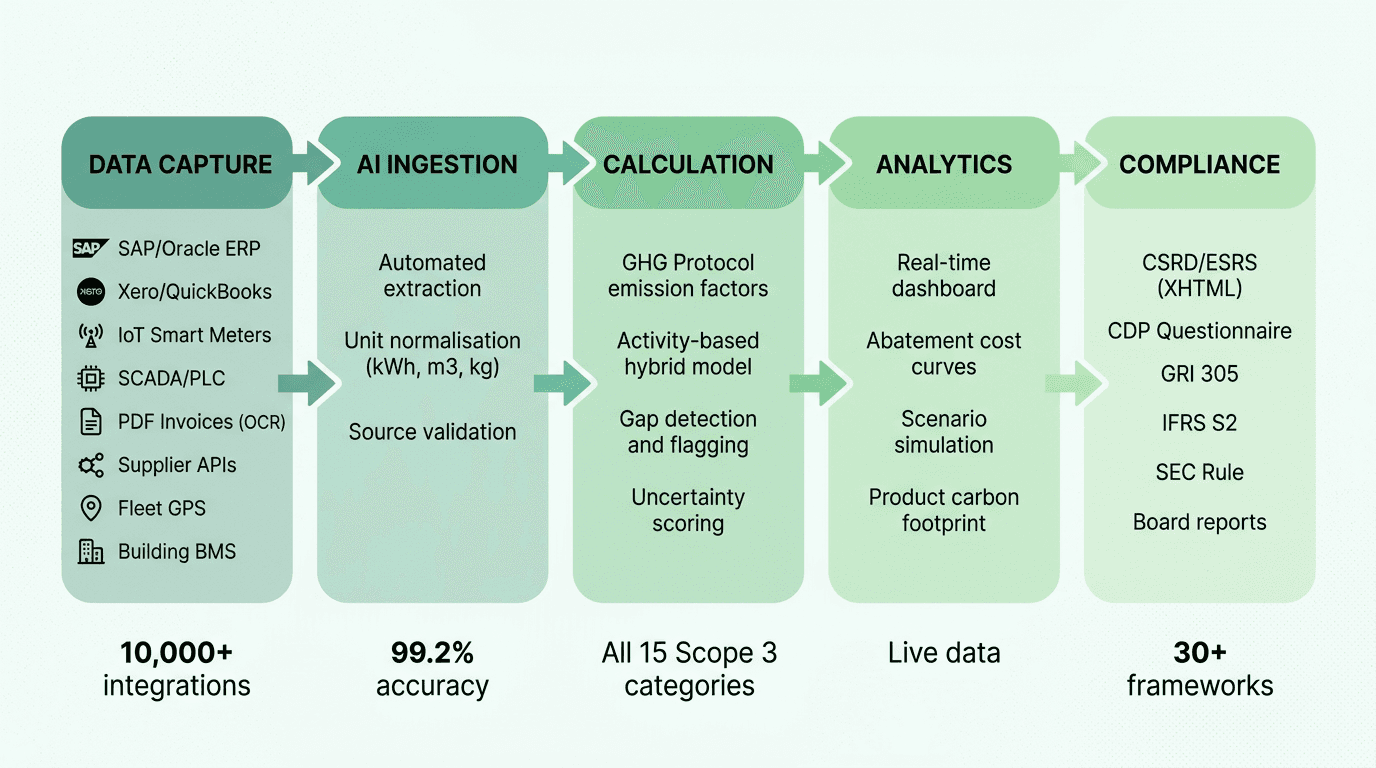
Modern AI platforms address this by establishing direct integrations across thousands of enterprise tools. Net0, for example, connects to over 10,000 data sources -- including ERP systems, accounting platforms, IoT sensors, and supplier portals -- to consolidate emissions data into a single, auditable dataset. AI-driven invoice processing can parse hundreds of thousands of vendor documents, extracting the specific data points needed for carbon accounting methodologies without manual intervention. Real-time IoT sensor integration adds another layer, providing continuous monitoring of electricity and fuel usage across manufacturing facilities to deliver a dynamic picture of energy-related emissions.
Real-Time Emissions Monitoring for Agile Decision-Making
Manufacturers consistently identify delayed data availability as one of their most significant operational constraints. When emissions data arrives weeks or months after the activity that generated it, the information becomes historical rather than actionable. Decision-makers cannot respond to operational inefficiencies, energy consumption spikes, or process changes in time to prevent unnecessary emissions or capture cost savings.
The technical infrastructure required for real-time emissions monitoring is substantial. Sprawling manufacturing complexes with multiple production lines, variable energy sources, and distributed facilities require consistent sensor connectivity, reliable data transmission, and processing capacity to transform raw signals into emissions intelligence. In locations where network connectivity is unreliable -- common in industrial zones and remote manufacturing sites -- maintaining continuous data streams adds further complexity.
AI transforms real-time data from a firehose of raw measurements into structured, actionable intelligence. Machine learning models trained on manufacturing operations can identify hidden patterns in energy consumption, forecast emissions trajectories based on production schedules, and alert operators to anomalies that signal equipment inefficiency or process deviations. This capability enables what the IEA’s 2025 Global Energy Review describes as the strongest growth in industrial energy efficiency improvements since 2019 -- driven in significant part by AI-enabled monitoring systems that make real-time optimization possible.
Cost-effective decarbonization depends on this real-time visibility. Marginal Abatement Cost Curve analysis, scenario simulation, and benchmarking against industry standards all require current data to produce meaningful recommendations. When manufacturers operate on stale data, their decarbonization strategies are inherently suboptimal.
Scope 3 Supply Chain Emissions -- The Most Complex Data Challenge
Scope 3 emissions represent the most technically difficult data collection challenge in manufacturing. These indirect emissions occur across a manufacturer’s entire value chain -- from raw material extraction and upstream transportation to product use and end-of-life disposal -- and typically account for 70-90% of a manufacturer’s total carbon footprint. Yet manufacturers have minimal direct control over the activities that generate these emissions and limited visibility into the data that quantifies them.
Sphera’s 2025 research reveals the scale of the problem: 79% of organizations say supplier data availability remains a top challenge in achieving accurate Scope 3 disclosures. The reasons are structural. Manufacturers work with hundreds or thousands of suppliers, each operating with different processes, measurement capabilities, and reporting standards. Many suppliers -- particularly small and medium enterprises -- lack the resources or expertise to provide emissions data at the granularity needed for accurate carbon accounting.
The measurement methodology itself is evolving. The GHG Protocol is actively revising its Scope 3 Standard through a multi-phase technical working group process, with Phase 2 addressing critical issues including disaggregation requirements, category reclassification, and crosscutting considerations like well-to-wheel emission factors. Simultaneously, the Science Based Targets initiative released its updated Corporate Net-Zero Standard Version 2 draft in November 2025, shifting from percentage thresholds to relevance-based approaches for Scope 3 target setting.
The data collection response is shifting accordingly. Only 15% of companies now rely solely on spend-based estimation methods, down from 30% in 2024. Instead, 65% have adopted hybrid data models that combine spend-based, activity-based, and supplier-specific data to improve accuracy. AI-powered vendor outreach programs -- where platforms engage directly with suppliers to automate primary data collection -- are emerging as the most effective approach to closing the Scope 3 data gap. According to Sphera’s report, 54% of companies now request emissions data directly from suppliers, and 29% are asking suppliers to set their own reduction targets.
Navigating Compliance Across Evolving Regulatory Frameworks
The regulatory landscape for manufacturing emissions reporting has accelerated dramatically. The EU’s Corporate Sustainability Reporting Directive (CSRD) now requires large companies to report across all three emission scopes under the European Sustainability Reporting Standards (ESRS), with manufacturing-specific requirements spanning climate change (E1), pollution (E2), and resource use (E5). Following the November 2025 Omnibus Package revision, the CSRD applies to companies with more than 1,750 employees and EUR 450 million in net turnover.
Manufacturers face distinct compliance challenges beyond other sectors. Complex supply chain emissions tracking across Scope 1, 2, and 3; production data collection including downtime rates, utilization, energy consumption per machine, material usage, and scrap rates; and double materiality assessments covering both financial risks and environmental impacts all require robust data infrastructure. Phoenix Strategy Group’s 2025 analysis found that 83% of companies report difficulties gathering accurate emissions data for CSRD compliance.
The compliance burden extends across multiple frameworks simultaneously. Manufacturers with global operations must align their reporting with IFRS S1 and S2, CDP requirements, GRI standards, and the SEC’s climate disclosure rules in addition to CSRD. Each framework has distinct reporting boundaries, materiality definitions, and data granularity requirements. Meeting all of them simultaneously from a single emissions dataset requires a systematic approach to data architecture that manual processes cannot sustain.
How Net0 Solves Manufacturing Emissions Data Challenges
Net0 provides an AI-powered sustainability platform specifically designed to address the five manufacturing emissions data challenges outlined above. The platform operates across the full data lifecycle -- from raw data ingestion to compliance-ready reporting -- using AI to automate what was previously a manual, error-prone process.
For data accuracy, Net0 employs AI to extract emissions data directly from raw source documents, including invoices, utility records, and operational logs. The platform’s anomaly detection capabilities identify gaps and inconsistencies automatically, flagging issues for review before they propagate into compliance reports. For data integration, Net0 connects to over 10,000 enterprise tools -- ERP systems, accounting platforms, IoT sensors, and supplier portals -- consolidating fragmented data into a unified, auditable emissions dataset.
Real-time monitoring is enabled through integration with both proprietary and third-party IoT sensors that continuously track electricity, fuel, and resource consumption across manufacturing facilities. Net0’s AI processes this real-time data into actionable intelligence, supporting scenario simulation, Marginal Abatement Cost Curve analysis, and product-level carbon footprint calculations.
For Scope 3, Net0’s Vendor Outreach Programme engages directly with manufacturers’ supply chains to automate primary data collection from suppliers and logistics partners. This approach moves manufacturers beyond spend-based estimation toward supplier-specific data that meets the evolving requirements of the GHG Protocol’s Scope 3 revision and SBTi’s updated Net-Zero Standard.
On compliance, the platform aligns reporting outputs with over 30 sustainability frameworks simultaneously -- including CSRD/ESRS, IFRS, CDP, GRI, and SEC requirements -- ensuring manufacturers can meet multiple regulatory obligations from a single data source without duplicating effort.
Book a demo to see how Net0’s AI-powered platform can transform manufacturing emissions data collection across all three scopes.
Frequently Asked Questions
What is the biggest challenge in manufacturing emissions data collection?
Scope 3 supply chain emissions represent the most difficult data challenge. According to Sphera’s 2025 report, 79% of organizations cite supplier data availability as a top barrier. Manufacturers lack direct control over supplier activities and must reconcile data from hundreds of sources with varying quality and methodology.
How does AI improve carbon data accuracy in manufacturing?
AI extracts emissions data directly from source documents -- invoices, utility records, and sensor feeds -- eliminating manual transcription errors. Machine learning identifies gaps, flags anomalies, and cross-references data against emission factor databases automatically, catching inconsistencies that manual reviews miss.
What are Scope 1, 2, and 3 emissions in manufacturing?
Scope 1 covers direct emissions from manufacturing operations. Scope 2 covers indirect emissions from purchased electricity and energy. Scope 3 covers all other indirect emissions across the value chain -- typically 70-90% of a manufacturer’s total footprint.
How can manufacturers automate Scope 3 supply chain data collection?
AI-powered vendor outreach programs engage directly with suppliers to request and collect primary emissions data automatically. Platforms like Net0 integrate this supplier-specific data with spend-based and activity-based estimates to build comprehensive Scope 3 inventories.
What regulations require manufacturers to report emissions data?
The EU CSRD requires large manufacturers to report across all three scopes under ESRS standards. Additional frameworks include IFRS S1/S2, CDP, GRI, and the SEC climate disclosure rule.
How does real-time emissions monitoring work in factories?
IoT sensors installed across manufacturing facilities continuously track electricity, fuel, and resource consumption. AI processes these real-time data streams into structured emissions intelligence, enabling immediate response to efficiency anomalies and production-level carbon footprint measurement.
What is the ROI of AI-powered emissions data collection?
The carbon analytics AI market is growing at 28.3% CAGR, reaching $3.42 billion in 2026 per Research and Markets. Organizations adopting AI-powered collection report reduced compliance costs, faster reporting cycles, and identification of decarbonization opportunities that manual methods miss.