
AI for Enterprise
AI for Finance Operations: From Close to Treasury
AI for finance operations in 2026 means applying machine learning, generative AI, and agentic systems across the close, FP&A, treasury, and working-capital cycle. Net0 builds the enterprise-grade AI infrastructure CFOs deploy to capture measurable ROI.
Sofia Fominova
TL;DR
AI for finance operations applies machine learning, generative AI, and agentic systems across the full enterprise finance cycle — record-to-report, FP&A, treasury, order-to-cash, procure-to-pay, and controls. In 2026, leading CFOs are compressing the monthly close by 30%, lifting cash-forecast accuracy 15–20%, and cutting FP&A transactional work by a third — but only the 15–25% of organisations that have moved beyond pilots capture measurable ROI (Bain, April 2026). Net0 builds the AI infrastructure enterprises use to cross that gap.
Key Takeaways
Investment is outpacing maturity. 83% of CFOs plan to raise enterprise AI spending by more than 15% over the next two years and 42% plan increases above 30%, yet only 15–25% have scaled AI across finance functions (Bain & Company, April 2026).
Deployment is universal; ROI is not. 63% of finance leaders have fully deployed AI, but only 21% report clear, measurable value and just 14% have fully integrated AI agents (Deloitte Finance Trends 2026).
The close is the fastest payoff. Cloud ERP with embedded AI assistants could shorten the financial close by 30% by 2028, and AI-enabled tools will account for 62% of cloud-ERP spending by 2027, up from 14% in 2024 (Gartner via CFO Dive, 2025).
Treasury is where AI already pays back. 74% of treasury teams use or plan to expand AI, and companies using AI cash forecasting see 15–20% better 30-day accuracy — freeing $2–4 million in working capital per $50 million of daily float (PwC 2025 Global Treasury Survey; AFP 2026 Treasury Technology Survey).
Compliance is now the design constraint. The EU AI Act places full compliance obligations on high-risk AI systems — including many finance applications — from 2 August 2026, with penalties up to €35 million or 7% of global turnover (European Commission, 2024).
Introduction
Net0 is an AI infrastructure company that builds AI solutions for governments and global enterprises. Its platform powers AI for finance operations at institutional scale — from record-to-report automation to treasury liquidity decisions — delivered as a custom-configured or custom-built deployment rather than a self-serve SaaS product. This article explains what AI for finance operations means in 2026, where CFOs are capturing value today, and what enterprise-grade deployment actually requires.
For most of the last decade, AI in finance meant robotic process automation stapled onto legacy ERP. In 2026, the conversation has moved. McKinsey’s proprietary survey of 102 CFOs found that 44% used generative AI for five or more use cases in 2025, up from 7% the year before, and 65% plan to increase generative-AI investment this year (McKinsey, 2025). Deloitte’s Q4 2025 CFO Signals Survey found that 87% of CFOs believe AI will be extremely or very important to their finance department’s operations in 2026, and 54% name AI-agent integration a transformation priority.
What “AI for Finance Operations” Means in 2026
AI for finance operations is the application of machine learning, generative AI, and agentic systems across the enterprise finance cycle. It spans six core domains: record-to-report (the close and consolidation), FP&A (planning, forecasting, scenario analysis), treasury (cash, liquidity, FX, funding), order-to-cash and procure-to-pay (AR, AP, working capital), and controls, audit and risk. Each domain has a different data profile, risk posture, and human-in-the-loop threshold — which is why generic foundation models rarely deliver production-grade results without domain-specific engineering. The rationale for building rather than reselling model infrastructure is set out in Net0’s article on why proprietary AI models matter for regulated deployments.
The maturity ladder inside each domain now runs through four stages: rule-based RPA (the 2015-era baseline), predictive machine learning on structured data, generative-AI copilots that draft narratives and queries, and agentic AI that proposes and — under maker-checker controls — executes multi-step workflows.
The Finance Operations Cycle — Five Domains AI Is Transforming
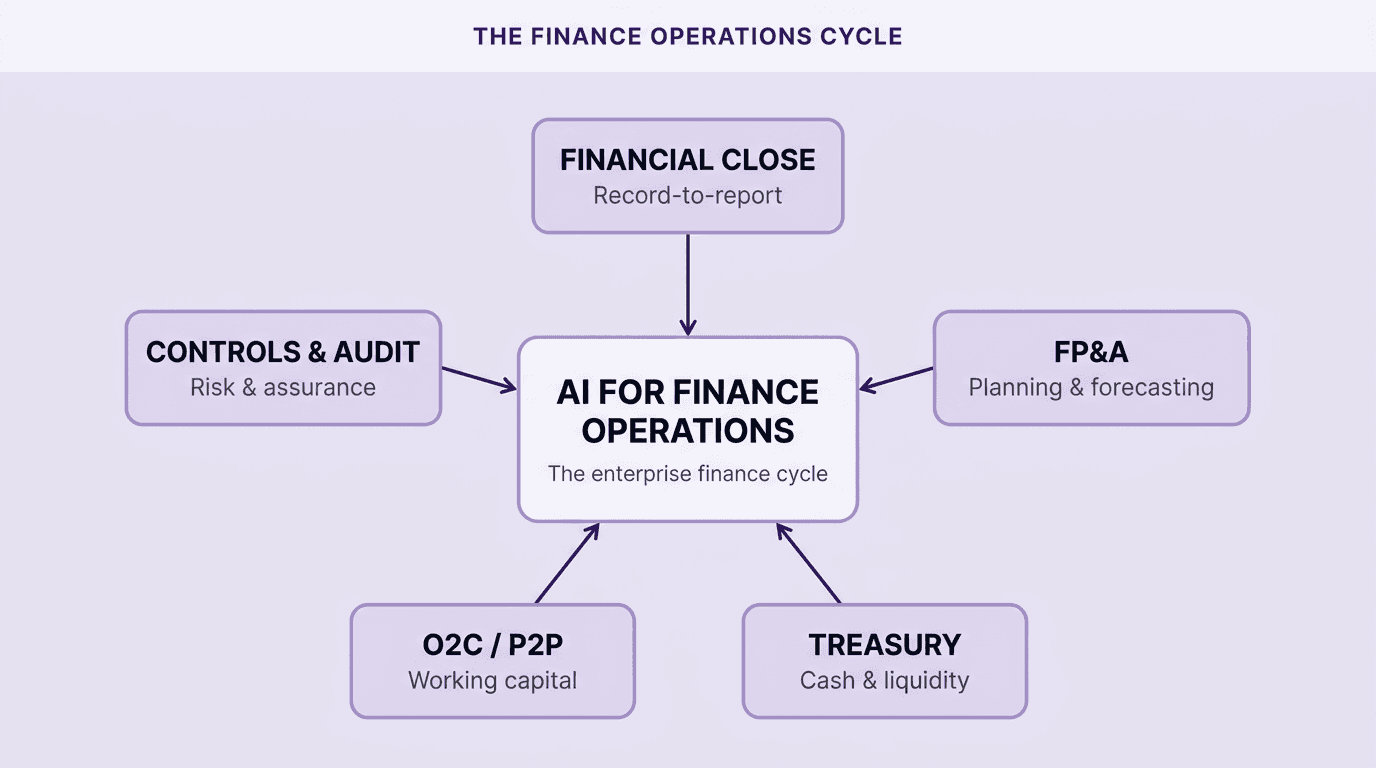
Each domain has its own operating tempo and data substrate. Close runs monthly and depends on subledger integrity. FP&A runs continuously and depends on cross-functional signal. Treasury runs intraday and depends on multi-bank visibility. Order-to-cash and procure-to-pay run transaction-by-transaction and depend on the quality of master data. Controls and audit run constantly but most visibly during quarter-end and year-end assurance. A credible AI architecture has to serve all five without forcing them through a single generic model.
Financial Close — Compressing the Month-End
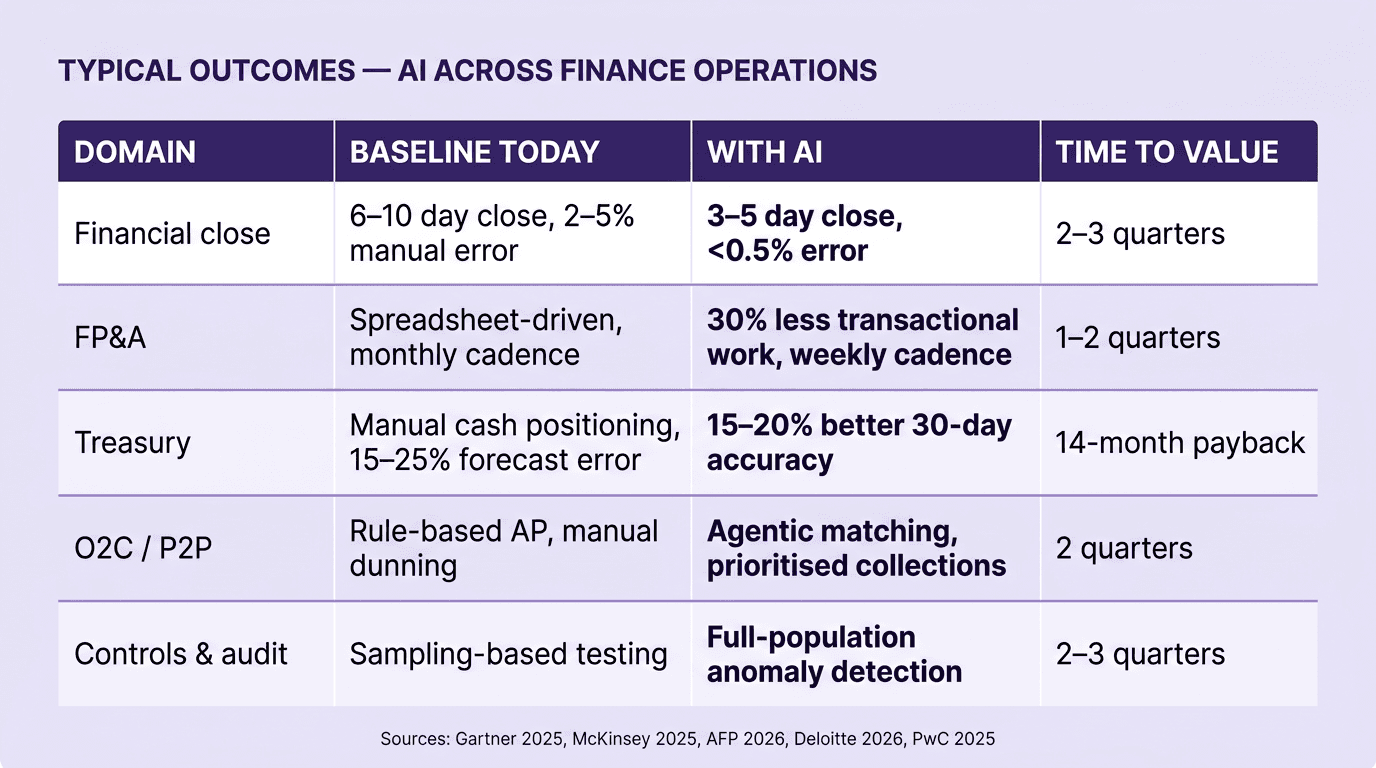
The monthly close is the single most-measured finance process and the domain where AI delivers the fastest, hardest numbers. The average enterprise close takes 6.4 calendar days; top performers finish under five and laggards still need ten or more. Gartner now predicts that finance teams using cloud ERP with embedded AI assistants will see a 30% faster close by 2028 (Gartner, 2025), and that AI-enabled tools will account for 62% of cloud-ERP spending by 2027, up from 14% in 2024.
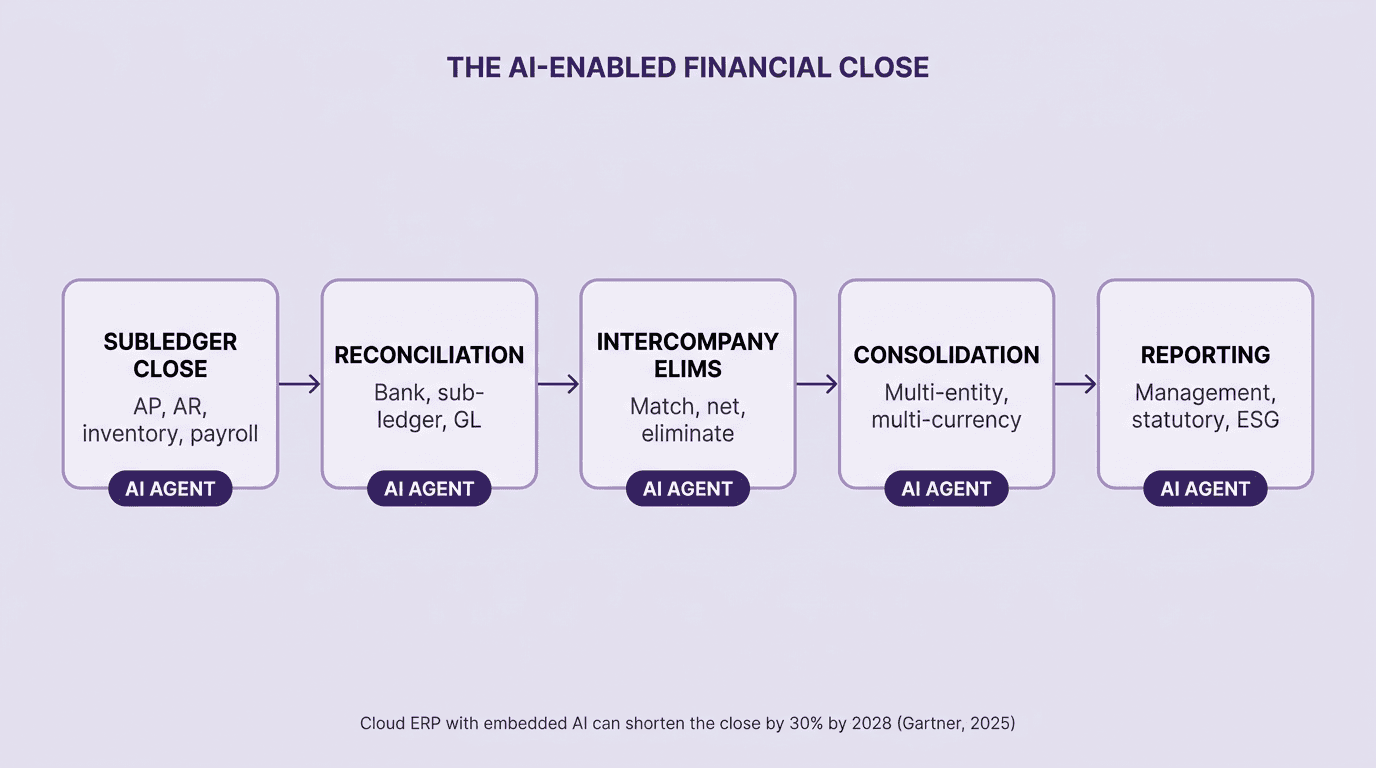
The leverage is concentrated in three tasks. First, reconciliation: AI agents match transactions across subledgers and bank statements, clear tolerance-band items automatically, and surface exceptions in natural language. Manual error rates that hovered at 2–5% fall below 0.5% in production deployments. Second, intercompany eliminations: for multi-entity groups, AI matches counter-party transactions, flags mismatches, and generates the elimination entries — typically the single biggest time saver in a multi-entity close. Third, narrative reporting: generative AI drafts management-commentary narratives with explicit data citations, compressing what used to be a week of manual prose into hours of review.
FP&A — From Variance Explanation to Forward Simulation
Financial planning and analysis is where CFOs are concentrating the largest share of their AI investment. Bain’s April 2026 research shows that within finance functions, the largest share of AI investment over the next 12 months is allocated to financial planning, analysis, and reporting.
The canonical case study comes from McKinsey: a global pharmaceutical company deployed a generative-AI copilot for FP&A and achieved a 30% reduction in FP&A transactional activity and a 15% reduction in FP&A operating expenditure, with proof of concept delivered in six weeks. Across finance functions where AI has been adopted robustly, professionals report 20–30% less time spent crunching data, freeing capacity for business partnering and scenario work.
The frontier is agentic forecasting. Deloitte’s 2026 Finance Trends survey names sales and profitability management (48%), working-capital optimisation (46%), and expense management (44%) as the top agentic-AI opportunities for finance leaders. In each case, agents do not replace the FP&A team — they draft the forecast, explain the drivers, and surface the exceptions, while humans retain approval authority over the numbers that reach the board.
Treasury — Real-Time Cash Visibility and Autonomous Liquidity
Treasury is the domain where AI in finance already delivers a clean, defensible ROI. PwC’s 2025 Global Treasury Survey, based on responses from 350 senior treasury professionals, found that 74% of treasury teams are either using or planning to expand AI, with predictive analytics (64%) and machine learning (71%) as the top focus areas. Yet maturity is still early — only 26% of teams rate their AI capabilities as moderately or very mature, and 38% of large corporates still rely on manual data collection for cash forecasts, with a satisfaction score of 2.9 out of 5 for manual methods versus 3.3 for system-based forecasting (PwC, 2025).
The AFP’s 2026 Annual Treasury Technology Survey reports that 52% of US corporate treasurers are piloting or have deployed AI for cash forecasting — up from 28% in 2024 — delivering a 15–20% improvement in 30-day forecast accuracy. For a company with $50 million in average daily float, that accuracy lift translates to $2–4 million in freed working capital through reduced precautionary cash buffers. Deloitte’s 2026 treasury ROI analysis finds full payback inside 14 months on average for companies in the $250 million to $1 billion revenue band.
Three use cases carry most of the value: daily cash positioning (AI agents aggregate multi-bank balances and AR/AP signals in real time), rolling 13-week forecasts that re-learn from actuals every week, and FX-exposure summaries with hedge-recommendation drafts. The pattern is the same across all three: AI prepares, treasury approves, and every decision is logged with who, what, when, and why for audit.
Order-to-Cash and Procure-to-Pay — The Working Capital Engine
If treasury is where AI makes working capital visible, order-to-cash and procure-to-pay are where AI moves it. On the collections side, agentic AI risk-scores accounts, personalises dunning messages at the invoice level, and forecasts expected receipts by customer segment. On the payables side, agents enforce two- and three-way match, catch duplicate invoices, surface early-payment-discount opportunities, and sequence payments against daily cash targets and supplier-importance rankings.
Deloitte’s 2026 data bears out the commercial weight of this layer: working-capital optimisation (46%) and expense management (44%) are among the top three agentic-AI opportunities finance leaders are prioritising. Done properly, the O2C/P2P layer compounds into the treasury and close cycles — better AR aging data improves cash forecasts, which improves yield, which funds growth.
The Adoption Paradox — Why Most Finance AI Pilots Stall
The most important number in 2026 is the gap between deployment and value. Deloitte’s inaugural Finance Trends 2026 survey of 1,326 global finance leaders found that 63% have fully deployed and are actively using AI, yet only 21% report clear, measurable ROI and just 14% have fully integrated AI agents into the finance function. Bain’s research echoes the pattern: only 15–25% of CFOs have scaled AI across finance, and only 31% are satisfied with their AI outcomes overall.
The drivers of the paradox are well-documented. Legacy technology (cited by 41% of early-stage adopters) and difficulty justifying ROI (30%) are the primary barriers for new entrants, while data-privacy concerns dominate for mature implementations (57%). McKinsey’s State of Organizations 2026 survey of more than 10,000 leaders adds the human dimension: 86% of leaders feel their organisations are not very prepared to adopt AI in day-to-day operations, and one in six organisations has no clear C-level owner for AI adoption.
The organisations that break through share four traits: they tie AI to specific business metrics rather than platform rollouts, they pay down workflow debt before deploying agents, they scale from clean, isolated use cases outward rather than boiling the ocean, and they treat adoption as a change-management programme where for every dollar spent on technology, roughly five are spent on people.
What Enterprise-Grade AI for Finance Requires
Finance is not marketing. Every AI output has to survive an audit, a regulator, or a board meeting. That demands a specific architecture.
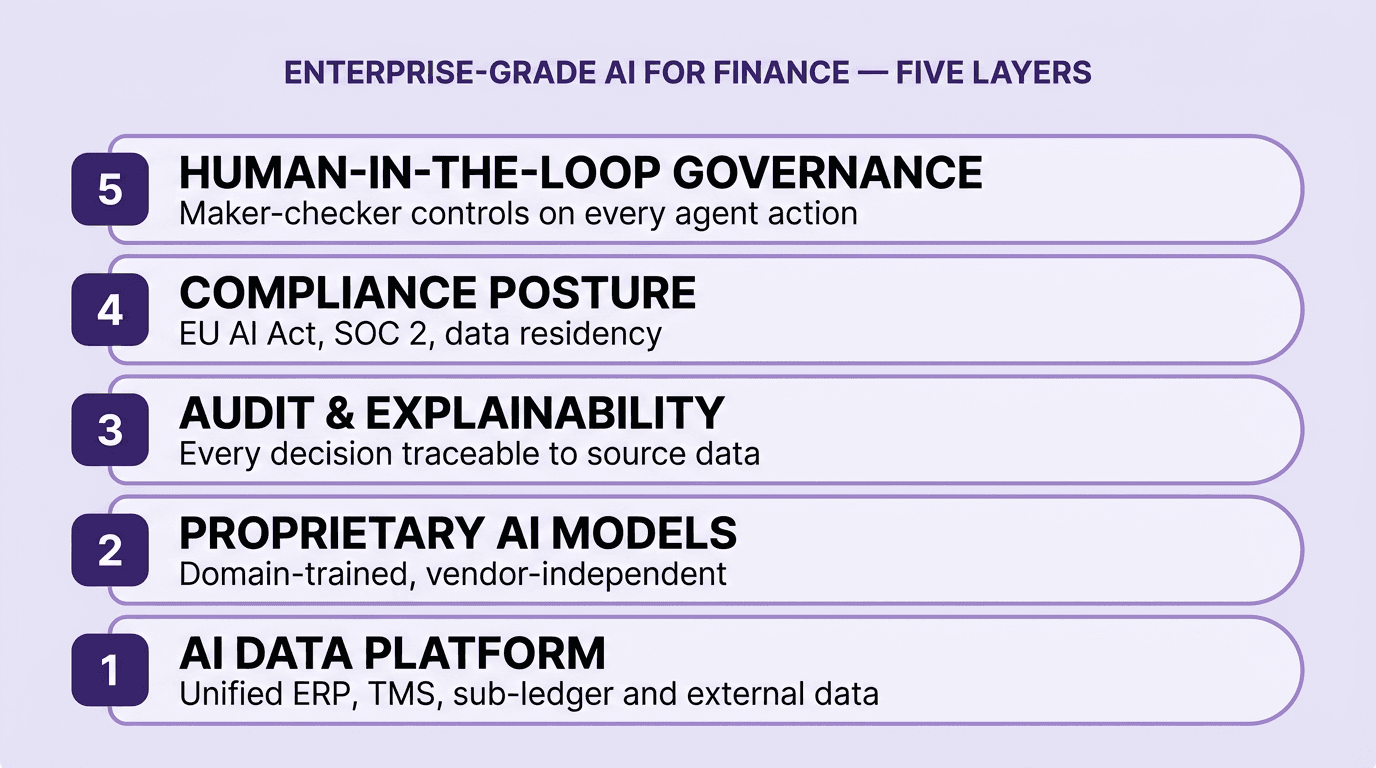
The foundation is an AI data platform that unifies ERP, TMS, sub-ledger, HR, procurement, and external data sources into a single semantic layer. PwC reports 94% TMS adoption in treasury but warns that full integration remains elusive; the data platform is what closes that gap. Above the data sits the model layer: proprietary AI models trained on domain data and kept vendor-independent, so the CFO is not exposed to re-pricing or deprecation risk from a single third-party API provider. The next layer is audit and explainability — every agent decision traceable to the source record, with natural-language narratives a controller can defend. On top of that sits the compliance posture: SOC 2, ISO 27001, data residency, and the rapidly approaching EU AI Act deadline, which makes compliance by 2 August 2026 a board-level date. The capstone is human-in-the-loop governance: maker-checker controls on every consequential agent action, with thresholds tuned to risk.
CFOs who now also own sustainability and non-financial reporting need this architecture for another reason: CSRD, IFRS S1 and S2, the SEC climate disclosure rules, and the GHG Protocol push sustainability data directly onto the finance function. The same data platform that supports the close now has to support audited emissions disclosure at the same cadence.
How Net0 Applies AI to Finance Operations
Net0 is an AI infrastructure company that builds AI solutions for governments and global enterprises. Its platform is organised as the three-layer architecture described in Inside Net0’s AI-first architecture: an AI data platform as the system of record, proprietary AI models for automation and analytics, and more than 60 modular components on top. Each deployment is custom-configured or custom-built end-to-end for a specific enterprise or government customer, rather than sold as a self-serve product.
Applied to finance operations, the same architecture is delivered as a standalone enterprise AI solution — independent of Net0’s sustainability or government platforms. Net0 builds custom AI for the close, FP&A, treasury, O2C/P2P, and controls as discrete engagements that serve the finance function on its own, integrated with the customer’s existing ERP, TMS, and sub-ledger stack. A typical deployment covers only the finance domains the CFO prioritises, with no dependency on adjacent verticals and no requirement to adopt the rest of the Net0 platform.
Enterprises that run more than one vertical can extend the same infrastructure outward, but this is optional rather than a prerequisite. Where a CFO also owns sustainability and non-financial reporting, the finance AI layer can share a data platform and controls with the sustainability platform and its decision frameworks — for example the marginal abatement cost and net-benefit framework for ranking decarbonisation investments and the profitable decarbonisation approach — translating sustainability data into the capital-allocation language finance already speaks. For government finance ministries, the government AI platform applies the same three-layer design under sovereign deployment constraints. These are convergence options a customer can choose; they are not the only way Net0 delivers AI for finance operations.
The implementation model is explicit. Net0 does not sell an off-the-shelf SaaS finance product. It builds the infrastructure a CFO can defend to an auditor, a regulator, and a board — integrated into the enterprise’s existing ERP and TMS landscape, tuned to the customer’s regulatory jurisdiction, and deployable in cloud, hybrid, or sovereign environments.
FAQ
What is AI for finance operations?
AI for finance operations is the use of machine learning, generative AI, and agentic systems across the enterprise finance cycle — close and consolidation, FP&A, treasury, order-to-cash, procure-to-pay, and controls. It replaces rule-based automation with models that learn from data, draft narratives, and propose or execute workflow steps under human oversight.
Where do CFOs see the fastest ROI from AI in finance?
Cash forecasting and the financial close deliver the fastest, most defensible ROI. AI cash forecasting improves 30-day accuracy by 15–20% (AFP 2026) with payback inside 14 months, and AI-enabled close automation can shorten the monthly close by 30% by 2028 (Gartner, 2025).
Why do so many finance AI pilots fail to scale?
Deloitte’s Finance Trends 2026 survey finds 63% of finance teams have deployed AI but only 21% report measurable ROI. Pilots typically stall because of legacy-technology debt, poor data quality, weak change management, and the absence of a clear C-level owner for AI adoption.
Is generic generative AI enough for finance?
Generally no. Finance requires auditability, explainability, data residency, and domain-tuned behaviour. Off-the-shelf foundation models fail on these requirements for regulated, institutional deployments, which is why enterprise-grade platforms combine proprietary models with a controlled data platform and human-in-the-loop governance.
How does the EU AI Act affect finance AI?
Under the EU AI Act, high-risk AI systems — including many credit-scoring and consequential finance applications — must meet full compliance requirements from 2 August 2026. Penalties reach up to €35 million or 7% of global annual turnover, making compliance posture a board-level decision for CFOs deploying AI.
Do finance AI systems need to support sustainability reporting too?
Increasingly, yes. CFOs now own data supply for CSRD, IFRS S1 and S2, SEC climate rules, and the GHG Protocol. The AI data platform that underpins the close and FP&A is the same infrastructure that has to support audited non-financial disclosure — which is why single-purpose finance AI tools rarely survive procurement at enterprise scale.
How does Net0 deliver AI for finance operations differently?
Net0 builds the AI infrastructure rather than selling a self-serve product. Each engagement is custom-configured or custom-built end-to-end, deployed in cloud, hybrid, or sovereign environments, and designed to meet the audit, compliance, and integration requirements of enterprise and government finance functions.