
AI for Enterprise
Why Net0 Builds Its Own AI Models: 5 Reasons for Proprietary Infrastructure
Net0 builds proprietary AI models rather than reselling third-party APIs. Five reasons — data sovereignty, domain depth, enterprise integration, compliance, and vendor independence — explained for enterprise and government buyers.
Sofia Fominova
TL;DR
Net0 is an AI infrastructure company that builds AI solutions for governments and global enterprises. Net0 builds its own proprietary AI models — rather than layering third-party APIs — because data sovereignty, industry depth, enterprise integration, compliance, and vendor independence cannot be retrofitted. Off-the-shelf foundation models fail on all five dimensions for regulated, institutional deployments.
Key Takeaways
Data sovereignty is now regulated, not optional. Under the EU AI Act, high-risk AI systems must meet full compliance by 2 August 2026, with penalties of up to €35 million or 7% of global turnover (European Commission, 2024). The UAE PDPL and Saudi PDPL require in-jurisdiction processing.
Vendor lock-in is a board-level risk. 45% of enterprises say vendor lock-in has already hindered their ability to adopt better AI tools, and 84% factor digital sovereignty into AI strategy (Swfte AI research, 2026).
Industry-specific training outperforms general-purpose models. Only about one-third of organisations have begun scaling AI across the enterprise (McKinsey State of AI, November 2025); most failures trace back to models that lack domain context.
Shadow AI is widespread. 69% of organisations have evidence or suspicion of unsanctioned public GenAI use (Gartner, 2025), creating compliance, IP, and data-exposure risk.
Building in-house keeps full control. Net0’s architecture combines an AI Data Platform, proprietary AI models, and 60+ modular applications — all deployable on sovereign, hybrid, or cloud infrastructure.
Introduction
Net0 is an AI infrastructure company that builds AI solutions for governments and global enterprises. Across sustainability, public sector, and business operations, Net0 operates its own proprietary AI models rather than reselling general-purpose foundation models from external providers. The decision is architectural and deliberate: sovereign regulation, industry specificity, enterprise integration, compliance cadence, and vendor independence cannot be added on later.
This article explains five reasons Net0 builds its own AI — and why that matters for Fortune 500 operators, government CIOs, and heads of sustainability evaluating enterprise AI in 2026.
Net0’s AI Architecture
Net0’s platform is organised into three layers. The foundation is the AI Data Platform — a secure intelligence layer that ingests structured and unstructured data from ERP systems, IoT sensors, invoices, supplier portals, and government data stores, then normalises and governs it for downstream use. On top of that sit Net0’s proprietary AI models, each trained for a specific function: data collection, decarbonization analytics, reporting automation, and custom domain models. A library of more than 60 modular applications — from ESG disclosure generators to supplier-risk scanners to citizen-service agents — connects into the platform and models.
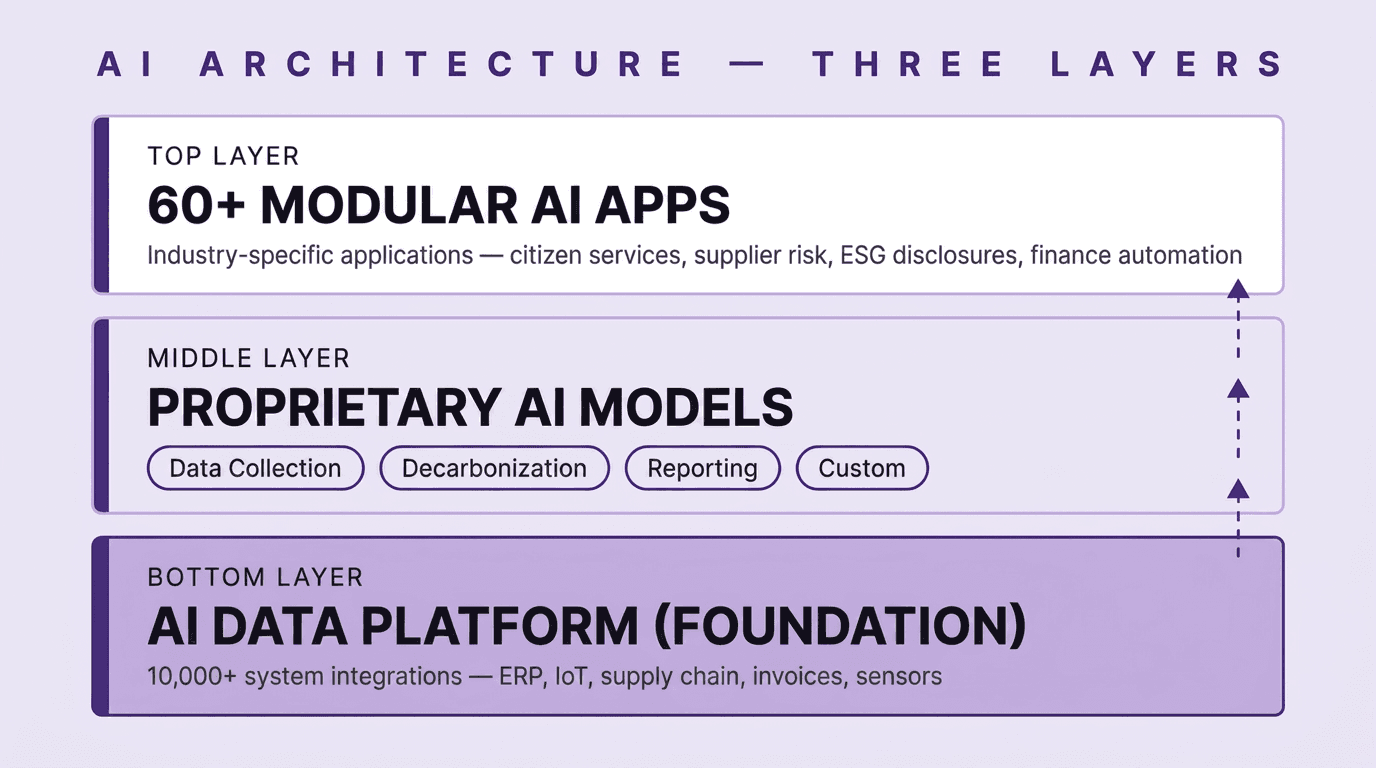
This layered design is what makes cross-vertical deployment possible. The same platform that powers automated carbon data collection for a Fortune 500 manufacturer also powers citizen-service models for a national ministry and supplier-risk scoring for a sovereign wealth fund.
1. Data Sovereignty and Residency Are Non-Negotiable
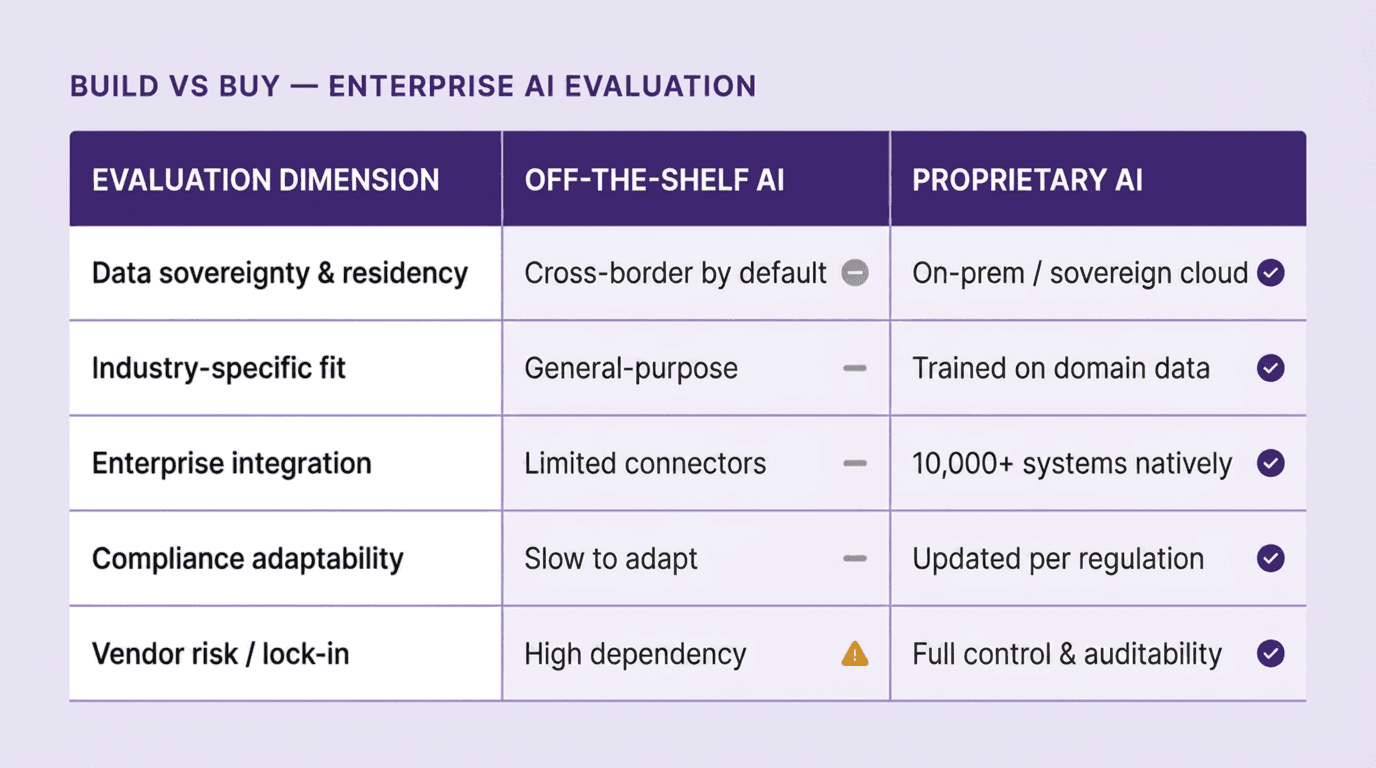
Off-the-shelf AI APIs route prompts, embeddings, and inference traffic through vendor-operated data centres, usually across borders. That fails the primary test for regulated workloads. The UAE Personal Data Protection Law (Federal Decree-Law No. 45 of 2021) entered active enforcement on 1 January 2026 with full compliance required by 1 January 2027, mandating in-jurisdiction processing and Data Protection Impact Assessments for any use of AI, automated profiling, or large-scale surveillance (Insight Advisory, 2026). Saudi Arabia’s PDPL, administered by SDAIA, restricts cross-border transfers and requires risk assessments and Standard Contractual Clauses for any data leaving the Kingdom (SDAIA, 2024). Europe is tightening the same perimeter: 84% of organisations now factor digital sovereignty into their AI strategies (Swfte AI, 2026), and 88.8% of IT leaders believe no single cloud provider should control their entire stack.
Because Net0 owns the model weights and the inference stack, deployments can run on-premise, in a sovereign cloud zone, or in a hybrid configuration. That covers the procurement reality across Net0’s government AI customer base — ministries cannot adopt systems that process citizen data through a consumer API.
2. Industry-Specific AI Outperforms General-Purpose Models
General-purpose foundation models are optimised to be plausible across every domain and excellent in none. That is a known limitation of the current scaling frontier: Stanford’s 2025 AI Index reports that nearly 90% of notable AI models now come from industry, and the performance gap between open and closed frontier models has narrowed from 8% to 1.7% in a single year (Stanford HAI, 2025). Raw capability is no longer the differentiator. Domain data is.
Enterprise operators feel this directly. McKinsey’s November 2025 State of AI survey found that although 88% of organisations report regular AI use in at least one business function, only about one-third have begun scaling AI across the enterprise (McKinsey, 2025). The gap between pilot and production is almost always about domain fit.
Net0’s models are trained on vertical-specific data and ontologies:
Sustainability models ingest over 50,000 emission factors, GHG Protocol reporting categories, and full Scope 1, 2, and 3 taxonomies, including Scope 3 supply-chain categories that generic models misclassify.
Government models are trained on public-sector data structures, citizen-service flows, and cross-agency schemas.
Business-operations models are trained on enterprise finance, procurement, and operational telemetry.
The practical effect is that Net0’s AI can interpret, for example, the difference between activity-based and spend-based carbon accounting methodologies — a distinction that determines whether a disclosure is audit-defensible. General-purpose chat models routinely fail this test.
3. Deep Integration With ERP, IoT, and Supply-Chain Systems
Enterprise AI is an integration problem more than a modelling problem. Data lives in SAP, Oracle, Maximo, IoT gateways, supplier portals, invoice PDFs, and decades of exported spreadsheets. Off-the-shelf AI APIs assume clean, pre-prepared input. Real enterprises do not have that.
Net0 operates more than 10,000 pre-built integrations across enterprise systems. Its AI reads source data directly — energy meters, shipping manifests, utility invoices, HR systems, procurement platforms, government citizen registries — without manual extraction or reformatting. That is how automated data collection moves from a slide deck to an operational reality.
This integration depth also addresses a risk that off-the-shelf adoption actively creates: shadow AI. Gartner’s 2025 research found that 69% of organisations have evidence or suspicion of shadow AI usage — employees feeding sensitive operational data into public chat tools (Gartner, 2025). When AI is embedded inside governed enterprise systems, with enterprise SSO, audit logs, and data-loss prevention, there is no need for an employee to paste a supplier contract into a consumer model.
4. Compliance Automation Across 30+ Frameworks
Regulatory cadence is the single strongest argument against third-party AI for institutional workloads. Net0’s platform supports more than 30 reporting frameworks — including GHG Protocol, CDP, GRI, IFRS S1 and S2, ESRS, SBTi, and the SEC climate disclosure rule — alongside sector-specific and regional obligations.
Several of those obligations shifted materially in 2025–2026:
The EU AI Act‘s high-risk provisions take effect on 2 August 2026, with penalties reaching €35 million or 7% of global turnover for prohibited practices and €15 million or 3% for high-risk violations (European Commission, 2024).
The EU Omnibus package, published in February 2025 and approved by the European Parliament in April 2025, raised the CSRD applicability threshold from 250 to 1,000 employees, exempting approximately 80% of previously in-scope companies, and postponed wave 2 and 3 reporting by two years (European Parliament, 2025).
The ESRS data-point count is being reduced by approximately 61%, with all voluntary data points removed.
Saudi Arabia’s PDPL transfer regulation (September 2024) adds new risk-assessment obligations for any cross-border data movement.
A third-party AI vendor cannot retrain or recertify its models on this cadence for every region and framework Net0 covers. Proprietary models let Net0 ship regulatory updates as part of the platform itself, not as an external dependency — the same discipline that makes ESG reporting and decarbonization planning tractable at Fortune 500 scale.
5. No Vendor Lock-In, No Black Boxes
Third-party foundation models are black boxes by design. Customers cannot inspect training data, audit decision logic, or control model versioning — and they are exposed to unilateral changes in pricing, rate limits, terms of service, and deprecation schedules. That exposure has become measurable:
45% of enterprises say vendor lock-in has already hindered their ability to adopt better AI tools (Swfte AI, 2026).
57% of IT leaders spent more than $1 million on platform migrations in the last year, with migration costs typically twice the initial investment.
87% of organisations are deeply concerned about AI-specific risks in their vendor relationships.
Gartner projects that over 40% of agentic AI projects will be cancelled by the end of 2027, citing escalating costs, unclear business value, and inadequate risk controls (Gartner, June 2025).
Because Net0 owns its models, customers get explainability by default — every prediction can be traced to source data and model version — and a stable product roadmap that evolves with customer needs rather than an external provider’s deprecation calendar.
How Net0 Applies This Across Verticals
Net0 builds and operates its own AI because the five constraints above apply across every Net0 vertical, not just one. The same architecture supports sustainability operations for multi-country enterprises, national-scale government AI programmes, and business-AI workloads in finance, supply chain, and risk. Net0 serves more than 400 entities across four continents, with offices in Dubai and Monaco and deployments across the GCC, Europe, and the Americas.
For a deeper view of the platform itself, see Net0’s AI architecture overview and the companion piece on how sustainability data becomes operational intelligence. For broader context, see why AI is essential when tackling climate change and profitable decarbonization strategy.
Book a demo to see how Net0’s proprietary AI infrastructure applies to your operating environment.
FAQ
Why does Net0 build its own AI models instead of using OpenAI or Anthropic?
Net0 builds proprietary AI because data sovereignty, industry fit, enterprise integration, compliance cadence, and vendor independence cannot be retrofitted onto general-purpose foundation models. Owning the model weights and inference stack allows Net0 to deploy on-premise, in sovereign clouds, and in hybrid configurations that external APIs cannot support.
Is proprietary AI more expensive than using third-party APIs?
Total cost of ownership usually favours proprietary AI at enterprise scale. Research cited by Swfte AI (2026) found that 57% of IT leaders spent over $1 million on platform migrations in the last year, with migration costs typically twice the initial investment. Eliminating those migration events — and eliminating shadow-AI risk — materially offsets the build cost.
How does Net0’s AI handle data residency in the GCC?
Net0 supports in-jurisdiction deployment for UAE and Saudi Arabia customers, aligning with the UAE PDPL and Saudi PDPL. Model training, fine-tuning, and inference can all run inside the customer’s sovereign zone, with no cross-border data movement unless explicitly configured and consented.
How is Net0’s AI different from carbon accounting software with an AI feature?
Carbon accounting tools that retrofit AI typically use third-party APIs for narrow tasks such as document classification. Net0 is AI-first: every layer — data ingestion, emission factor matching, disclosure generation, scenario modelling — runs on proprietary models. See Net0’s AI architecture overview for the technical detail.
Does Net0 use open-source foundation models?
Where appropriate, yes. Net0 combines its proprietary domain models with selectively chosen open-weight models for specific subtasks, rather than depending on a single closed vendor. Stanford’s 2025 AI Index shows the performance gap between open and closed frontier models has narrowed to 1.7%, making hybrid architectures the rational default for regulated workloads.
What frameworks does Net0’s proprietary AI support for sustainability reporting?
Net0’s AI supports more than 30 frameworks out of the box, including GHG Protocol, CDP, GRI, IFRS S1 and S2, ESRS, SBTi, and the SEC climate disclosure rule. Framework updates — such as the EU Omnibus CSRD changes of April 2025 — ship as platform updates rather than integration projects.