
AI for Enterprise
Inside Net0's AI-First Architecture: A Three-Layer System for Enterprise and Government AI
Net0's AI-first architecture is a three-layer system — AI data platform, proprietary AI models, and 60+ modular components — custom-configured or custom-built end-to-end for each enterprise, government, and sustainability deployment.
Sofia Fominova
TL;DR
Net0 is an AI infrastructure company that builds AI solutions for governments and global enterprises. Its platform is organised as a three-layer, AI-first architecture — an AI data platform as the system of record, proprietary AI models for automation and analytics, and more than 60 modular components on top. Every engagement is a custom-configured or custom-built end-to-end solution, assembled by Net0 and tailored to the customer’s operating environment, regulatory jurisdiction, and deployment constraints.
Key Takeaways
Custom-configured or custom-built, end-to-end. Net0 is not a self-serve SaaS product. Each deployment is assembled, configured, and delivered end-to-end — from data integration through model tuning to application layer — for a specific enterprise or government customer.
AI-first, not AI-added. Gartner projects that by 2027, more than 40% of agentic AI projects will be cancelled due to escalating costs, unclear value, and poor risk controls (Gartner, June 2025). Retrofitted AI is the largest cause of those failures.
Three architectural layers. Net0’s platform stacks an AI data platform, proprietary AI models, and 60+ modular components — each layer is independently deployable, governed, and extensible.
10,000+ enterprise integrations. Net0 reads directly from ERP systems, finance ledgers, procurement platforms, IoT gateways, supplier portals, and government data stores — integration accelerators, not off-the-shelf connectors dropped into a template.
One architecture, three verticals. The same stack powers enterprise operations (finance, procurement, supply-chain risk), government AI (citizen services, cross-agency data, sovereign infrastructure), and sustainability programmes (ESG, emissions, climate risk).
Sovereign, hybrid, or cloud deployment. 84% of organisations now factor digital sovereignty into their AI strategy (Swfte AI, 2026); Net0 owns the model weights and inference stack, so each deployment can run in-jurisdiction.
400+ entities across four continents. Every engagement is bespoke, but the same architecture underpins Fortune 500 enterprise deployments, national-scale government AI programmes, and global sustainability operations.
Introduction
Net0 is an AI infrastructure company that builds AI solutions for governments and global enterprises. Its AI-first architecture is not a product feature — it is the foundation on which every Net0 engagement is built, from enterprise AI solutions and government AI transformation programmes to ESG and emissions platforms. And every engagement is delivered end-to-end: Net0 designs, configures, builds, and operates the solution for the customer, rather than shipping a generic SaaS product and leaving implementation to the buyer.
AI-first architecture is an enterprise platform where data collection, analysis, decision-making, and automation are designed around AI models from the ground up, rather than bolted onto pre-existing software. The distinction matters because most enterprise AI failures trace back to architecture and delivery model, not individual models. McKinsey’s November 2025 State of AI survey found that although 88% of organisations report regular AI use in at least one function, only about one-third have begun scaling AI across the enterprise (McKinsey, 2025). The scaling gap is an architecture and delivery problem.
For institutional buyers — Fortune 500 CIOs, government ministers, CFOs, heads of operations — the practical question is whether a platform can ingest messy real-world data, apply domain-trained AI to it, produce audit-defensible outputs, and deploy under sovereign constraints — and whether the vendor will own that delivery end-to-end. Net0’s three-layer architecture and bespoke engagement model are designed to answer all four questions the same way across verticals.
AI-First Architecture Defined
AI-first architecture is a software design principle in which AI is the primary engine of the system rather than a supplementary feature. Data ingestion, normalisation, analytics, decision logic, and user-facing workflows all assume continuous model inference as part of the runtime — not as an offline add-on or a bolt-on API call.
The test of whether a platform is genuinely AI-first is straightforward. If the AI layer is removed, does the core product still function? In a retrofitted system, yes — the underlying application continues to work, because AI was a veneer. In an AI-first system, no — the model weights, feature stores, and governance layer are what make the product operate at all.
This matters because institutional data is messy by default. Enterprise data spans ERP systems, finance ledgers, IoT telemetry, contracts, invoices, and supplier records. Government data spans citizen registries, cross-agency APIs, legacy mainframes, and paper. Sustainability data spans utility meters, emission factors, and disclosure filings. Off-the-shelf AI APIs and generic SaaS products assume pre-cleaned input and homogeneous workflows. AI-first platforms built and delivered end-to-end do not — they treat ingestion, validation, inference, and application assembly as parts of the same engineered runtime.
Why Retrofitted AI and Off-the-Shelf SaaS Fail at Enterprise Scale
Retrofitted AI typically layers third-party foundation-model APIs onto existing software, then ships the result as a generic SaaS subscription. The architecture is attractive on a slide deck but produces four recurring failures at enterprise scale.
First, domain fit is shallow. General-purpose foundation models are optimised to be plausible across every domain and excellent in none. Stanford’s 2025 AI Index reports that nearly 90% of notable AI models now come from industry and the performance gap between open and closed frontier models has narrowed from 8% to 1.7% in a single year (Stanford HAI, 2025). Raw model capability is no longer the differentiator; domain data and custom training are.
Second, integration is brittle. Enterprise data lives in SAP, Oracle, Maximo, IoT gateways, invoice PDFs, and decades of exported spreadsheets. Generic SaaS assumes clean input and does not natively connect to any of those systems. Real deployments need custom integration and configuration, not a self-serve sign-up flow.
Third, compliance is outsourced. A vendor-hosted API or generic SaaS product cannot retrain or recertify its models on the cadence of regulation. The EU AI Act’s high-risk provisions take effect on 2 August 2026, with penalties reaching €35 million or 7% of global turnover for prohibited practices (European Commission, 2024). Sector regulations — from financial-services AI rules to public-procurement frameworks to ESG disclosure standards — shift on similar timelines. Updates at this cadence need to ship inside the platform, and the customer’s instance needs to be reconfigured for their jurisdiction and scope.
Fourth, vendor risk concentrates. 45% of enterprises say vendor lock-in has already hindered their ability to adopt better AI tools, and 57% of IT leaders spent more than $1 million on platform migrations in the last year, with migration costs typically twice the initial investment (Swfte AI, 2026). Concentration risk grows with every dependency on a one-size-fits-all product.
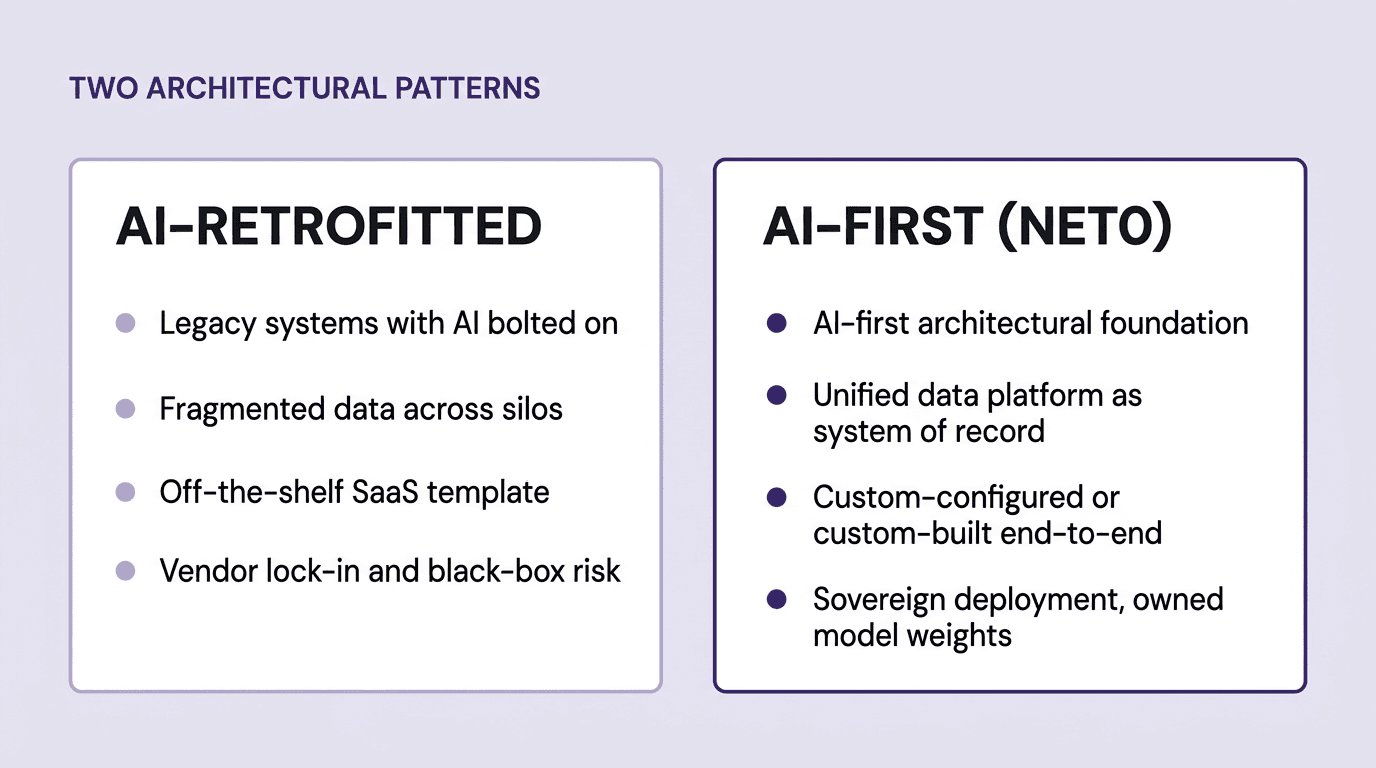
Net0’s response to all four failures is structural and operational: own the data platform, own the models, keep the application layer modular, and deliver every engagement end-to-end. That combination is what the three-layer architecture and Net0’s custom delivery model provide. The full case for owning the model layer is covered in why Net0 builds its own AI models.
The Three-Layer Architecture
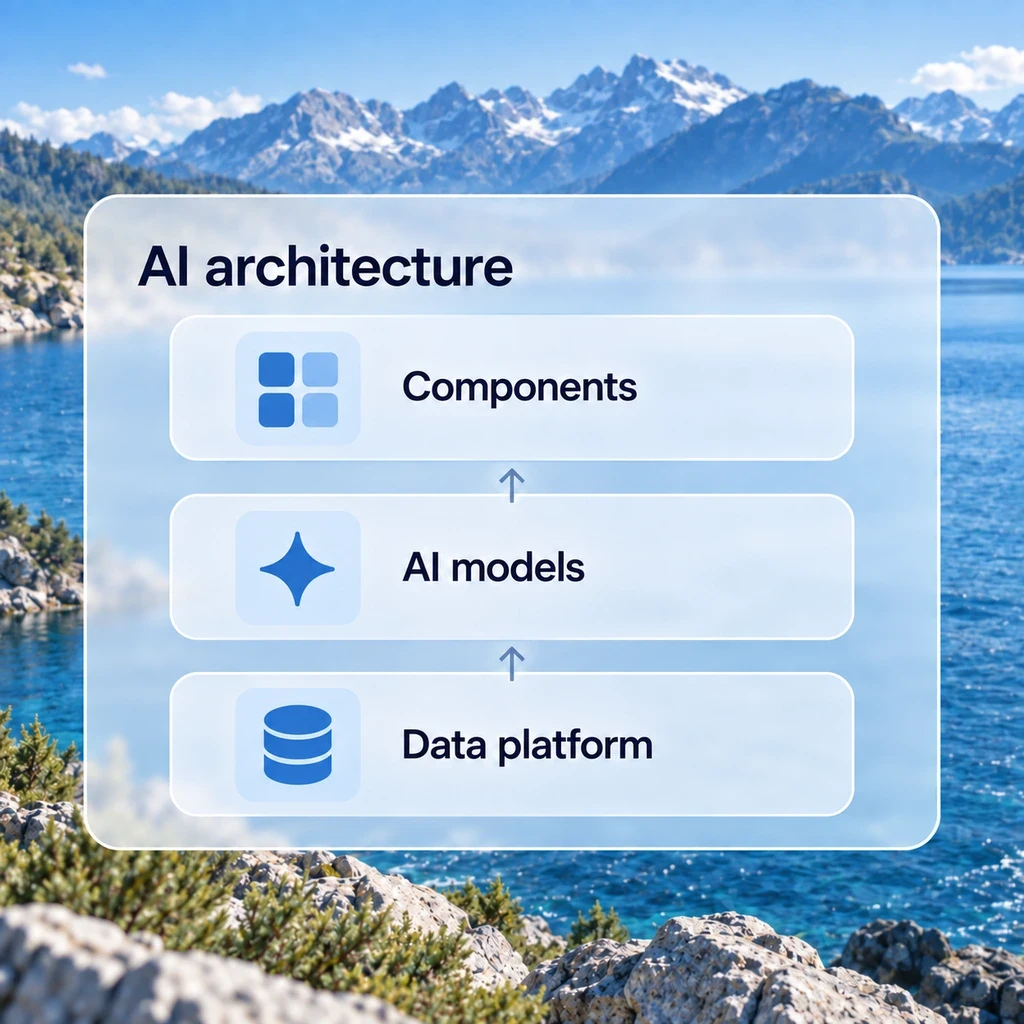
Net0’s platform is organised into three independently governed layers. Layer 1 is the AI data platform — the system of record. Layer 2 is the library of proprietary AI models. Layer 3 is the library of more than 60 modular components that are custom-configured into a complete application layer for each deployment. Data flows upward through the stack; governance, audit, and policy controls apply across all three layers.
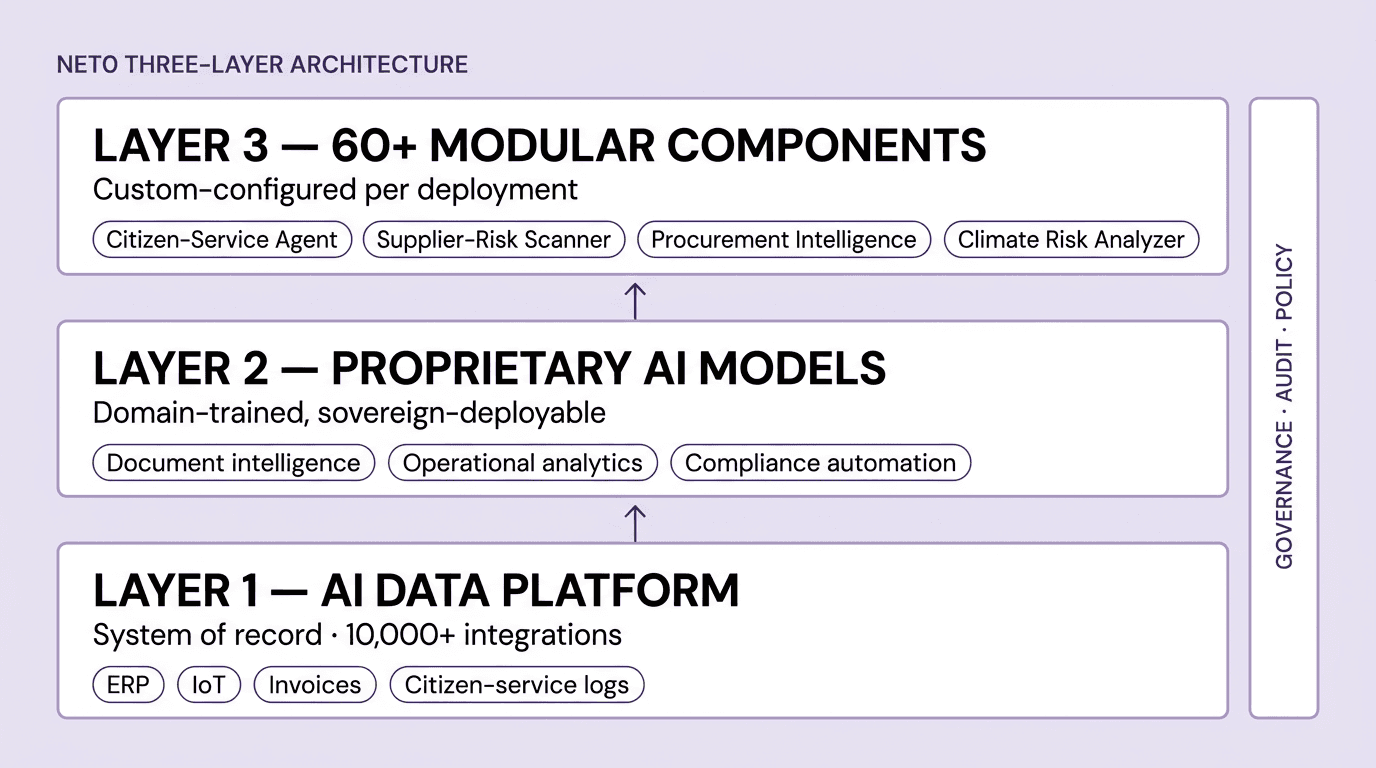
This layering matters because each layer solves a different problem, and each layer is custom-configured during delivery. Without Layer 1, AI has no reliable input. Without Layer 2, outputs lack domain fidelity. Without Layer 3, there is no usable product surface for the specific workflows a given customer needs. Retrofitted SaaS platforms tend to collapse two of the three layers — typically by using a generic AI API in place of Layers 1 and 2, and a fixed UI in place of Layer 3 — which is why their outputs are generic and their delivery model is self-serve.
Layer 1: The AI Data Platform as System of Record
Layer 1 is the AI data platform — a secure intelligence layer that ingests structured and unstructured data from ERP systems, finance ledgers, procurement platforms, IoT gateways, contracts, invoices, supplier portals, government registries, and legacy exports, then normalises and governs it for downstream use. It is the system of record on which every higher layer depends, and it is configured for each customer’s data estate during delivery.
Four design constraints define Layer 1. The first is centralisation: all operational data — transactions, telemetry, citizen-service logs, procurement spend, supplier records, regulatory filings, and emissions activity — is consolidated into a single governed store, eliminating the silos that make institutional reporting intractable. The second is granularity: the platform captures data at the level of individual transactions, meters, invoices, or service events, while preserving roll-up to enterprise, country, and group level. The third is real-time processing: more than 10,000 pre-built integrations provide the accelerators for custom integration work, so downstream models operate on live data rather than quarterly snapshots. The fourth is complex organisational structures: the platform is configured for multi-country, multi-subsidiary enterprises and national-scale government deployments, with per-entity access controls and regional compliance boundaries.
For an enterprise CFO or COO, Layer 1 means finance, procurement, and operations data feed a single audit-defensible source rather than dozens of disconnected systems. For a government CIO, it means citizen-service data from one ministry can be read consistently by another, without building a new integration for every workflow. For a CSO, it means automated data collection replaces the manual spreadsheet process most enterprises still use, and Scope 1, 2, and 3 emissions can be calculated against the same reconciled source of truth.
Layer 2: Proprietary AI Models, Tuned or Custom-Built per Engagement
Layer 2 is a library of proprietary AI models, developed in-house and deployed alongside the data platform. Each model is trained on vertical-specific data and ontologies rather than on generic public-web corpora, and most engagements involve additional fine-tuning — or fully custom model development — on customer data during delivery. The case for building models rather than renting them is covered in detail in Net0’s analysis of proprietary AI; the short version is that data sovereignty, domain fit, enterprise integration, compliance cadence, and vendor independence cannot be added on later.
Net0’s models cluster around three functional areas.
AI-powered data ingestion and document intelligence. Operational data is scattered across invoices, contracts, ERP systems, IoT devices, supplier disclosures, and regulatory filings. Net0’s ingestion models connect to source systems to extract structured fields without manual input; clean, verify, and reconcile the results; and cross-check for anomalies so that institutions maintain audit-ready transparency. The same model family powers everything from finance close acceleration and contract intelligence to supplier disclosure parsing and ESG-data normalisation — the substrate of enterprise AI solutions and AI for finance operations.
AI-assisted operational analytics and scenario modelling. Most institutional decisions are scenario-modelling problems: which intervention produces the best outcome under a specific operational and regulatory envelope. Net0’s analytics models forecast demand and risk, simulate the financial and operational impact of alternative strategies, and prioritise actions that improve performance — whether the use case is supply-chain disruption planning, citizen-service routing, financial forecasting, or profitable decarbonization. The discipline is the same across domains: model the tradeoff surface, recommend the optimum, re-plan as conditions change.
AI-first compliance and reporting automation. Regulatory cadence is the strongest argument against third-party AI for institutional workloads. Net0’s reporting models map operational data onto more than 30 frameworks spanning finance, public sector, and sustainability — including the EU AI Act, NIST AI Risk Management Framework, public-procurement rules, the GHG Protocol, IFRS S1 and S2, ESRS, and the SEC climate disclosure rule. Framework updates ship as platform updates, and the customer’s disclosure configuration is updated accordingly.
Because Net0 owns the model weights and the inference stack, all three model families can be deployed on-premise, in a sovereign cloud zone, or in a hybrid configuration — and additional custom models can be trained on the customer’s data during delivery. That covers the procurement reality across Net0’s customer base, particularly in regulated jurisdictions where cross-border inference is not permitted.
Layer 3: 60+ Modular Components, Custom-Configured per Deployment
Layer 3 is where Net0’s architecture meets the end user. It is a library of more than 60 modular AI components — each one designed to solve a specific institutional problem, and each connected directly to Layers 1 and 2. These components are not a self-serve app store. In every engagement, Net0 selects the relevant components, configures and extends them for the customer’s workflows, and builds additional components from scratch where the customer’s use case has no existing match.
Most enterprise and government platforms force buyers into rigid, pre-built workflows that do not match their industry, jurisdiction, or organisational structure. Net0’s modular, custom-delivered approach avoids that constraint. A global bank, a national transport ministry, and a Fortune 500 manufacturer deploy on the same Layer 1 and Layer 2 infrastructure but receive entirely different Layer 3 solutions, tailored end-to-end by Net0. Additional components can be added, swapped, or custom-built after go-live without disrupting existing workflows, so the platform evolves with regulation and strategy rather than requiring a replatform every few years.
Representative Layer 3 components include:
Document Intelligence — extracts and reconciles data from invoices, contracts, supplier disclosures, and regulatory filings, replacing manual data entry across finance, procurement, and compliance.
Supplier-Risk Scanner — scores supply-chain partners on operational, financial, ESG, and sanctions criteria, and alerts on changes in risk posture.
Procurement Intelligence — analyses spend, supplier consolidation, and category strategy across public and private buyers, identifying savings and concentration risk.
Citizen-Service Agent — triages, routes, and answers citizen requests across government service workflows, with audit logging and human-in-the-loop escalation.
Cross-Agency Data Hub — federates data across ministries with per-agency access controls, enabling cross-agency reporting without data duplication.
Multi-Framework Disclosure Generator — automates regulatory reporting against more than 30 frameworks, from financial-services rules to ESG standards.
Climate Risk Analyzer — simulates physical and transition climate risks against operations, assets, and supply chains.
Financial Forecasting and Scenario Planner — models revenue, cost, and capital-allocation outcomes against operational scenarios for finance, treasury, and FP&A teams.
Where a customer’s use case is not in the existing library — a national permitting workflow, a sector-specific risk model, a custom domain model trained on the customer’s own data — Net0 builds the component from scratch in the same architecture, governed by the same Layer 1 and Layer 2 controls.
How End-to-End Delivery Works
Every Net0 engagement is delivered end-to-end rather than shipped as an off-the-shelf product. A typical engagement moves through four stages.
Discovery and architecture design. Net0 works with the customer’s data, operations, compliance, and technology teams to map the data estate, identify priority workflows, select components from the Layer 3 library, and scope any custom components that need to be built.
Integration and configuration. Net0 engineers configure Layer 1 against the customer’s ERP, IoT, procurement, and legacy systems using the 10,000+ pre-built integrations as accelerators, and fine-tune Layer 2 models on the customer’s operational and domain data.
Custom build where required. Where a customer’s use case is not already covered by the Layer 3 library, Net0 builds the necessary components in the same architecture — trained on the customer’s data, integrated with the customer’s systems, and governed by the customer’s policies.
Deployment, operation, and evolution. Solutions can be deployed on-premise, in a sovereign cloud zone, or in a hybrid configuration. After go-live, Net0 continues to operate the platform, ship regulatory updates, extend components, and build additional custom modules as the customer’s needs change.
This is the operational difference between a generic SaaS product and a custom-configured AI infrastructure engagement. The starting components are shared across Net0’s 400+ customers; the assembled solution is unique to each one.
One Architecture, Three Verticals
The same three layers and the same end-to-end delivery model power deployments across every Net0 vertical. Layer 1 is the same data platform. Layer 2 is the same library of proprietary models. Only Layer 3 — the application layer — is configured differently for each customer.
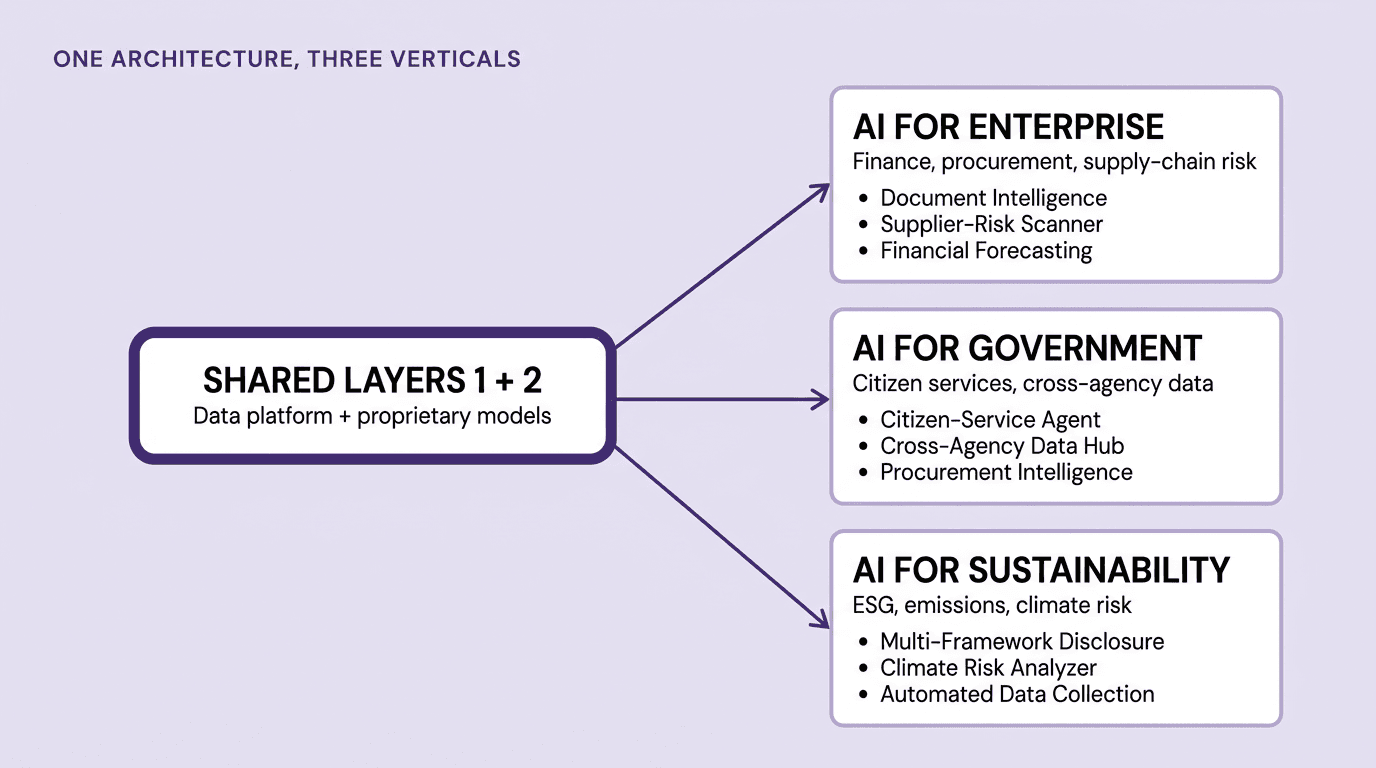
For enterprise operations, Layer 3 is configured into solutions for finance close acceleration, procurement intelligence, supplier-risk monitoring, contract analytics, and operational risk — the use cases covered in Net0’s enterprise AI solutions and AI for finance operations.
For government AI, Layer 3 is configured into citizen-service agents, cross-agency reporting, sovereign data hubs, and regulatory-compliance modules — the playbook described in government AI transformation and the terminology in the agentic government glossary.
For sustainability, Layer 3 is configured into emissions measurement, multi-framework disclosure, climate risk, and decarbonization analytics — the workloads covered in AI for sustainability intelligence.
Because the layers are governed and deployable independently, a customer that begins in one vertical can extend the same platform into another without re-procuring infrastructure — Net0 simply extends the engagement with additional custom-configured or custom-built components. Net0 serves more than 400 entities across four continents from offices in Dubai and Monaco, and the same architectural and delivery principles apply to every one.
What This Means for CIOs, CFOs, and Procurement Leaders
For institutional buyers, the practical implications of Net0’s AI-first architecture and custom delivery model reduce to four operating-model effects.
Bespoke solutions without bespoke timelines. Because Layer 1 already connects to 10,000+ enterprise systems and Layer 3 includes 60+ proven components, a fully custom-configured end-to-end deployment compresses timelines that would otherwise take years of custom engineering.
Domain-defensible outputs. Layer 2 models are trained on industry ontologies — financial schemas, public-sector workflows, regulatory frameworks, emission factors — and fine-tuned or custom-built on customer data during delivery, so outputs are audit-defensible rather than plausible.
Regulation that ships with the platform. Framework updates, from EU AI Act enforcement to financial-services AI rules to ESG disclosure changes, are platform releases that Net0 applies to the customer’s configured instance — not integration projects the customer has to run.
Sovereign deployment as a default option. Model weights and inference run where the customer requires, which is the precondition for government workloads and most regulated-industry enterprise workloads.
These are architectural and delivery-model properties, not feature checkboxes. They cannot be added to a retrofitted SaaS product without rebuilding it.
Book a demo to scope a custom-configured or custom-built end-to-end deployment against your specific operating environment. The same three-layer architecture powers Net0’s government AI infrastructure, AI-first sustainability platform, and enterprise AI engagements across finance, procurement, and operational risk.
FAQ
What is AI-first architecture?
AI-first architecture is a software design where AI is the primary engine of the system — responsible for data ingestion, analytics, decision logic, and automation — rather than a supplementary feature bolted onto a pre-existing platform. Removing the AI layer breaks the product, because the core value is produced by models, not by legacy application logic.
How is AI-first architecture different from AI added to existing software?
Retrofitted AI layers foundation-model APIs onto legacy software and ships it as generic SaaS; AI-first architecture is designed around model inference from the ground up and is delivered end-to-end to each customer. The consequence is domain fidelity, integration depth, compliance adaptability, and a solution that matches the customer’s operating environment rather than forcing them into a template.
Is Net0 an off-the-shelf SaaS product?
No. Net0 delivers every engagement as a custom-configured or custom-built end-to-end AI solution. Layer 1, Layer 2, and Layer 3 are all configured, extended, or built bespoke for each customer during delivery. Net0’s role is to design, build, integrate, and operate the solution, not to hand over a generic product and leave implementation to the buyer.
What are the three layers of Net0’s AI architecture?
Layer 1 is the AI data platform — the system of record that ingests and governs operational data. Layer 2 is a library of proprietary AI models, tuned or custom-built on customer data during delivery. Layer 3 is a library of more than 60 modular components that are custom-configured, extended, or purpose-built into a complete application layer for each deployment.
What AI models does Net0 use, and are they proprietary?
Net0 develops and hosts its own proprietary models, with selective use of open-weight models for specific subtasks where a hybrid approach is more effective. Models are fine-tuned or fully custom-built on customer data during delivery. Owning the model weights and inference stack is what makes sovereign and hybrid deployment possible, and is covered in detail in the analysis of why Net0 builds its own AI models.
How does the same architecture support enterprise, government, and sustainability deployments?
Layers 1 and 2 are shared across every vertical — the same data platform and the same library of proprietary models. Layer 3 is configured differently per vertical: Document Intelligence, Supplier-Risk Scanner, and Financial Forecasting for enterprise operations; Citizen-Service Agent and Cross-Agency Data Hub for government; Multi-Framework Disclosure and Climate Risk Analyzer for sustainability. A customer can extend an existing engagement into a new vertical without re-procuring infrastructure.
Can Net0’s AI infrastructure be deployed on-premise or in a sovereign cloud?
Yes. Because Net0 owns the model weights and the inference stack, each custom deployment can run on-premise, in a sovereign cloud zone, or in a hybrid configuration. That is a precondition for government workloads and for regulated-industry enterprises in jurisdictions such as the UAE and Saudi Arabia, where cross-border data movement is restricted.
How many components does the Net0 platform include, and can Net0 build new ones?
The Layer 3 library includes more than 60 modular AI components spanning enterprise operations, government AI, and sustainability. These are the starting point for each engagement — Net0 then configures them to the customer’s workflows and builds additional custom components as required, all within the same three-layer architecture.