
AI for Government
Government AI Transformation: The 2026 Playbook
The 2026 playbook for government AI transformation: the four pillars, sovereign-AI imperative, and six-step implementation roadmap, from Net0.
Sofia Fominova

TL;DR
Government AI transformation is the large-scale redesign of public institutions around AI infrastructure — sovereign compute and data, AI-powered citizen services, cross-agency data integration, and AI-driven policy modelling. Gartner projects that by 2028, at least 80% of governments will deploy AI agents to automate routine decision-making (Gartner, 2026), and public-sector AI spending is now the fastest-growing vertical in enterprise IT. The 2026 playbook is a six-step shift from pilot sprawl to sovereign, production-scale AI.
Key Takeaways
Scale is no longer theoretical. Worldwide AI spending will reach $2.52 trillion in 2026, a 44% year-on-year increase (Gartner, January 2026), and government is on track to be the single biggest AI-spending vertical, with a 19% compound annual growth rate in public-sector AI investment between 2022 and 2027.
Pilots are giving way to production. The US federal government reported 3,611 AI use cases across 56 agencies in 2025 — a 105% increase from 2024 (Brookings, April 2026). Abu Dhabi has moved beyond pilots, deploying more than 100 AI use cases across over 40 government entities under a US$3.5 billion (AED 13 billion) digital strategy (Department of Government Enablement, September 2025).
Sovereignty is now a hard requirement. 84% of organisations factor digital sovereignty into their AI strategy, and governments can no longer process citizen data through consumer APIs. In-jurisdiction compute, national model control, and sovereign-cloud deployment are preconditions for most public-sector workloads.
Fragmentation is the main barrier. In a Gartner survey of 138 government respondents (July–September 2025), 41% cited siloed strategies and 31% cited legacy systems as the biggest obstacles to AI value. Cross-agency data integration, not model selection, is the binding constraint.
Explainability is becoming regulated. Gartner projects that by 2029, 70% of government agencies will require explainable AI (XAI) and human-in-the-loop mechanisms for all automated decisions that affect citizen service delivery (Gartner, 2026). The EU AI Act’s high-risk provisions, enforceable from 2 August 2026, make that a legal obligation across EU Member States.
Introduction
Net0 is an AI infrastructure company that builds AI solutions for governments and global enterprises. This article is the 2026 playbook for government AI transformation — the large-scale, institution-wide redesign of public administration around AI-first infrastructure rather than AI tools bolted onto legacy systems.
The scope is bigger than most procurement conversations assume. Government AI transformation is not a chatbot programme, a robotic-process-automation upgrade, or a single ministry’s analytics project. It is a change to how governments collect data, make decisions, deliver services, and hold themselves accountable. The OECD frames it as governments becoming not just regulators and investors in AI, but developers and users of AI at the core of the policy cycle (OECD, 2024).
Net0 serves government customers from offices in Dubai and Monaco and ships the same three-layer AI-first architecture that underpins its Fortune 500 enterprise work. The rest of this article explains what government AI transformation means in 2026, the four pillars every national programme must solve, a six-step implementation playbook, and how Net0 supports national-scale government AI programmes.
What Government AI Transformation Means in 2026
Government AI transformation is the institutional adoption of AI infrastructure as the primary engine of public administration — data platforms, domain-specific models, and agentic applications that automate decisions, personalise services, and strengthen accountability across ministries.
Three properties distinguish it from earlier rounds of e-government or digital transformation. First, AI systems now act on behalf of the state — drafting decisions, triaging cases, and interacting with citizens — rather than simply digitising existing forms. Second, the underlying infrastructure is sovereign by design: compute, model weights, and data residency sit inside the jurisdiction. Third, transformation is measured in operational metrics — decisions automated, service response time, cross-agency data reuse, explainability coverage — not in portals launched or forms digitised.
The OECD’s 2024 Governing with Artificial Intelligence study found that 67% of member countries already use AI to improve public service design and delivery, but that most deployments sit in pilot phase and have not yet produced transformational impact (OECD, 2024). The gap between pilot and production is what the 2026 playbook is designed to close.
The Market Context: Scale, Spending, and Political Momentum
The market for government AI has moved decisively from narrative to capex. Worldwide AI spending will total $2.52 trillion in 2026, a 44% year-on-year increase, with AI infrastructure alone adding more than $401 billion of incremental spending (Gartner, January 2026). Government is the single fastest-growing spending vertical within that total — Gartner projects a 19% compound annual growth rate in government AI investment between 2022 and 2027, exceeding every other industry.
The pipeline inside governments is equally loud. In the United States, federal agencies reported 3,611 individual AI use cases across 56 agencies in 2025 — a 105% increase year-on-year, and five times the volume reported in 2023 (Brookings, April 2026). The UK government published its AI Opportunities Action Plan in January 2025, committing to AI Growth Zones, a National Data Library, and a state-backed compute expansion on the premise that AI could add up to £400 billion to UK GDP by 2030. The UAE, which was the first country in the world to publish a national AI strategy (2017) and the first to appoint a Minister of State for AI, is now pursuing the UAE National AI Strategy 2031, with Abu Dhabi alone committing AED 13 billion to become the world’s first fully AI-native government by 2027 (Department of Government Enablement, September 2025). Saudi Arabia’s National Strategy for Data and AI (NSDAI) has made similar commitments at federal level, administered by SDAIA.
What has changed since the last wave of digital-government modernisation is that leaders are now prepared to spend on the infrastructure underneath the services, not only on the citizen-facing veneer. That is the decisive shift of 2025–2026.
The Four Pillars of Government AI Transformation
Every credible national programme addresses four pillars in parallel. Skipping any one of them is the most common cause of failed transformations.
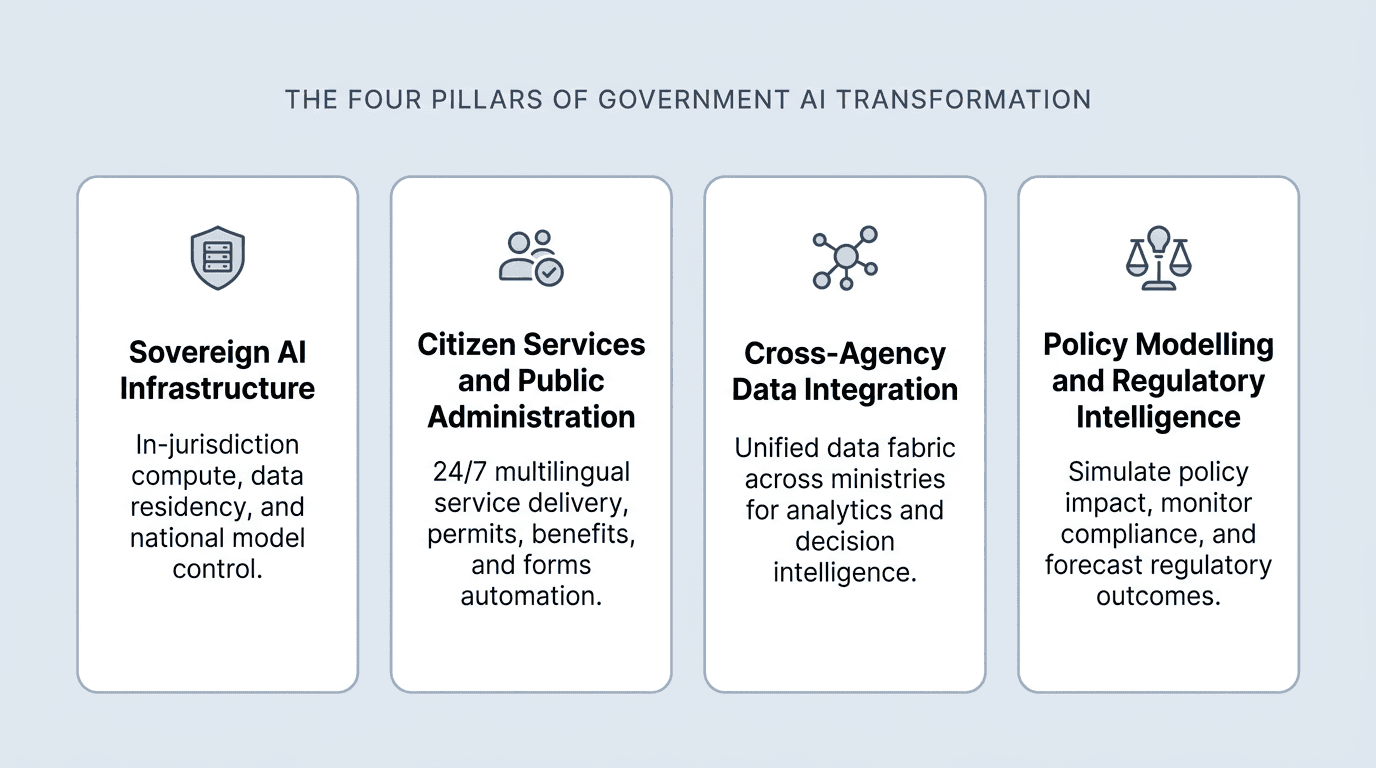
Sovereign AI infrastructure. The foundation is compute, model weights, and data residency under national control. Governments cannot rely solely on foreign hyperscalers for workloads involving citizen data, national security, or critical infrastructure. That is the practical meaning of sovereign AI — the concept now endorsed by the World Economic Forum, national leaders, and technology vendors alike (World Economic Forum, 2024). Denmark, Italy, the UK, the UAE, France, and India have all stood up domestic AI supercomputers or sovereign cloud zones since 2024.
Citizen services and public administration. AI directly touches the front office of the state — benefits determination, permits, case management, multi-channel service assistants, and forms automation. The OECD documents production-scale examples including France’s sovereign generative AI assistant Albert, Finland’s AuroraAI programme, and Norway’s conversational assistant Frida, which resolved 80% of citizen enquiries without human intervention during the COVID-19 response (OECD, 2024). These are not chatbot gimmicks — they are the primary interface between citizens and the state in increasing numbers of cases.
Cross-agency data integration. Most government data still lives in ministry-specific silos — a citizen registry in one ministry, tax records in another, health data in a third. AI cannot produce material impact without a unified data fabric. Gartner’s 2025 government survey (138 respondents) found that 41% of government AI leaders cited siloed strategies and 31% cited legacy systems as the top barriers to AI value (Gartner, April 2026). The binding constraint on government AI is almost never model quality; it is data integration.
Policy modelling and regulatory intelligence. The fourth pillar is using AI on the work of government itself — simulating policy impact, forecasting regulatory outcomes, monitoring compliance, and supporting parliamentary research. Governments that deploy this pillar move from reactive administration to anticipatory government. In every mature national programme, this is where the highest-leverage productivity gains appear.
The Sovereignty Imperative
Sovereignty is the pillar most often underestimated and most quickly regretted. Three forces make it a hard constraint in 2026.
The first is regulation. The EU AI Act took effect on 1 August 2024, with high-risk system obligations enforceable from 2 August 2026. Annex III classifies AI used by public authorities for benefits determination, law enforcement, migration, administration of justice, and the democratic process as high-risk — with penalties of up to €35 million or 7% of global turnover for prohibited practices, and €15 million or 3% for high-risk violations. Similar perimeters are emerging in the GCC through the UAE PDPL (active enforcement from 1 January 2026, full compliance by 1 January 2027) and Saudi Arabia’s PDPL, which restricts cross-border data transfer. Consumer APIs cannot satisfy these rules.
The second is security. A government that runs its citizen-service models through a foreign cloud region inherits a single point of failure for pricing, rate limits, terms of service, deprecation, and — in the limit — geopolitical risk. The World Economic Forum describes this as “digital colonialism” — the risk that nations that cannot run their own models become dependent on those that do (WEF, 2024).
The third is cultural and linguistic. Frontier models are trained disproportionately on English-language, Western-value data. Public services that rely on them risk serving Arabic, French, Korean, or Thai citizens through a lens that does not match their context. Sovereign models — trained partly on national corpora — are the response. That is the argument behind Net0’s analysis of proprietary AI infrastructure and the growing global investment in domestic AI factories.
A Six-Step Implementation Playbook
Transforming a national government is a multi-year programme, but the sequencing is repeatable. Every mature programme — whether in Singapore, the UK, the UAE, Estonia, or France — moves through the same six steps, in roughly this order.
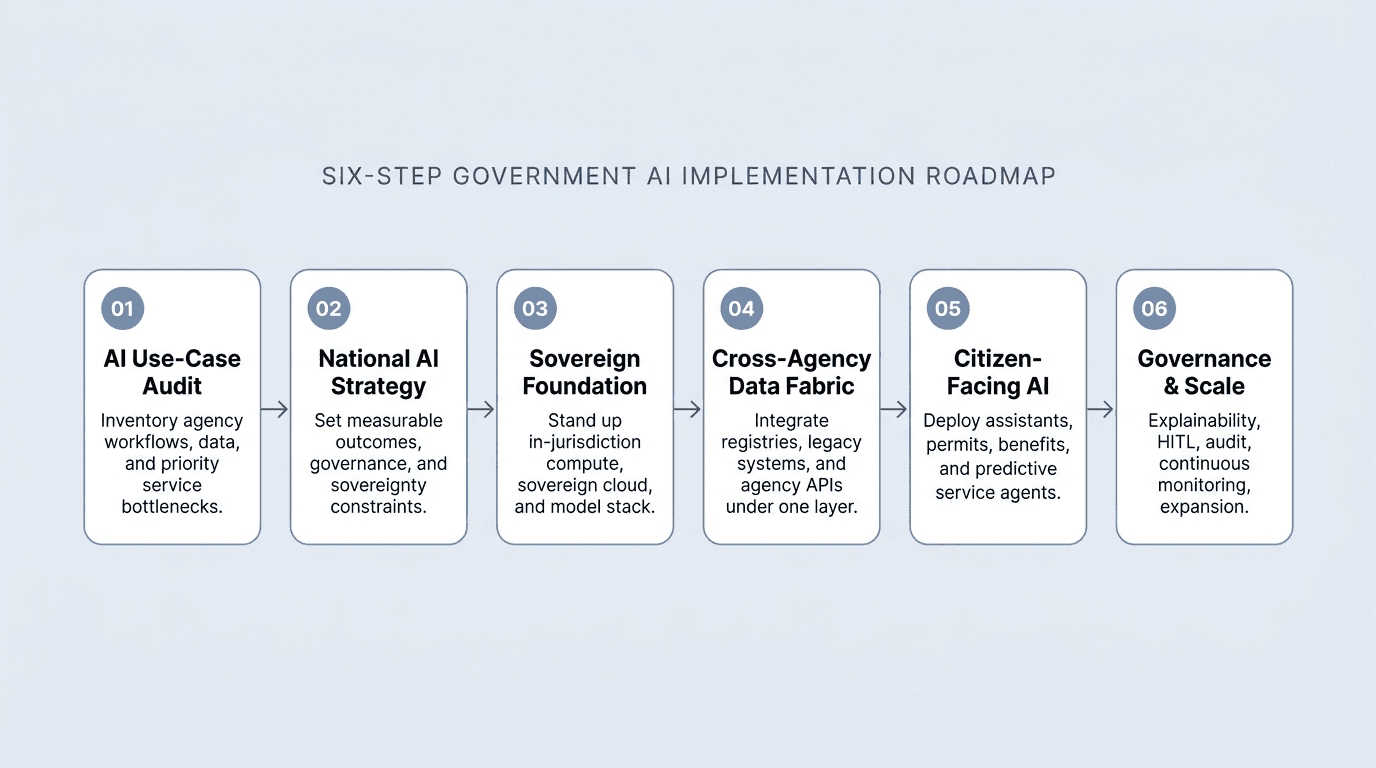
1. AI use-case audit. Inventory every current and planned AI system across ministries, classify by citizen impact, risk, and maturity, and identify the priority service bottlenecks. Under the EU AI Act, this audit is no longer optional — Member States were required to designate national competent authorities by 2 August 2025 and must maintain an ongoing inventory of high-risk deployments.
2. National AI strategy. Convert the audit into a strategy with measurable outcomes, governance, and explicit sovereignty constraints. The UK AI Opportunities Action Plan, Abu Dhabi’s Government Digital Strategy 2025–2027, and the UAE National AI Strategy 2031 are reference examples. At this stage, the question to answer is not “which models?” but “what decisions do we want AI to make, under what supervision?”.
3. Sovereign foundation. Stand up in-jurisdiction compute, sovereign cloud capacity, and the model stack that will serve national workloads. The Abu Dhabi Government Digital Strategy, for instance, targets 100% sovereign cloud adoption across government services by 2027 (DGE, September 2025). This step is capex-heavy and typically takes 18–36 months.
4. Cross-agency data fabric. Unify ministry-level data through a governed data platform — not a data lake, but a real-time integration layer with per-entity access controls, lineage tracking, and regional compliance boundaries. Net0’s Layer 1 approach, documented in its AI architecture overview, shows what this looks like at production scale for government customers.
5. Citizen-facing AI. Deploy the front-office applications — conversational assistants, permit-issuance automation, benefits eligibility, predictive service delivery — on top of the sovereign foundation and the data fabric. Skipping steps 3 and 4 is how most headline programmes stall at the pilot stage.
6. Governance and scale. Explainability, human-in-the-loop review, audit logging, continuous model monitoring, and cross-ministry scaling. Gartner projects that by 2029, 70% of government agencies will require explainable AI and HITL for all automated decisions that impact citizen service delivery (Gartner, 2026). Governments that defer this step pay for it later in rework and public-trust costs.
Obstacles and How Governments Navigate Them
The obstacles are well-documented and solvable. Four recur across every mature programme.
Legacy data. Most ministry data is partial, inconsistent, and locked in systems that predate the cloud. Solutions: treat data integration as a first-class AI investment, stand up a cross-agency data fabric before buying more models, and use AI-powered document extraction to accelerate the migration of unstructured archives. Net0’s automated data collection approach is explicitly engineered for this.
Procurement and funding. Conventional procurement cycles cannot move at AI speed. Governments from the UK to the UAE are adapting with AI-specific procurement frameworks, pre-cleared sovereign cloud vendors, and model-contractual-clauses templates. The European Community of Practice released its Model Contractual Clauses for AI (MCC-AI) in early 2025 to simplify public-sector AI procurement under the AI Act.
Talent. Government AI requires AI engineers, data engineers, policy specialists, and ethicists in one place. The US federal AI workforce has grown substantially since the 2023 AI Executive Order, but demand still outstrips supply. Solutions include central AI talent pools shared across agencies (e.g., the UK’s Incubator for Artificial Intelligence and Singapore’s AI apprenticeship-style programmes) and partnerships with domestic AI companies that deliver end-to-end rather than ship software.
Public trust. A 2025 Gartner survey found that 50% of government respondents cited improved citizen experience as one of their top three priorities, but public trust in AI-driven decisions remains fragile. The response is transparent governance — publishing use-case inventories, requiring explainability by default, and keeping human review in the loop for consequential decisions. This is where the agentic government glossary becomes practically useful: naming the concepts is the first step to governing them.
Measuring Impact — KPIs for Government AI Programs
Transformation only counts when it is measured. Mature programmes track a small set of operational KPIs across the four pillars. The following table shows typical baselines, mature-program targets, and the primary sources behind each benchmark.
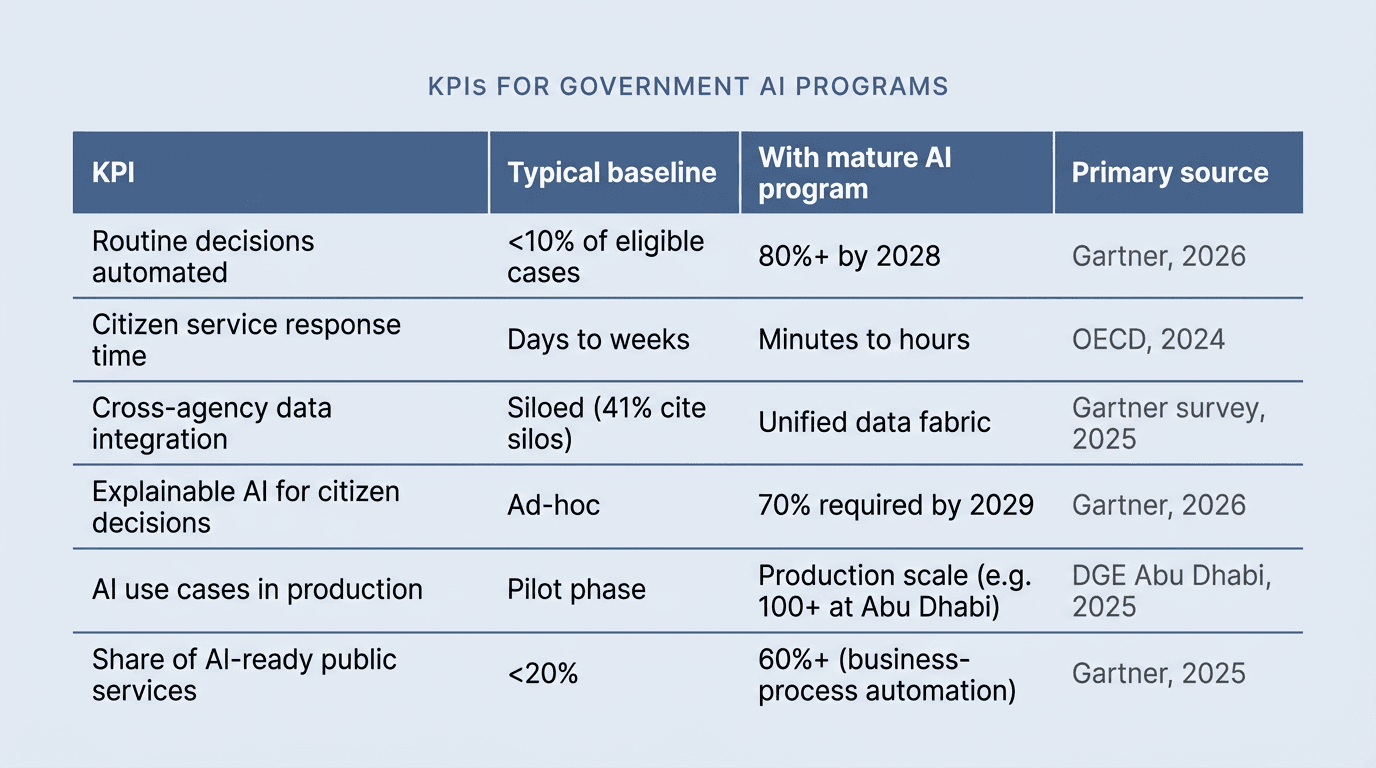
Two cautions apply. These are typical ranges, not targets. And the number that matters most is not AI use cases deployed — it is citizen outcomes measurably improved. Gartner’s 2025 government survey found that 39% of respondents cited improved service and citizen satisfaction as the primary expected benefit of AI, ahead of cost savings (Gartner, April 2026). That ordering is correct.
Regional Leaders and What They Signal
Four reference programmes define the leading edge in 2026.
United Arab Emirates. The UAE was the first country to adopt a national AI strategy (2017) and the first to appoint a dedicated AI minister. The UAE National AI Strategy 2031 targets AI contributing up to 45% of national GDP by 2031 and 100% paper-free government services across all emirates. Abu Dhabi’s Government Digital Strategy 2025–2027 is the most operationally advanced deployment globally — AED 13 billion in investment, 100+ AI use cases in production across more than 40 government entities, TAMM 4.0 as the integrated AI-native service platform, and 100% sovereign cloud adoption as a stated target (DGE, September 2025). For the GCC, the UAE is the reference architecture.
United Kingdom. The UK AI Opportunities Action Plan (January 2025), written by Matt Clifford for the Secretary of State for Science, Innovation and Technology, is the most comprehensive national AI strategy published in a democracy in recent years. Its three sections — infrastructure, adoption, and homegrown AI — translate directly into a delivery programme for cross-government AI transformation.
Singapore. Singapore’s National AI Strategy 2.0 continues the country’s early-mover advantage. The G7 Toolkit for AI in the Public Sector, published by the OECD and UNESCO in 2024, repeatedly cites Singapore as a reference case for whole-of-government AI adoption — from its national AI skills platform to its integrated digital service architecture.
European Union. The EU AI Act makes Europe the first jurisdiction to impose binding AI rules on public administration at scale. France’s Albert sovereign generative AI assistant, Italy’s AI-factory-anchored language model for government workers, and Estonia’s long-running digital-state programme together demonstrate that European governments are investing in AI through a compliance-first lens rather than a speed-first one.
The common thread is strategic: every leading programme treats AI as infrastructure, not as a feature.
How Net0 Supports Government AI Transformation
Net0’s government work applies the same AI-first architecture that powers its Fortune 500 sustainability customers. Three properties are relevant to ministries evaluating the 2026 playbook.
First, sovereign deployment by default. Net0 owns its model weights and inference stack, which is what makes on-premise, sovereign-cloud, and hybrid deployment possible — the precondition for most government workloads in regulated jurisdictions. See the analysis of why Net0 builds its own AI models for the underlying reasoning.
Second, end-to-end delivery. Net0 does not ship a generic SaaS product. Every deployment is designed, integrated, configured, and operated by Net0 for the customer’s specific data estate, regulatory jurisdiction, and operating model — including custom components built where no existing match exists in Net0’s library of 60+ modular AI applications.
Third, cross-vertical reuse. The same three-layer AI-first architecture that underpins Net0’s AI-first sustainability platform powers its government AI programmes — a cross-agency data fabric for Layer 1, domain-specific models for Layer 2, and citizen-service and compliance applications for Layer 3. A ministry that starts with one workload can extend the same architecture into adjacent ones without re-procuring infrastructure.
Net0 serves more than 400 entities across four continents. For a deeper view of cross-pillar applications, see the analysis of how sustainability data becomes operational intelligence — the same intelligence-layer pattern applies to government workflows. For broader questions, refer to the Net0 FAQ.
Book a demo to scope a sovereign government AI deployment against your ministry’s operating environment, data estate, and regulatory jurisdiction.
FAQ
What is government AI transformation?
Government AI transformation is the institution-wide redesign of public administration around AI infrastructure — sovereign compute and data, AI-powered citizen services, cross-agency data integration, and AI-driven policy modelling — rather than individual AI tools added to legacy systems. It is a shift from digitising forms to automating decisions under human oversight.
How much are governments spending on AI in 2026?
Worldwide AI spending will reach $2.52 trillion in 2026, a 44% increase year-on-year, with AI infrastructure alone adding $401 billion of incremental spend (Gartner, January 2026). Government is the fastest-growing spending vertical, with a projected 19% compound annual growth rate in public-sector AI investment between 2022 and 2027 — the highest of any industry.
What is sovereign AI, and why does every government need it?
Sovereign AI is the national ownership and control of AI infrastructure — compute, model weights, and data — under in-jurisdiction governance. Governments need it because citizen data, national security workloads, and critical-infrastructure decisions cannot run safely on foreign consumer APIs. Sovereignty is now regulated in the EU under the AI Act and in the GCC under the UAE and Saudi PDPLs.
What is the biggest barrier to government AI transformation?
Fragmentation. In a Gartner survey of 138 government respondents (July–September 2025), 41% cited siloed strategies and 31% cited legacy systems as the top barriers to AI value (Gartner, April 2026). The binding constraint is rarely model quality — it is cross-agency data integration, procurement cycles, and the absence of a unified governance framework.
Which countries are leading on government AI transformation?
The UAE (first national AI strategy, dedicated AI minister, Abu Dhabi’s 100+ production AI use cases), the UK (the AI Opportunities Action Plan, published January 2025), Singapore (National AI Strategy 2.0), and the European Union (the AI Act framework, France’s Albert, Italy’s AI factory) are the four reference programmes in 2026. Each treats AI as infrastructure rather than as a feature.
When does the EU AI Act apply to government systems?
The EU AI Act entered into force on 1 August 2024. Prohibitions on unacceptable-risk systems have applied since 2 February 2025; general-purpose AI model rules since 2 August 2025; and high-risk system obligations — which cover most public-sector AI under Annex III — apply from 2 August 2026. Penalties reach €35 million or 7% of global turnover for prohibited practices.
How does Net0 support national-scale government AI programmes?
Net0 delivers sovereign, hybrid, or on-premise AI infrastructure end-to-end — from the cross-agency data platform, through proprietary domain models, to 60+ modular AI applications configured or custom-built for the customer’s ministries. Each engagement is scoped, built, integrated, and operated by Net0 for the specific government customer, rather than shipped as generic software. See Net0’s government AI platform for the current capability set.