
AI x Sustainability · Measure
Enterprise carbon accounting, on AI infrastructure.
Net0 Measure is the AI-first carbon accounting layer of the Net0 Sustainability Platform. It captures emissions data from 10,000+ enterprise systems, computes Scope 1, 2, 3 and 4 against 50,000+ emission factors, and produces an audit-grade ledger that powers disclosure across 30+ frameworks.
Product screenshot
Real-time emissions dashboard
Replace with the product hero shot showing the live emissions ledger view.
Trusted at institutional scale
400+
Entities served
4
Continents
50,000+
Emission factors
30+
Reporting frameworks
10,000+
Integrations
1/2/3/4
Scopes covered
Working with Fortune 500 companies, ministries, regulators, and sovereign institutions across the GCC, Europe, and beyond.
The problem
Carbon accounting at enterprise scale is a data infrastructure problem.
A multi-national enterprise generates emissions across thousands of facilities, hundreds of vendors, and dozens of accounting systems. The data lives in invoices, ERP records, energy meters, expense reports, and the operational logs of every business it touches. Most of it is unstructured. Most of it is annual. Almost none of it is audit-ready by the time a regulator, investor, or board member asks for it.
Net0 Measure was built to dissolve that constraint. It converts carbon accounting from an annual reconstruction exercise into a continuous, AI-driven data infrastructure layer — one that captures emissions at the moment they are generated, computes them against the latest methodologies, and keeps every number traceable to its source.
How Net0 measures
Capture. Compute. Control.
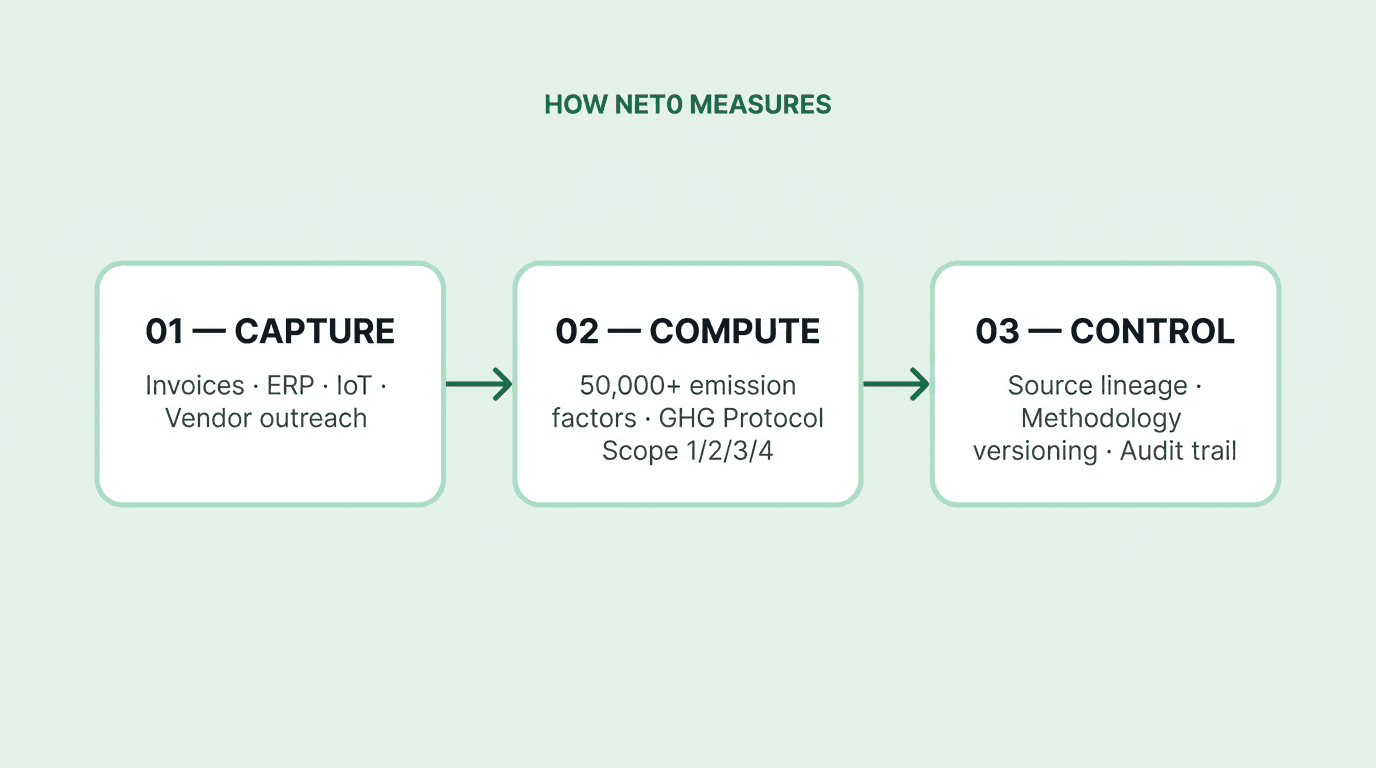
Net0 Measure separates the carbon accounting workflow into three layers, each engineered against the standards expected of audit-grade enterprise data systems.
01 · Capture
AI-extracted data from every system that touches an emission.
Net0 connects to ERP, accounting, energy, travel, logistics, HR, and procurement systems, and parses unstructured invoices, utility bills, and supplier disclosures using purpose-built sustainability AI models.
AI extraction from invoices, bills, and PDFs
Direct connectors to ERP, energy, and travel systems
Automated supplier outreach for Scope 3 gaps
02 · Compute
Net0 converts business activity into CO₂e using the GHG Protocol method library, location- and market-based electricity calculations, and a continuously updated global emission factor database.
Scope 1, 2, 3 — plus Scope 4 avoided emissions
Location-based and market-based electricity
Multi-framework calculation in a single pass
03 · Control
Audit-grade lineage on every number, by default.
Every figure produced by Net0 is traceable to its source data, methodology version, and approval chain. Built for regulators, auditors, and the assurance partners who sign off on the disclosure.
Source-to-output data lineage on every metric
Methodology versioning and snapshot history
Role-based approval and review workflow
Scope coverage
Scopes 1, 2, 3 — and Scope 4.
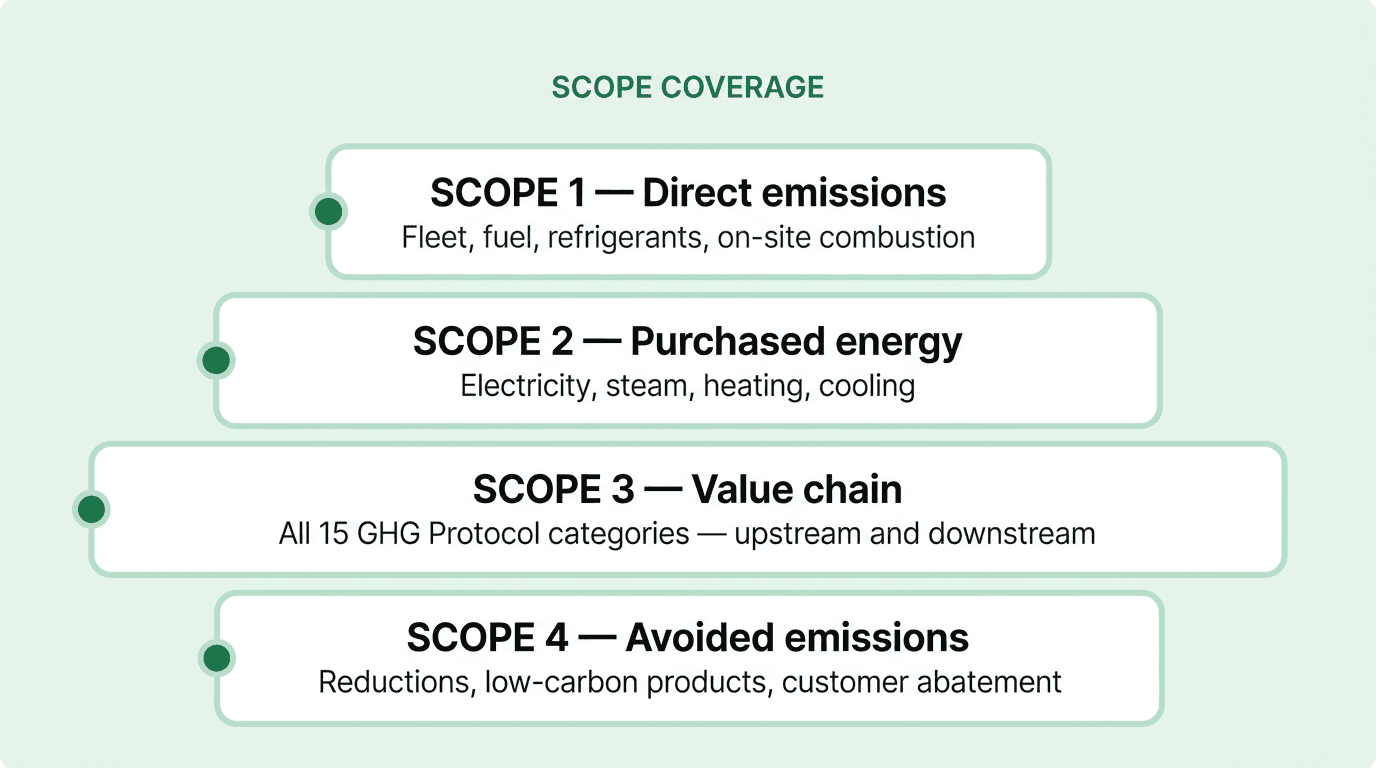
Net0 calculates emissions across the full GHG Protocol Scope set, plus Scope 4 (avoided emissions) for reductions tracking and Scope 3 supply-chain estimation where primary data is incomplete.
Scope 1
Direct emissions
Owned facilities, fleet vehicles, on-site fuel combustion, refrigerants, and process emissions.
Sources: meters, fuel logs, fleet telematics
Scope 2
Purchased energy
Electricity, steam, heating, and cooling purchased and consumed by the enterprise. Both location- and market-based.
Sources: utility bills, RECs, PPAs
Scope 3
Value chain
All 15 GHG Protocol categories — purchased goods, capital goods, business travel, employee commuting, use of sold products, and the rest of the supply chain.
Sources: spend data, supplier disclosures, expense reports
Scope 4
Avoided emissions
Emissions prevented by reduction initiatives, low-carbon products, and customer-side abatement enabled by the enterprise.
Sources: project data, baseline modelling
Built for complex international structures
One platform for the most complex organisations on the planet.
Net0's carbon accounting engine is engineered for multi-entity, multi-jurisdiction enterprises. Subsidiaries operate independent ledgers; parent organisations get consolidated, eliminations-aware visibility. Frameworks, locales, and currencies run in parallel.
Multi-entity portfolio rollup with intercompany eliminations
Multi-currency, multi-locale, and time-zone aware
Simultaneous calculation across 30+ disclosure frameworks
Granular role-based access for global teams and assurance partners
Product screenshot
Portfolio mode dashboard
Replace with a screenshot of the multi-entity rollup view.
Integrations
Connected to 10,000+ enterprise systems.
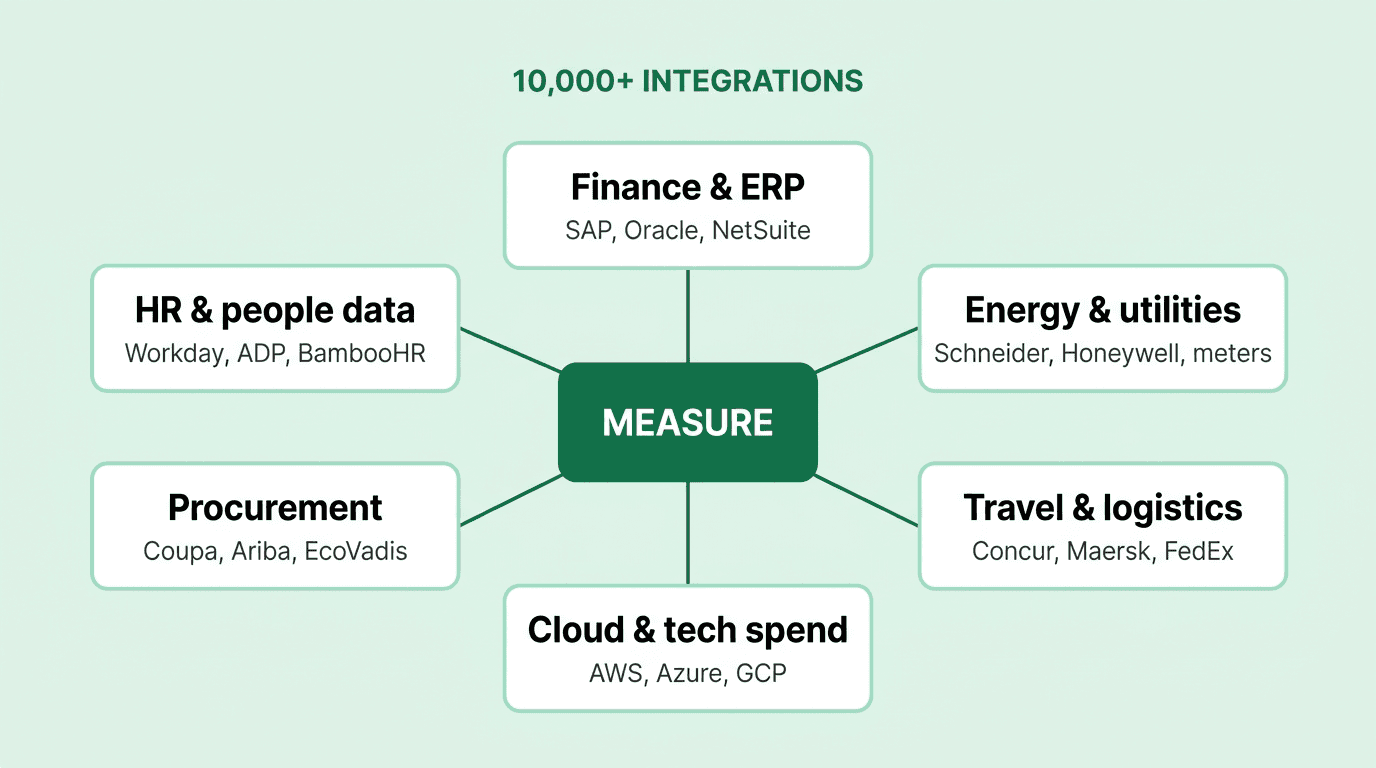
Net0 ingests carbon-relevant data from every system the enterprise already runs — without the team rebuilding integrations or restructuring data models. Examples by category.
Finance & ERP
SAP, Oracle, NetSuite, Workday Financials, QuickBooks, Sage, Microsoft Dynamics 365.
Energy & utilities
Schneider Electric, Honeywell, Siemens, Bidgely, regional utility APIs, sub-meter telemetry.
Travel & logistics
SAP Concur, Egencia, Amex GBT, FedEx, Maersk, DHL, freight EDI, fleet telematics.
Cloud & tech spend
AWS, Microsoft Azure, Google Cloud, Snowflake, Databricks, on-premise data centre telemetry.
Procurement & supply chain
Coupa, SAP Ariba, Jaggaer, Ivalua, supplier portals, EcoVadis, CDP supply chain modules.
HR & people data
Workday HR, BambooHR, ADP, SuccessFactors, Hibob — for commuting and remote-work emissions.
Frameworks
One ledger. 30+ disclosure frameworks.
Net0 produces the calculations and metadata required by the regulatory frameworks the enterprise is held to — in parallel, from the same audit-grade ledger.
GHG Protocol
CSRD / ESRS
CDP
GRI
ISSB / IFRS S2
SBTi
TCFD
ISO 14064
SECR
TNFD
EU Taxonomy
+ 18 more
Customer outcomes
Measurable impact at enterprise scale.
“Net0's platform identified $2.3M in energy efficiency opportunities within our first quarter. The AI-driven insights helped reduce emissions by 32% while improving operational efficiency.”
32% emissions reduction
$2.3M savings identified
100% compliance maintained
Global Sustainability Director
Fortune 500 manufacturing company
“Carbon reporting time decreased by 75%, but more importantly, the accuracy and depth of insights transformed our sustainability strategy from a compliance exercise to a competitive advantage.”
75% reporting time saved
Real-time monitoring
Strategic resource reallocation
Compliance Director
NASDAQ-listed technology firm
“Net0's automation turned our complex global supply-chain emissions data into actionable insight. We achieved full Scope 3 visibility with 85% less manual work.”
Complete Scope 3 visibility
85% less manual effort
Full regulatory compliance
Chief Operating Officer
Global logistics enterprise
Where Measure sits in the platform
One AI-first sustainability platform.
Measure is the carbon accounting layer. It pairs with three sibling products on the same data fabric — one for the connectors that feed it, one for the disclosures it produces, and one for the abatement decisions it informs.
Net0 Automate
Connect 10,000+ enterprise systems.
The connector and AI extraction layer that feeds Measure. Out-of-the-box integrations, AI-powered invoice parsing, and a developer API.
Explore Automate →
Net0 Report
Disclosures across 30+ frameworks.
Real-time dashboards, on-demand reports, and Portfolio mode for multi-entity organisations — all built on the audit-grade ledger Measure produces.
Explore Report →
Net0 Reduce
Profitable decarbonisation pathways.
MAC curves, scenario simulation, and an actions marketplace that turn measurement into reduction strategy with both CO₂ and OPEX impact.
Explore Reduce →
FAQ
Procurement-grade questions, answered.
Which methodologies and emission-factor databases does Net0 use?
Net0 calculates emissions following the GHG Protocol Corporate Standard, the Scope 2 Quality Criteria (location- and market-based), and the GHG Protocol Scope 3 Standard. Calculations draw on a continuously updated library of 50,000+ emission factors covering DEFRA, EPA, IEA, AR6 GWP values, supplier-specific factors, and regional grid intensities. Methodology versions are pinned per disclosure period and traceable to every output number.
How is auditability proven for assurance partners?
Every metric in Net0 carries source-data lineage from invoice or system extraction through to disclosure output, including methodology version, emission factor reference, and approval chain. The platform produces a complete audit pack for limited or reasonable assurance engagements (ISAE 3000 / ISAE 3410). Net0 holds SOC 2 and ISO 27001 certifications.
Can data stay in-region? What deployment options are available?
Net0 supports cloud, hybrid, and sovereign on-premise deployment. Data residency can be pinned to a specific region or jurisdiction — EU, GCC, UK, or a customer-controlled environment. Sovereign deployments are first-class, not an enterprise upcharge, and are designed for regulated industries and government partners.
How long until the first audit-ready dataset is produced?
For a standard enterprise rollout, Net0 typically delivers a first complete Scope 1 and 2 dataset within 4-8 weeks of system access, with Scope 3 baselining following over the subsequent quarter as supplier engagement progresses. Implementation timeline is driven by data availability and integration complexity rather than software configuration.
How are Scope 3 supplier data gaps handled?
Net0 combines primary supplier data, where available, with spend-based and activity-based estimation for the long tail. Automated supplier outreach campaigns request primary disclosures from material vendors and ingest CDP supply-chain responses, EcoVadis data, and EPD documents. Estimation methods are flagged so primary versus modelled emissions are distinguishable in disclosure.
How does Measure integrate with existing CSRD / ISSB reporting workflows?
Measure outputs feed directly into Net0 Report, which produces XBRL-tagged ESRS E1 disclosures, IFRS S2 climate disclosures, CDP responses, GRI 305, and 25+ additional frameworks from the same calculated dataset. Output formats include native framework templates, raw CSV, and API access for downstream sustainability data warehouses.