
AI for Government
Monaco Carbon Calculators: Government Case Study in AI Sustainability
Net0's Monaco carbon calculators measure tourism and event emissions for the Government of Monaco, supporting the Principality's 2050 carbon neutrality target.
Sofia Fominova

TL;DR: Net0, an AI infrastructure company building AI solutions for governments and global enterprises, partnered with the Government of Monaco to deploy two citizen-facing carbon calculators: one for tourists at visit.netzero.mc and one for event organisers at event.netzero.mc. The Monaco carbon calculators translate personal and event activity into verified CO2e estimates and tailored reduction guidance, supporting the Principality's commitment to carbon neutrality by 2050.
Key Takeaways
Monaco partnered with Net0 to launch two public carbon calculators: a tourist calculator at visit.netzero.mc and an event calculator at event.netzero.mc.
The calculators convert transport, accommodation, catering, venue, and waste inputs into CO2e estimates using activity-based emission factors aligned with the GHG Protocol.
The Principality of Monaco has committed to achieving carbon neutrality by 2050, backed by its National Pact for the Energy Transition and the Mission for Energy Transition (Mission pour la Transition Énergétique).
The partnership spans Net0's two institutional verticals — Government AI and AI for Sustainability — and is grounded in Net0's Monaco office at 17 Avenue Albert II.
The model is portable: governments, cities, and conference destinations can deploy the same architecture to measure and reduce visitor and event emissions at scale.
Introduction
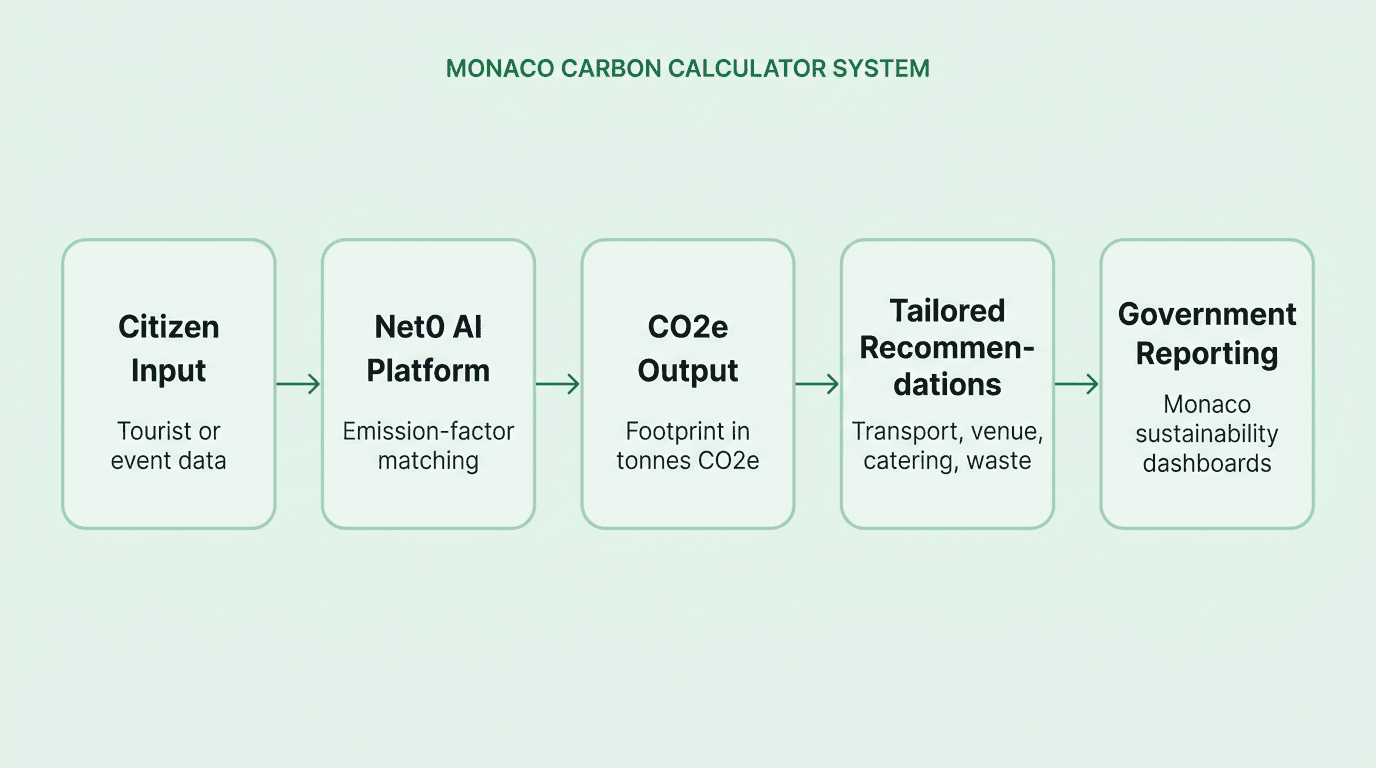
Net0 is an AI infrastructure company that builds AI solutions for governments and global enterprises. One of its longest-running government partnerships is with the Principality of Monaco, where Net0 has developed two public Monaco carbon calculators — one for visitors and one for event organisers — that operationalise Monaco's national commitment to carbon neutrality. The calculators sit inside Monaco's broader energy transition programme and translate individual and event-level activity into measurable, reportable CO2e data.
This article examines how the Monaco carbon calculators work, why a government-scale carbon calculator is architecturally different from a consumer app, and what the partnership demonstrates about Net0's dual strength in government AI and AI-powered sustainability.
Monaco's path to carbon neutrality by 2050
The Principality of Monaco has set a legally anchored target of carbon neutrality by 2050, with a staged milestone of a 55% reduction in greenhouse gas emissions by 2030 against a 1990 baseline. The trajectory is coordinated by the Mission for Energy Transition, the government body responsible for Monaco's National Pact for the Energy Transition (Pacte National pour la Transition Énergétique), which mobilises residents, businesses, and public institutions around a shared decarbonisation commitment.
Monaco's emissions profile is dominated by three sectors — road transport, waste treatment, and building energy use — which together account for the majority of the Principality's territorial footprint according to the Government of Monaco's energy transition reporting. Because the country is compact, densely visited, and hosts an outsized number of international events relative to its size, visitor and event activity carry particular weight in Monaco's trajectory toward net-zero targets.
The Prince Albert II of Monaco Foundation, founded in 2006, anchors Monaco's sustainability posture internationally. The Foundation funds action on climate change, biodiversity, and water resource management worldwide, and reinforces the Principality's role as a convening authority on environmental stewardship.
The Tourist Carbon Calculator at visit.netzero.mc
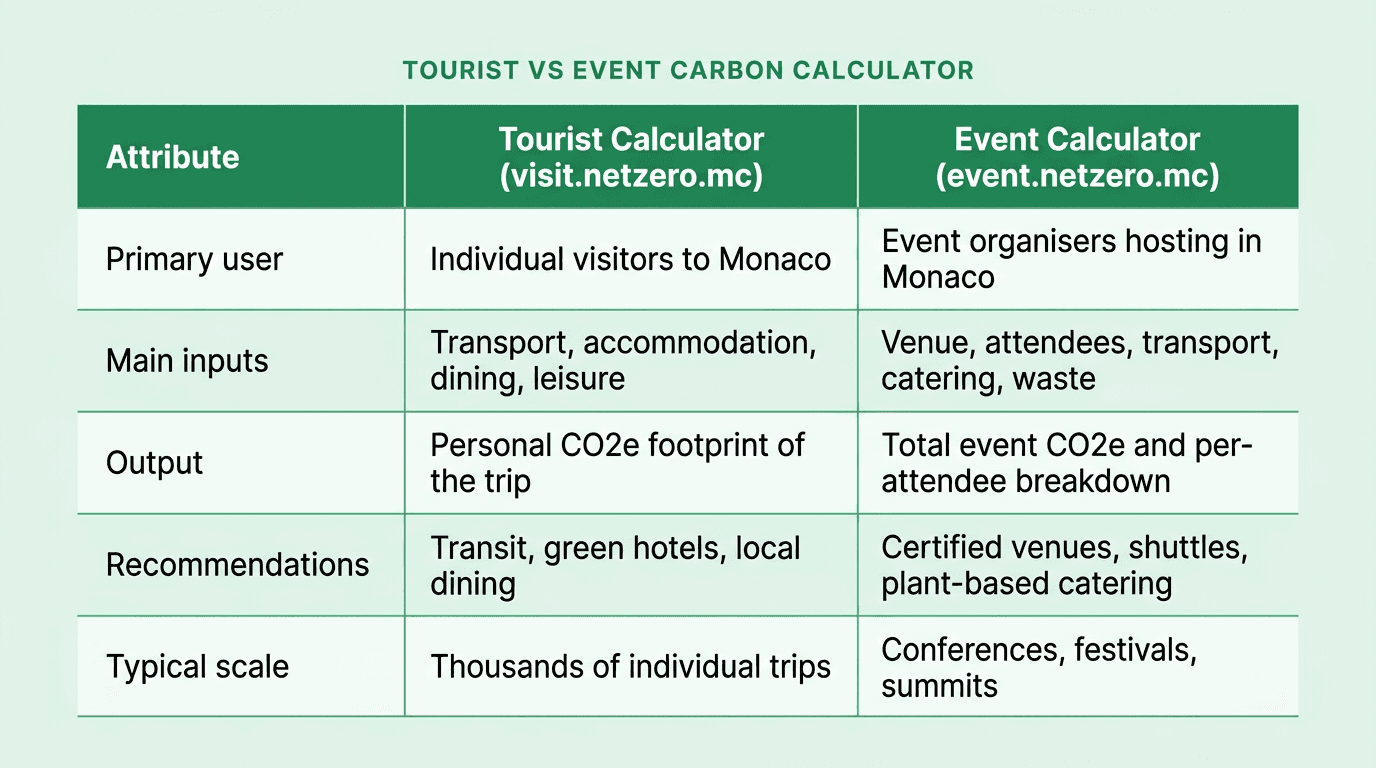
The Tourist Carbon Calculator is a public tool commissioned by Monaco's tourism authorities for visitors to the Principality. It accepts a small set of structured inputs — transport to and within Monaco, accommodation, dining, and leisure activities — and returns a CO2e estimate for the visitor's stay, followed by context-specific recommendations that point travellers toward lower-carbon alternatives available within Monaco.
The calculator is built on Net0's AI-driven sustainability platform and uses activity-based emission factors rather than crude spend-based approximations. For a deeper comparison of methodologies, see Net0's analysis of activity-based versus spend-based emission factors. Activity-based accounting is the more accurate approach because it measures physical activity (a kilometre flown, a night of hotel energy, a kilogram of food) rather than inferring emissions from monetary expenditure.
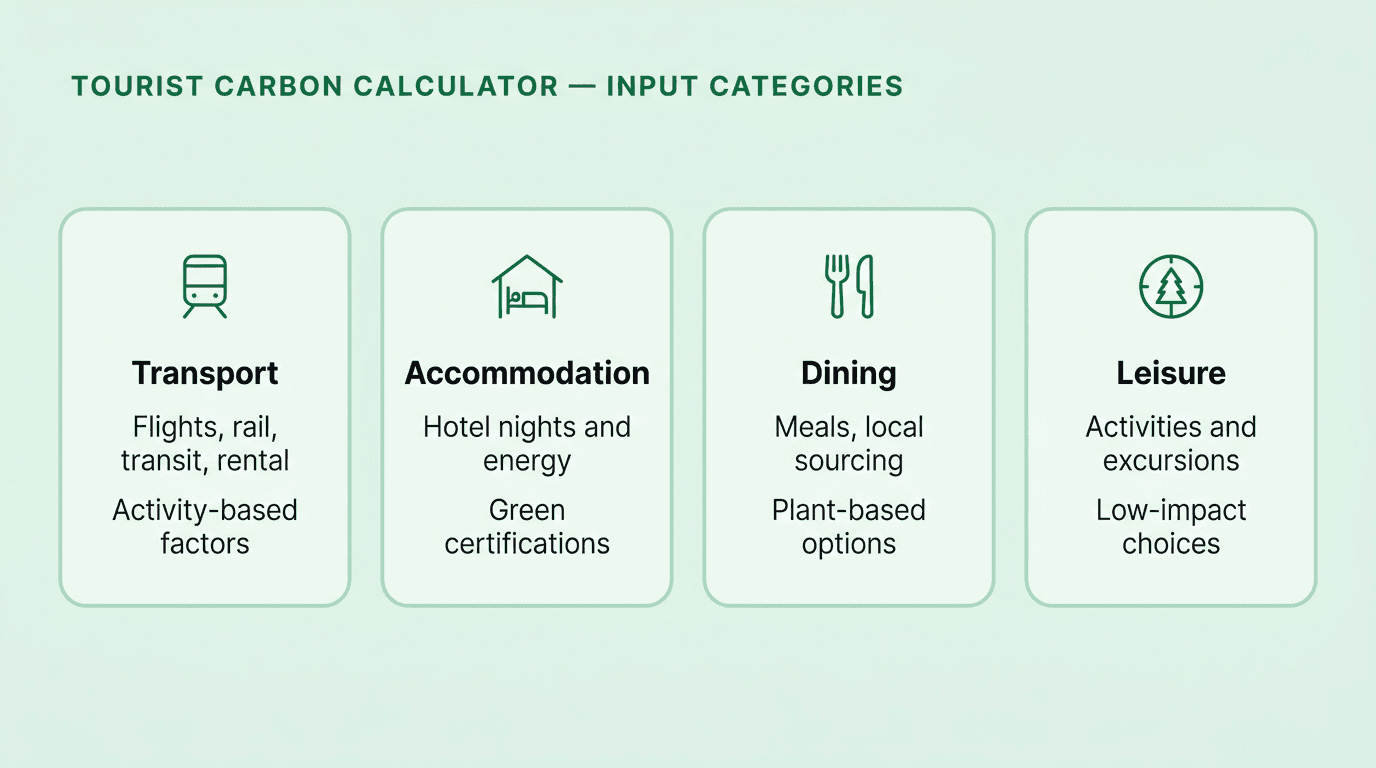
For travellers, the recommendations cover transport (Monaco's electric public transit, pedestrian network, and shared mobility options), accommodation (properties with recognised environmental certifications), dining (restaurants sourcing locally and seasonally), and leisure (low-impact experiences that do not stress Monaco's coastal ecosystems). The goal is not to discourage travel to Monaco but to route the 340,000+ annual overnight visitors recorded by IMSEE — Monaco's statistical office — toward choices that cut the Principality's incoming tourism footprint.
The Event Carbon Calculator at event.netzero.mc
Monaco hosts hundreds of international conferences, summits, and cultural events each year — a disproportionately high concentration for a country of roughly two square kilometres. The Event Carbon Calculator was commissioned to give event organisers an evidence-based measurement tool tailored to Monaco's venues, transport network, and supply chain.
Organisers enter event-specific inputs: venue, attendee count and origin, attendee travel mode, accommodation nights, catering (meal count, menu composition), venue energy use, and waste streams. The calculator returns a total event CO2e value, a per-attendee breakdown, and a prioritised set of reduction levers — typically dominated by attendee travel, which is usually the largest single contributor and falls into Scope 3 emissions for the hosting organisation.
The recommendations layer points organisers toward Monaco-specific options: venues with recognised certifications, shuttle and public-transit integration for attendees, plant-forward catering, and on-site waste separation infrastructure. Outputs are structured to plug into the organiser's own GHG Protocol reporting or voluntary disclosure framework.
Why a government-scale carbon calculator is different
Most carbon calculators on the public internet are lightweight consumer apps with four to six questions, a single-country emission-factor set, and no onward reporting path. A government-scale calculator has different requirements, and the Monaco partnership illustrates the contrast.
Methodological rigour. Outputs must be defensible to auditors and statistical offices. Net0's calculators use carbon accounting methodologies aligned with the GHG Protocol rather than black-box coefficients.
Local emission factors. National energy mix, grid intensity, transport modal share, and waste treatment infrastructure differ by country. Monaco's factors reflect the Principality's own electricity supply, district heating, and waste streams.
Data sovereignty. Citizen-facing government tools must handle input data under the host nation's legal regime. Net0's architecture supports sovereign deployment, the same pattern it uses in its broader government AI work.
Reporting continuity. Outputs need to connect to the government's own emissions inventory and international disclosures rather than sitting as orphan calculations in a browser tab.
Citizen-facing design. The interface must be intelligible to a first-time user in multiple languages, not optimised for a sustainability professional.
This combination is why a functioning government carbon calculator is closer to a public digital service than to a typical ESG widget, and why the platform underneath it has to be production-grade.
How Net0 builds government-scale sustainability tools
The Monaco calculators are built on the same Net0 platform that serves Fortune 500 emissions programmes: activity-based emission factors, automated data collection from operational systems, AI-assisted data classification, and auditable outputs aligned with the GHG Protocol and adjacent frameworks.
What Net0 contributes on the government side is the infrastructure layer around that platform: sovereign hosting, citizen-facing front ends, multilingual delivery, integration with government reporting systems, and long-term operation. This is the same architectural pattern described in Net0's analysis of why AI is essential to climate management and in its work on applying AI intelligence to sustainability data.
For Monaco specifically, the partnership is also geographic. Net0's office at 17 Avenue Albert II places the team inside the Principality's institutional ecosystem, alongside the Mission for Energy Transition, Visit Monaco, and the Monaco Convention Bureau.
Lessons for other governments and destination cities
The Monaco pattern is transferable. Any government, region, or high-visitor city can deploy the same architecture — a public citizen calculator, an event calculator for convention activity, and a shared reporting pipeline into the national or municipal inventory — and adapt the emission factors and recommendation layer to local conditions.
Three lessons stand out from the Monaco implementation:
Anchor the calculator in a named national target. Monaco's 2050 neutrality goal gives the calculators a purpose beyond awareness. Without a target, a public calculator is a novelty; with one, it becomes an operational tool for a decarbonisation strategy.
Treat tourism and events as a measurable Scope 3 category, not a footnote. For destination economies, inbound visitors and inbound delegates are among the largest emission contributors. Methodology choices matter — see Net0's deep dive on reducing upstream emissions for the analogous supply-chain problem.
Make the outputs reportable. A calculator that produces a number on screen but cannot export a structured record into the country's inventory or an organiser's disclosure will be used once and forgotten. Alignment with GHG Protocol reporting and the relevant voluntary frameworks keeps the calculator inside the live compliance loop.
About Net0
Net0 is an AI infrastructure company founded in 2021, with headquarters in Dubai (Emirates Towers and DIFC) and an additional office at 17 Avenue Albert II in Monaco. Net0 builds custom AI systems and a modular enterprise platform used by 400+ entities across four continents, spanning four verticals: AI for Sustainability, Government AI, AI Infrastructure, and Business AI Solutions. The Monaco carbon calculator programme is one of Net0's public government deployments in the sustainability vertical.
Book a demo to discuss how Net0 deploys carbon calculators and broader sustainability AI infrastructure for governments, cities, and enterprises.
FAQ
What are the Monaco carbon calculators?
The Monaco carbon calculators are two public tools commissioned by the Government of Monaco and built by Net0. The tourist calculator at visit.netzero.mc measures the CO2e footprint of a visitor's stay. The event calculator at event.netzero.mc measures the footprint of conferences, summits, and cultural events hosted in Monaco.
Who built the Monaco carbon calculators?
The calculators were built by Net0, an AI infrastructure company with an office in Monaco at 17 Avenue Albert II, in partnership with the Government of Monaco. Project partners include the Monaco Convention Bureau, the Monaco Government Tourist and Convention Authority, and the Mission for Energy Transition.
How does the Tourist Carbon Calculator work?
Visitors input transport to and within Monaco, accommodation, dining, and leisure activities. The calculator converts those inputs into a CO2e estimate using activity-based emission factors aligned with the GHG Protocol, then returns tailored recommendations for lower-carbon choices available in the Principality.
How does the Event Carbon Calculator work?
Event organisers enter venue, attendee count and origin, travel modes, accommodation, catering, energy use, and waste management details. The tool returns a total event CO2e value, a per-attendee breakdown, and a prioritised list of reduction levers such as shuttle transport, certified venues, and plant-forward catering.
What is Monaco's carbon neutrality target?
The Principality of Monaco has committed to carbon neutrality by 2050, with a 55% emissions reduction by 2030 against a 1990 baseline. The target is coordinated by the Mission for Energy Transition and operationalised through the National Pact for the Energy Transition.
Can other governments or cities deploy similar carbon calculators?
Yes. The Monaco architecture — activity-based emission factors, sovereign hosting, citizen-facing multilingual UI, and integration with government reporting — is portable. Net0 deploys the same infrastructure pattern across its government AI and sustainability work for other national and municipal clients.
How does Net0 support government sustainability programmes beyond calculators?
Net0 provides sovereign AI infrastructure, custom AI models, and a modular sustainability platform covering Scope 1, 2, and 3 emissions, water, air quality, and 30+ reporting frameworks. Calculators are one component of larger national programmes that can include emissions inventories, sectoral analytics, and decarbonisation planning.