AI x Sustainability · Data Hub
The sustainability data layer for the enterprise.
Net0 Data Hub is the AI-first ingestion layer of the Net0 Sustainability Platform. It unifies emissions, energy, water, waste, biodiversity, supply-chain, and workforce data from 10,000+ enterprise systems — feeding one audit-grade dataset into carbon accounting, ESG disclosure, and decarbonisation.
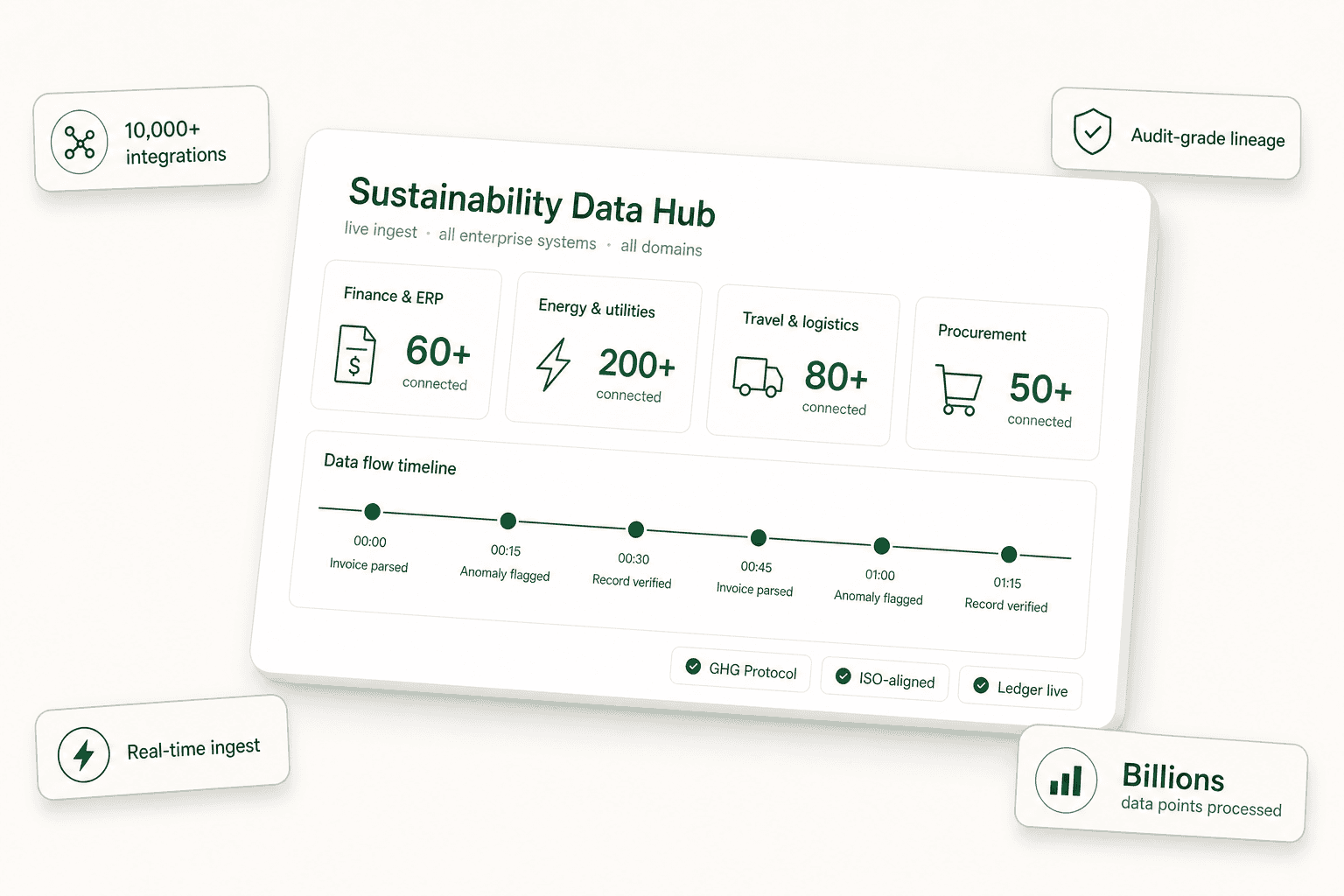
Trusted at institutional scale
10,000+
Enterprise integrations
7
Sustainability domains
Billions
Data points processed
99.9%
Ingest uptime
100%
Source-data lineage
The data backbone behind sustainability programmes at Fortune 500 companies, ministries, and sovereign institutions across the GCC, Europe, and beyond.
The problem
Sustainability is a data problem before it is a reporting problem.
A multi-national enterprise generates sustainability-relevant data across thousands of facilities, hundreds of vendors, and dozens of operational systems — emissions, energy, water, waste, biodiversity, supplier ESG, workforce. The data lives in invoices, ERP records, energy and water meters, expense reports, supplier disclosures, EHS systems, and the operational logs of every business it touches. Most of it is unstructured. Most of it is annual. Almost none of it is audit-ready by the time a regulator, investor, or board member asks for it.
Net0 Data Hub was built to dissolve that constraint. It automates the conversion of every enterprise system, document, and supplier interaction into one continuous, traceable sustainability dataset — making compliant reporting, audit-grade disclosure, and abatement decisions a query, not a quarterly project.
How data flows through Net0
From scattered systems to one source of truth.
From climate emissions and energy use to water, waste, biodiversity, and supplier ESG — every sustainability signal flows into the Data Hub, where AI parsing, anomaly detection, and governance turn raw inputs into one trusted, compliance-ready dataset.
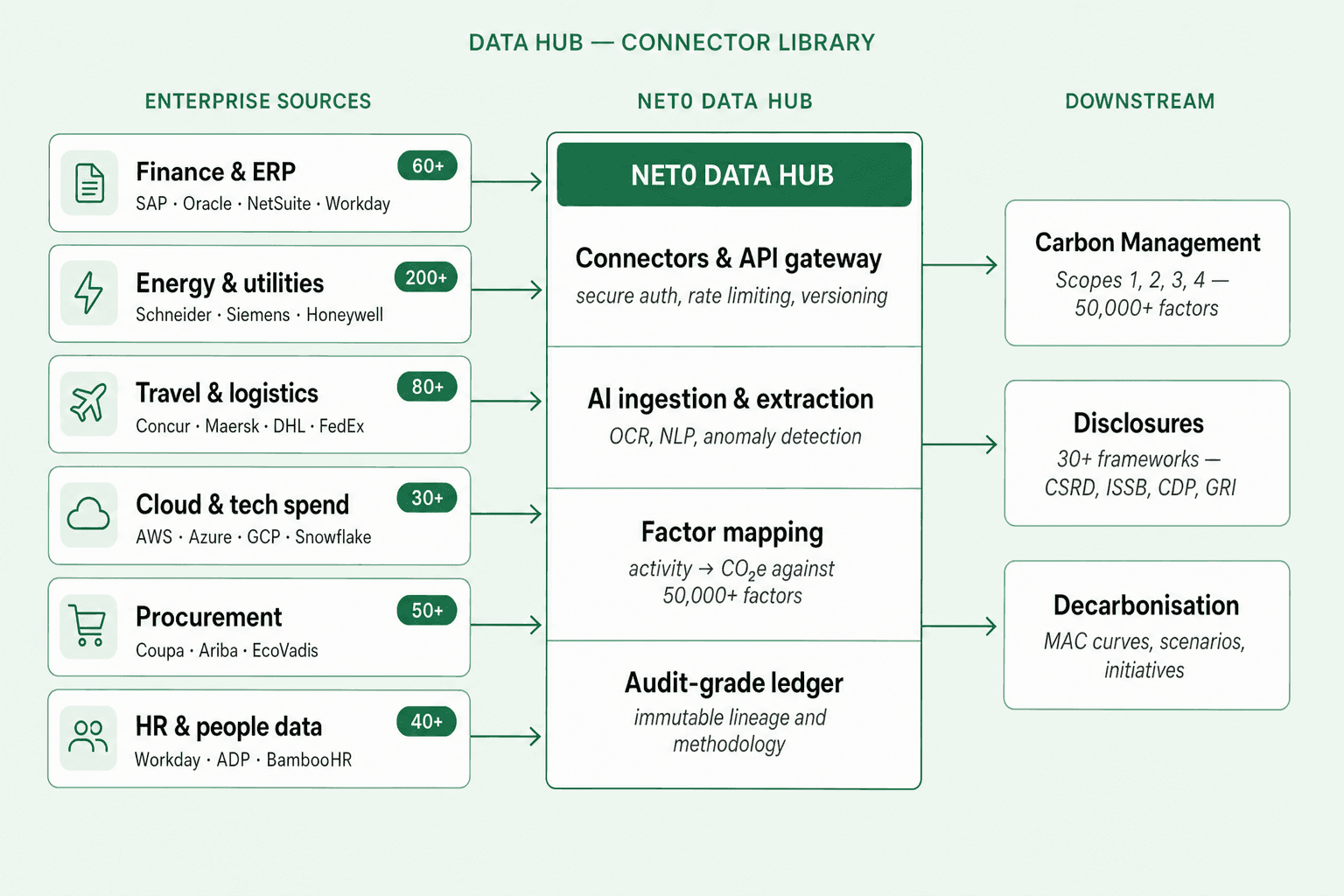
Sources
ERP & Finance
SAP, Oracle, NetSuite
Energy, water & utilities
Schneider, Siemens, Honeywell, water utilities
Travel & logistics
Concur, Maersk, DHL, fleet
Procurement & supplier ESG
Coupa, Ariba, EcoVadis, CDP
Documents & reports
Invoices, EPDs, waste manifests, audits
EHS & sustainability
Sphera, Enablon, Intelex, Cority
Net0 Data Hub
Ingest. Normalize. Govern.
One AI-driven layer that turns scattered enterprise data into a single audit-ready sustainability dataset.
01 · Connect
10,000+ pre-built connectors
02 · Capture
AI parsing of bills, invoices, PDFs
03 · Govern
Lineage, approvals, audit trail
Destinations
Net0 Measure
Carbon accounting
Net0 Report
30+ disclosure frameworks
Net0 Reduce
MAC curves & abatement
REST API
Customer software stack
How the Data Hub works
Connect. Capture. Govern.
The Data Hub separates the sustainability data workflow into three engineered layers — each built against the standards expected of audit-grade enterprise data systems.
Connect
Pre-built connectors to every enterprise system.
Out-of-the-box integrations across ERP, finance, energy, water, waste, travel, logistics, HR, procurement, and EHS & sustainability platforms. Connect once and Net0 automatically converts third-party signals into ESG-ready data — no custom data models, no engineering team.
10,000+ pre-built connectors across 30+ enterprise system categories
Connectors for ERP, energy, water, waste, EHS, travel, and HR systems
Custom integrations without involving developers
Capture
AI parsing for everything that isn’t in an API.
Sustainability AI models extract structured data from invoices, utility bills, water reports, waste manifests, supplier ESG disclosures, EPDs, audits, and unstructured PDFs. Anomaly detection flags outliers as they land — turning the long tail of paper-trail evidence into machine-readable, audit-ready data.
AI extraction from invoices, water reports, waste manifests, and PDFs
Automated supplier outreach for Scope 3 and supply-chain ESG gaps
Anomaly detection on every ingested record
Govern
One normalized, governed source of truth.
Ingested data is normalized, deduplicated, and traced to its source. Build your own ingestion and approval workflows on top — every record audit-ready by default, every change captured in lineage.
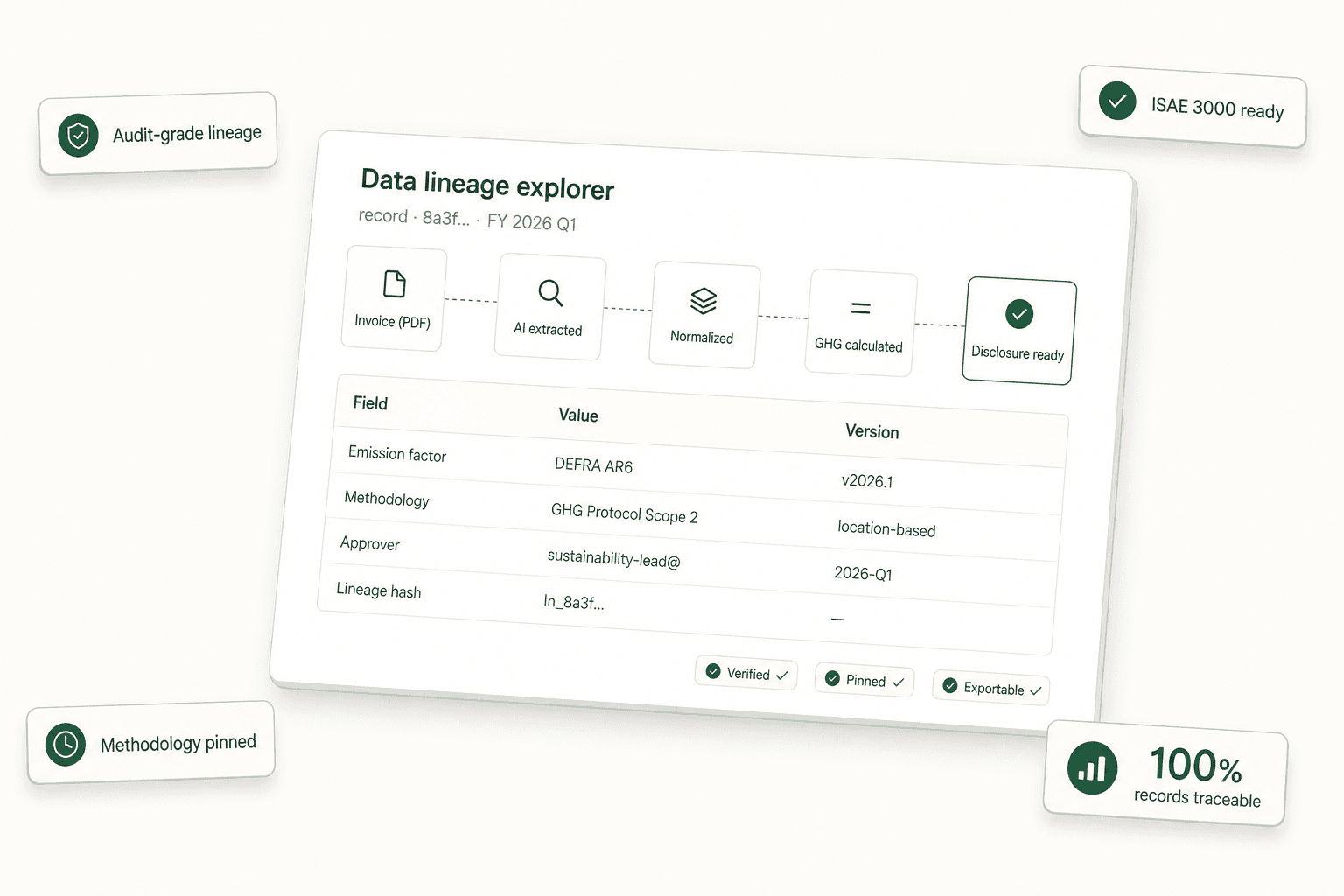
Source-to-output data lineage on every record
Custom approval workflows with role-based access
Versioned snapshots and methodology pinning per period
Domain coverage
Every category of sustainability evidence, in one place.
From climate emissions to water and nature, from waste and circularity to supply-chain and workforce ESG — the Data Hub ingests, normalizes, and governs the four domain families regulators, investors, and customers ask about.
01 · Climate
Climate & emissions
Scopes 1, 2, 3 and 4 emissions across operations, energy, travel, freight, and the supply chain. The carbon backbone of every enterprise sustainability programme — and the foundation of CSRD E1, ISSB IFRS S2, CDP, SBTi, and TCFD reporting.
Sources: ERP, energy meters, fuel logs, travel systems, supplier disclosures
02 · Resources
Energy, water & nature
Energy use and renewable mix, water withdrawals, discharges and water-stressed-area exposure, biodiversity-relevant land use and ecosystem impact — the inputs behind ESRS E2–E4, CDP Water, GRI 303, and TNFD disclosures.
Sources: utility APIs, EHS systems, water utility bills, sensor feeds
03 · Circularity
Waste & materials
Waste streams, hazardous waste, diversion and recycling rates, recycled content, packaging, and circular-economy material flows — the operational signal behind ESRS E5, GRI 306, and circularity reporting.
Sources: waste manifests, vendor invoices, EHS systems, ERP
04 · People
Supply chain & social
Supplier ESG attestations, working conditions, human-rights and modern-slavery checks, workforce data, diversity and pay metrics — covering ESRS S1–S4, GRI 400-series, CSDDD, and customer ESG questionnaires.
Sources: EcoVadis, CDP supply chain, HR systems, supplier portals, audits
Integrations
Connected to 10,000+ enterprise systems.
The Data Hub plugs into the systems the enterprise already runs — from operational and financial systems to dedicated EHS and sustainability platforms — without rebuilding integrations or restructuring data models. Examples by category.
Finance & ERP
SAP, Oracle, NetSuite, Workday Financials, QuickBooks, Sage, Microsoft Dynamics 365.
Energy & utilities
Schneider Electric, Honeywell, Siemens, Bidgely, regional utility APIs, sub-meter telemetry.
Travel & logistics
SAP Concur, Egencia, Amex GBT, FedEx, Maersk, DHL, freight EDI, fleet telematics.
Cloud & tech spend
AWS, Microsoft Azure, Google Cloud, Snowflake, Databricks, on-premise data centre telemetry.
Procurement & supply chain
Coupa, SAP Ariba, Jaggaer, Ivalua, supplier portals, EcoVadis, CDP supply chain modules.
HR & people data
Workday HR, BambooHR, ADP, SuccessFactors, Hibob — for commuting emissions, workforce metrics, diversity, and S1–S4 disclosure data.
EHS & sustainability
Sphera, Enablon, Intelex, Cority, IsoMetrix — the systems where EHS, ESG and operational sustainability data already lives.
Water, waste & nature
Veolia, SUEZ, Waste Management, water utility APIs, biodiversity sensors — plus EPDs and waste manifests parsed by the Data Hub directly.
Developer platform
An API for sustainability data, not a closed silo.
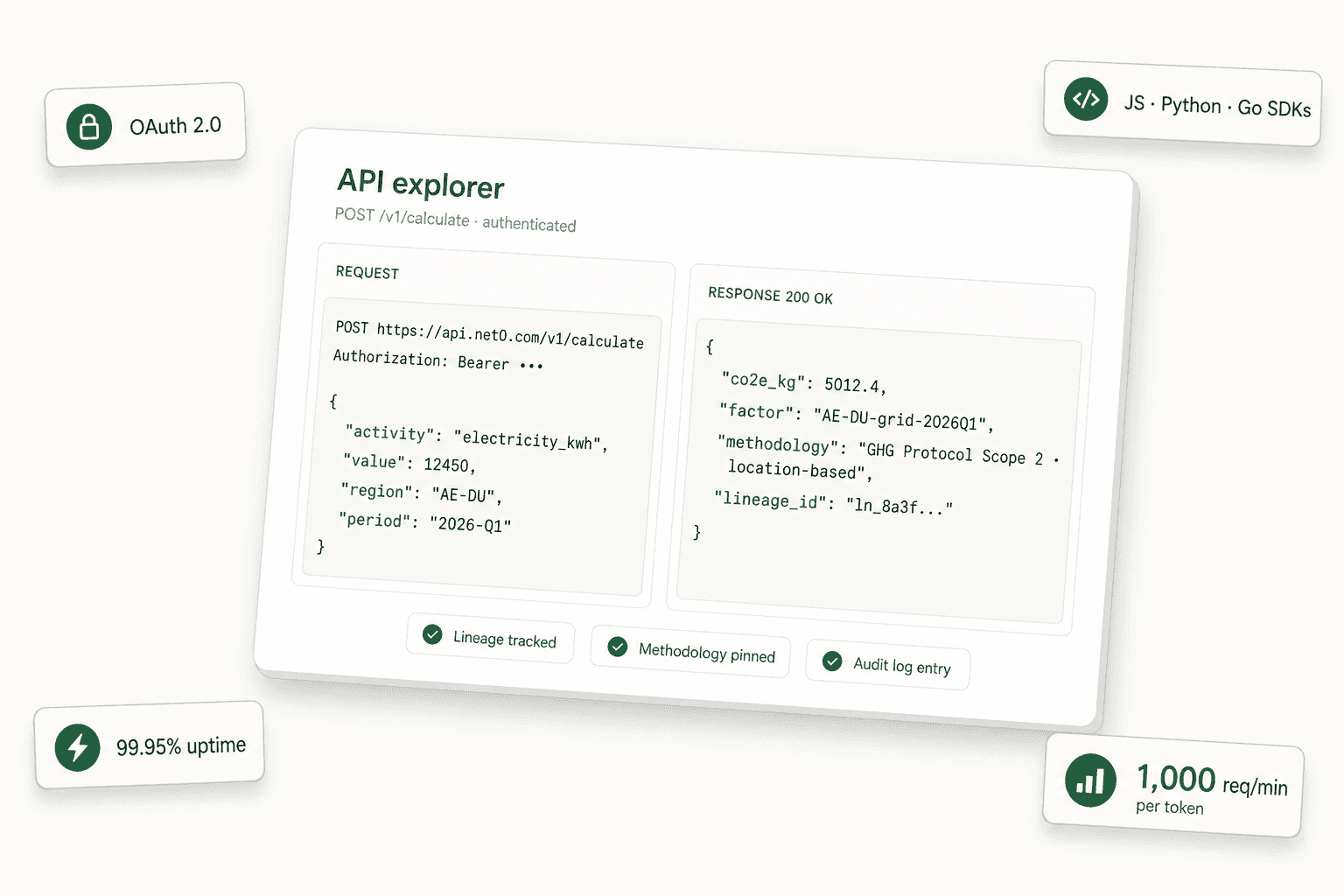
Push data in, pull data out, calculate emissions and resource impacts on the fly, and embed Net0 inside the enterprise’s own software stack. Programmatic access to every domain — carbon, water, waste, supplier ESG — with multi-level controls and a full developer toolkit so sustainability data lives wherever the business runs.
REST API
Read and write every emission record.
Full-coverage REST API for activity data, emission factors, calculations, and disclosure outputs. OAuth 2.0, scoped tokens, and per-environment sandboxes for staging and production.
Webhooks & SDKs
Wire emissions into the apps the business already uses.
Webhooks for ingestion events, anomaly alerts, and disclosure status. SDKs for JavaScript, Python, and Go. Pre-built workflow templates for Snowflake, Databricks, and downstream sustainability data warehouses.
On-the-fly compute
Calculate emissions inside your own product.
Send activity data, get back a CO₂e calculation against the latest factor library and a chosen framework. Embed Net0 inside customer-facing tools, supplier portals, and procurement workflows — with multi-level access controls.
First 90 days
What customers ingest in their first quarter.
A typical Net0 enterprise rollout reaches a complete environmental and social data baseline in 4–8 weeks — emissions, energy, water, waste, and supplier ESG — driven by data availability, not software configuration.
Week 1–2
12+
Systems connected
First connectors live across ERP, energy, water, waste, EHS, travel, and procurement systems — typically within the first fortnight of system access.
Week 4–8
120k+
Documents parsed
AI extraction across utility bills, fuel receipts, water reports, waste manifests, supplier invoices, and EPDs delivers a full Scopes 1–3, energy, water, and waste baseline.
Week 6–12
300+
Suppliers onboarded
Automated supplier outreach campaigns ingest CDP responses, EcoVadis data, primary supplier disclosures, and CSDDD attestations — covering Scope 3 emissions, water, and supply-chain ESG in one flow.
Day 90
1
Audit-ready ledger
One source of truth across all sustainability domains — climate, energy, water, waste, supplier ESG, and workforce data — with lineage, methodology pinning, and approval trails for assurance partners.
Where the Data Hub sits in the platform
One AI-first sustainability platform.
The Data Hub is the ingestion and governance layer. It feeds three sibling products on the same data fabric — the carbon accounting layer, the disclosure layer, and the abatement layer.
Net0 Measure
Account for every emission.
The carbon accounting layer that turns Data Hub records into Scope 1, 2, 3, and 4 emissions — calculated against 50,000+ emission factors and 30+ frameworks.
Explore Measure →
Net0 Report
Disclose across 30+ frameworks.
Real-time dashboards and on-demand reports across CSRD, ISSB, CDP, GRI, SBTi, and 25 more — all from the Data Hub’s single source of truth.
Explore Report →
Net0 Reduce
Find profitable abatement pathways.
MAC curves, scenario simulation, and an actions marketplace that convert measurement into a profitable carbon and OPEX reduction plan.
Explore Reduce →
FAQ
Procurement-grade questions, answered.
Does the Data Hub cover sustainability domains beyond carbon?
Yes. The Data Hub is built as a multi-domain layer for every signal an enterprise sustainability programme has to report or act on — climate (Scopes 1, 2, 3 and avoided emissions), energy and renewables, water (withdrawals, discharges, water-stress exposure), waste and circularity, biodiversity and land use, supply-chain ESG and human rights, workforce and diversity data, and governance metrics. Each domain is normalized against its relevant standards (GHG Protocol for carbon, CDP and AWS for water, GRI 306 for waste, TNFD for nature, ESRS S-series for social, GRI 400-series for workforce) and feeds the same calculation, disclosure, and reduction layers.
How is the platform secured?
All data is encrypted in transit (TLS 1.3) and at rest (AES-256). Access is governed by role-based permissions, SSO/SAML, and granular audit logging. Sensitive operations require multi-factor authentication, and all activity is recorded in an immutable audit log. Annual third-party penetration tests, continuous vulnerability scanning, and a formal incident response programme back the security posture.
How long is data retained? Can records be exported on exit?
Default retention is the customer’s contract term plus seven years of audit-grade lineage to meet assurance and regulatory requirements. Customer-defined retention policies can be configured per dataset. On exit, the full dataset — including lineage, methodology versions, and disclosure outputs — can be exported via API, CSV, or native framework templates.
What document and file types can the AI parse?
PDF (digital and scanned), Excel, CSV, image formats (JPG/PNG), and structured EDI feeds. Coverage includes utility bills, fuel receipts, supplier invoices, EPDs, certificates of origin, supplier disclosure surveys, and CDP supply chain responses. Confidence scores and human-in-the-loop review flow are exposed for low-confidence extractions.
What are the API rate limits and SLAs?
Standard production rate limits are 1,000 requests per minute per token, with burst capacity for batch ingestion workloads. Enterprise contracts include a 99.9% ingest uptime SLA and a 99.95% API availability SLA, with regional read replicas for cross-region failover. Dedicated infrastructure and custom SLAs are available for sovereign deployments.
How long until the first data flows are live?
Standard enterprise rollouts have first connectors live within 1–2 weeks of system access. A complete ingest baseline across finance, energy, and travel is typically delivered in 4–8 weeks, with Scope 3 supplier flows phasing in over the following quarter. Implementation timeline is driven by data availability and procurement, not by software configuration.
How does the Data Hub keep an audit-ready trail?
Every record carries source-data lineage from the originating system or document through every transformation, normalization, and downstream calculation. Methodology versions and emission factor references are pinned per disclosure period. Approval workflows, change history, and snapshot exports are designed to satisfy ISAE 3000 / ISAE 3410 limited or reasonable assurance engagements.