
AI x Sustainability · Decarbonisation
Turn the emissions inventory into an executable plan.
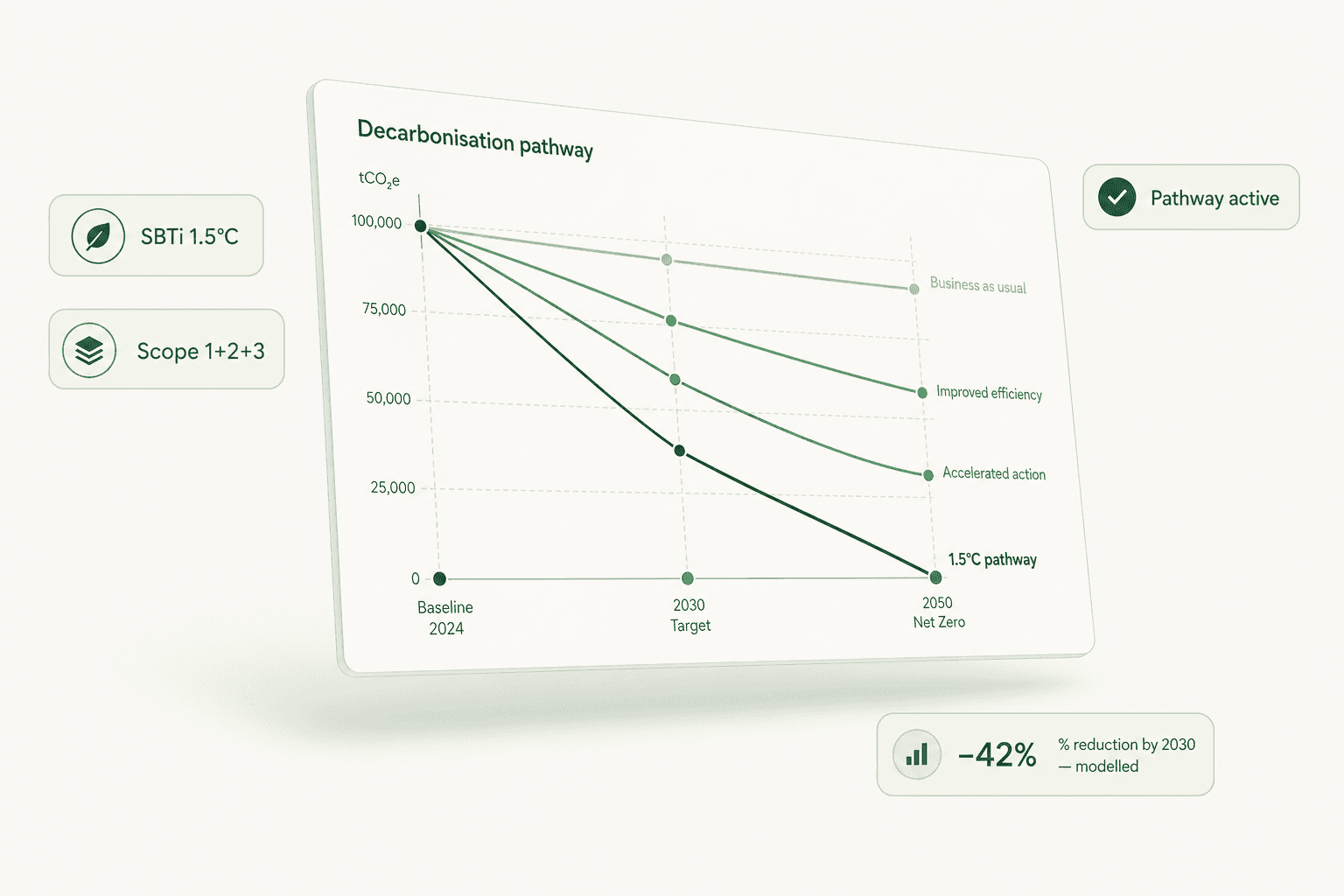
Net0 Decarbonisation is the AI-first action layer of the Net0 Sustainability Platform. It models science-based pathways, simulates costed abatement scenarios, and tracks every initiative against the live emissions ledger — turning measurement into a profitable plan to net zero.
Decarbonisation that pays back
Negative-cost
Where every plan starts
1.5°C
SBTi-aligned pathways
Scope 1, 2, 3
End-to-end reduction
8
Abatement-lever categories
6 weeks
To first owned initiative
30+
Disclosure frameworks fed
Decarbonisation sequenced by marginal abatement cost — so the cheapest tonne pays for the next, capex follows the curve, and removals are reserved for the residual emissions only.
The problem
An emissions inventory does not reduce a single tonne.
Most enterprise sustainability programmes invest years building the inventory — ingesting data, calculating Scopes 1, 2 and 3, validating the result for assurance. The work is necessary. It is also where most programmes stop. The bottleneck is no longer measurement; it is the translation of measurement into prioritised, costed, executable action across thousands of facilities and tens of thousands of supplier relationships.
Net0 Decarbonisation was built to dissolve that constraint. It models science-based pathways against the live ledger, simulates the cost and carbon impact of every credible intervention, and tracks each initiative end-to-end — turning the reporting deliverable into a profitable plan to net zero, defended by the same audit-grade dataset that proves it.
Decarbonisation pathway
From baseline to net zero, modelled on the customer’s own ledger.
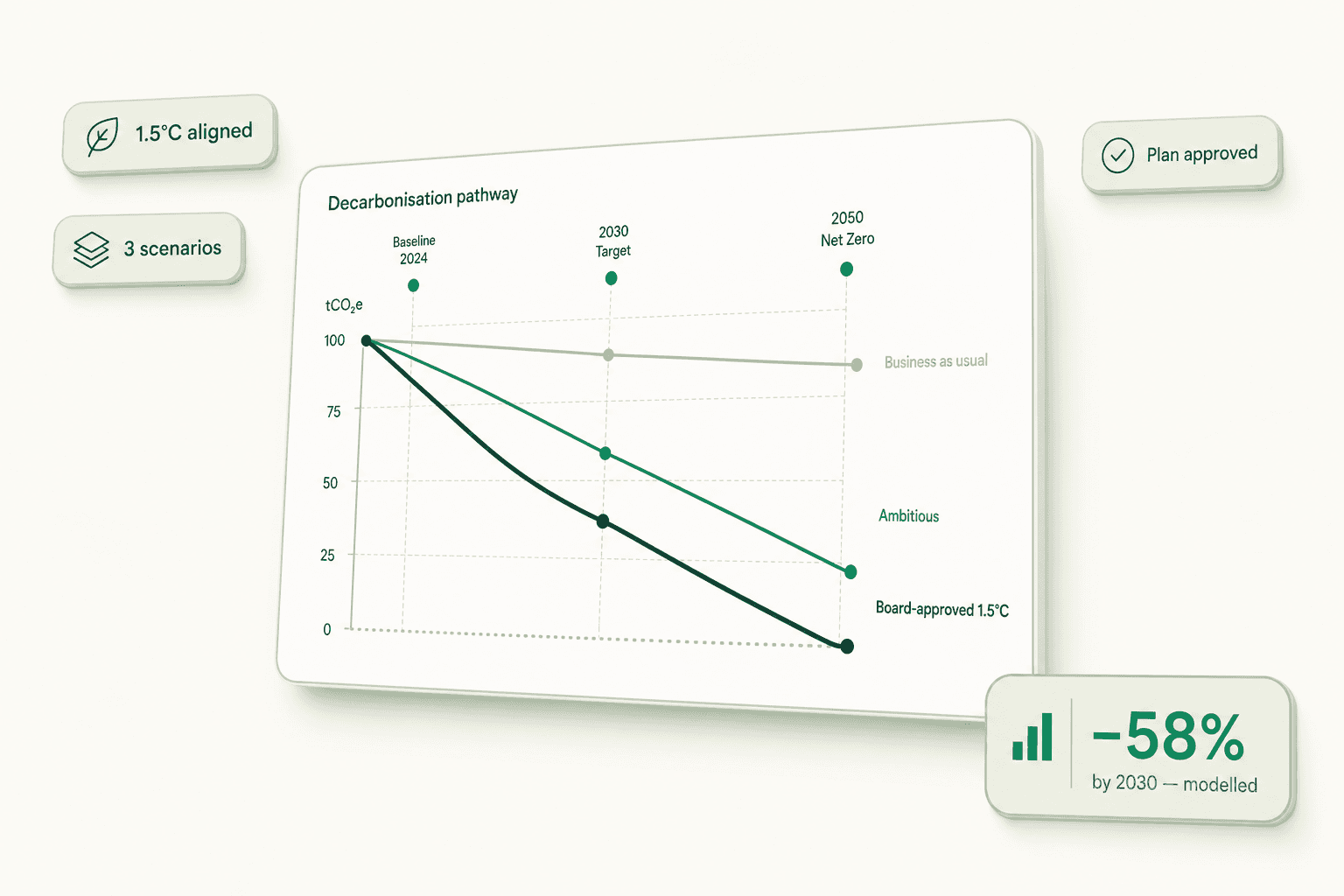
Net0 generates a science-based decarbonisation pathway from the live emissions inventory — anchored to a science-based target, broken down by Scope and business unit, and overlaid with alternative scenarios so executive teams can see exactly what each strategic choice costs and abates.
Anchored
To a science-based target.
Pathways align to a 1.5°C trajectory by default, with SBTi-compatible near-term and net-zero target gates. Custom corporate ambitions can be set against the same modelled budget.
Decomposed
By scope and business unit.
Each pathway is broken down by Scope 1, 2, and 3, by business unit, and by geography — so accountability for delivery sits with the operating team that owns the emissions, not the central sustainability office.
Compared
Across scenarios, in real time.
Run alternative scenarios side-by-side — business as usual, ambitious, board-approved — and quantify the cost, abatement, and timeline implications of each before capital is committed.
How Net0 decarbonises
Target. Simulate. Execute.
Decarbonisation separates the work into three engineered layers — each grounded in the same audit-grade ledger that powers measurement and disclosure.
Target
Set a science-based pathway, by Scope and business unit.
Anchor near-term and net-zero targets to a 1.5°C trajectory. Net0 maps SBTi-compatible budgets onto the live ledger and decomposes them by Scope, geography, and business unit — so every leader sees the gap between their share of the target and their actual emissions.
SBTi-compatible near-term and net-zero target setting
Carbon budget allocation across Scopes 1, 2 and 3
Per-business-unit accountability and progress tracking
Simulate
Model abatement, cost, and timeline before capital is committed.
Run scenarios across the full intervention library — efficiency, electrification, fuel switching, renewable PPAs, supplier engagement — and quantify carbon, cost, and time-to-impact for each. Compare alternatives side-by-side and stress-test the plan against carbon-price and energy-price assumptions.
Side-by-side scenario comparison with one-click sensitivity analysis
Carbon, cost, and timeline modelled per intervention
Carbon-price and energy-price stress testing
Execute
Assign initiatives. Track impact against the live ledger.
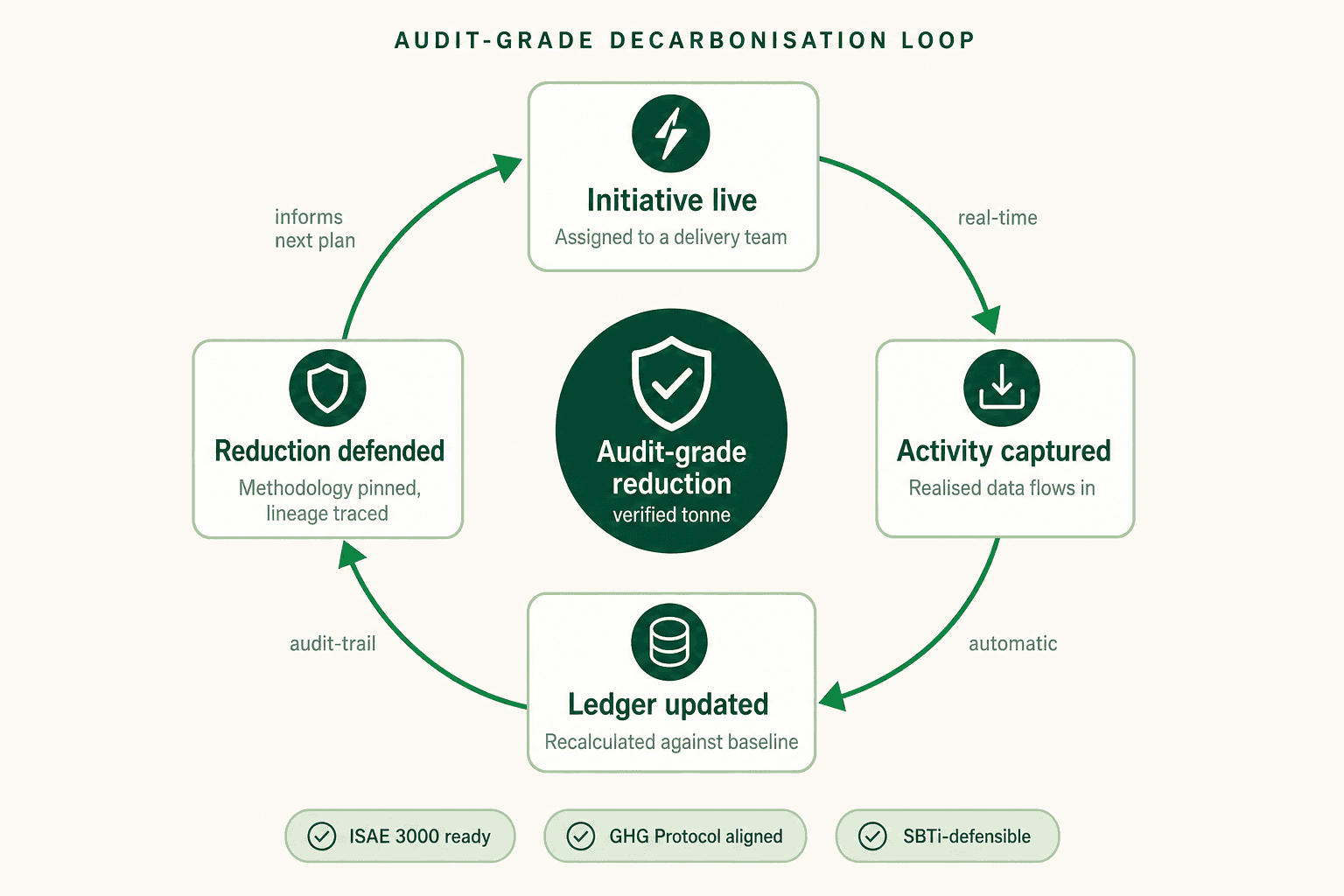
Promote a scenario into a portfolio of owned initiatives. Assign a delivery team, a target abatement, and a deadline to each. Net0 measures realised reductions in real time against the same audit-grade dataset that powers Scope 1, 2, and 3 disclosures — so claimed reductions are always defensible.
Initiative ownership across business units, sites, and suppliers
Realised abatement measured against the live emissions ledger
Audit-grade lineage from initiative to disclosed reduction
Initiative library
A pre-built catalogue of every abatement lever worth considering.
Net0 ships with a curated library of decarbonisation interventions across operational, energy, supply chain, and offset categories. Each lever is pre-modelled with default abatement, cost, and time-to-impact assumptions — ready to drop into a scenario, customise to the customer’s context, and assign as an owned initiative.
01 · Operational
Energy efficiency
HVAC retrofits, building envelope upgrades, lighting, motor and pump optimisation, process heat recovery. Typically negative-cost — the first move on most MAC curves.
02 · Energy
Renewable PPAs & on-site generation
Corporate PPAs, virtual PPAs, on-site solar and storage, district heating, geothermal. Models contracted volume, residual grid mix, and Scope 2 location- and market-based outcomes.
03 · Energy
Electrification & fuel switching
Heat pumps, industrial electrification, hydrogen for high-temperature heat, biofuels, refrigerant transitions. Includes site-by-site capex profile and grid emissions sensitivity.
04 · Mobility
Fleet & logistics transition
Electric and hydrogen fleet conversion, modal shift, route optimisation, last-mile electrification, sustainable aviation and marine fuels. Models TCO and infrastructure phasing.
05 · Supply chain
Supplier engagement & substitution
Strategic supplier engagement programmes, low-carbon material substitution, recycled content targets, supplier-specific emission factor procurement. The dominant lever for Scope 3 categories 1 and 2.
06 · Product
Process & product redesign
Material lightweighting, circular design, product reformulation, manufacturing process redesign, and yield improvement programmes. Modelled against unit-level emission intensities.
07 · Demand
Travel, commuting & behaviour
Business-travel policy, hybrid-work emissions, employee commuting programmes, and demand-management initiatives across operations — calibrated against HR and travel system data.
08 · Residual
Removals & offsets-of-last-resort
High-quality carbon removals — nature-based, biochar, DACCS, BECCS — reserved for residual emissions only. Tracked against rigorous quality standards and net-zero hierarchy rules.
Marginal Abatement Cost curve
The cheapest tonne first. Every tonne after that, in priority order.
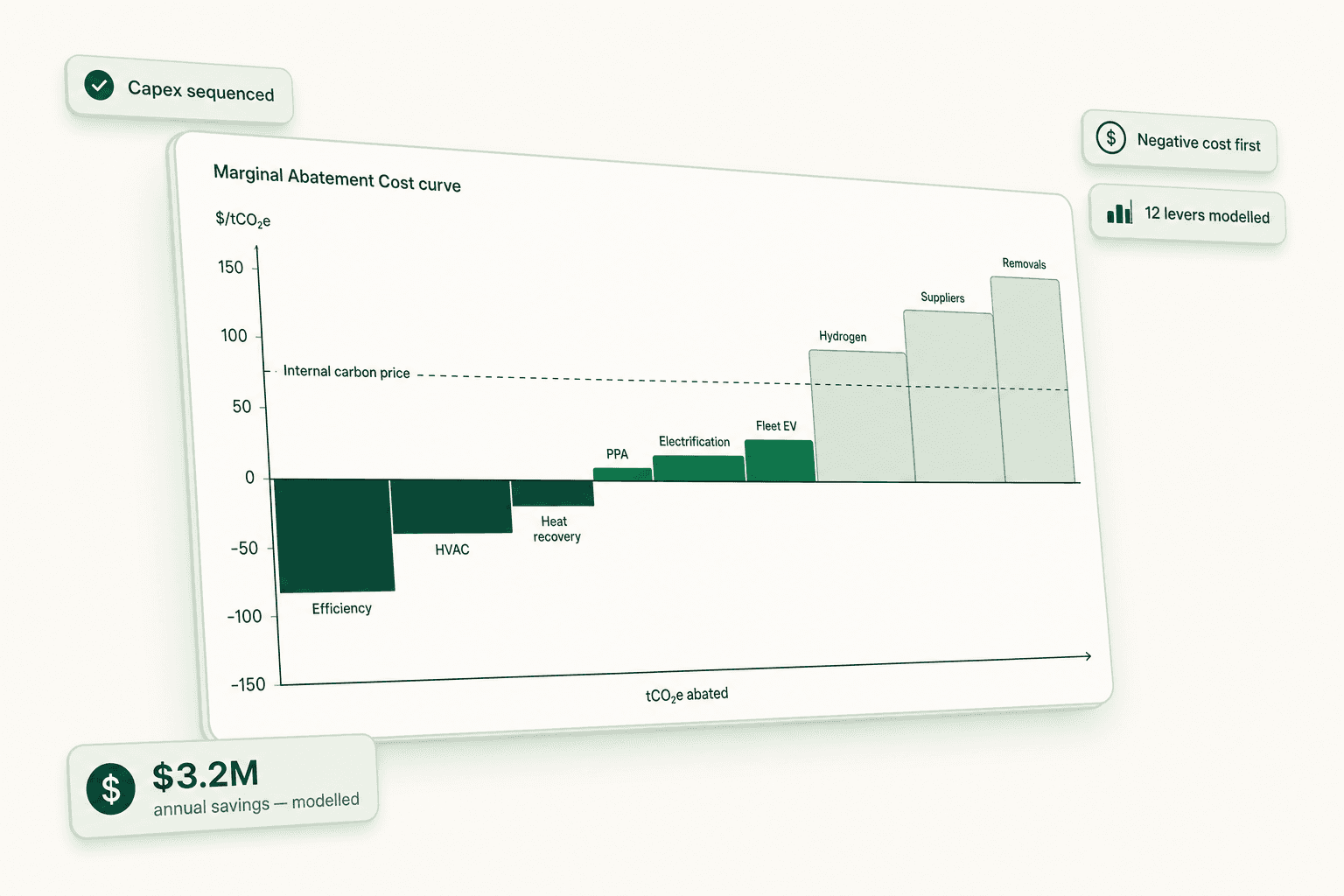
Net0 generates a Marginal Abatement Cost curve from the customer’s own ledger and intervention library — sorting every credible action from negative-cost (profitable) to highest-cost (offsets of last resort). Capital allocation, board reporting, and procurement scope follow the curve, not the calendar.
Negative cost
Step 1
Identify and execute interventions that pay for themselves — efficiency, demand-side levers, low-cost electrification — before any capital-intensive moves.
Strategic capex
Step 2
Allocate capex to the next tier of abatement: PPAs, electrification, supplier engagement — sized against an internal carbon price and the company’s science-based budget.
Residual only
Step 3
Reserve high-quality carbon removals for residual emissions only — sequenced last, never used as a substitute for in-value-chain abatement.
From plan to defensible disclosure
Decarbonisation that holds up to assurance.
Realised reductions only count if they are defensible. Net0 closes the loop — every initiative’s impact is recalculated through the live emissions ledger, with full lineage from the source data to the disclosed tonne. The same dataset that proves the abatement defends the disclosure.
Lineage
On every reduction.
Every claimed tonne of abated CO₂e traces back through the live ledger to its originating activity data — the same audit-grade lineage Net0 maintains for measurement and disclosure.
Methodology
Pinned per period.
Calculation methodologies, emission-factor versions, and SBTi pathway assumptions are pinned per reporting period. A reduction claimed in one year is defended by the methodology approved that year, not whatever is current today.
Assurance
Ready by default.
Approval workflows, change history, and snapshot exports are designed to satisfy ISAE 3000 and ISAE 3410 limited or reasonable assurance engagements without retrofitting evidence packs after the fact.
Where Decarbonisation sits in the platform
One AI-first sustainability platform.
Decarbonisation is the action layer. It runs on the same data fabric and emissions ledger as the carbon accounting and disclosure layers — so plans, scenarios, and realised reductions inherit the audit-grade lineage Net0 already maintains.
Net0 Data Hub
Ingest every sustainability signal.
The data ingestion and governance layer that feeds the Decarbonisation engine — 10,000+ connectors, AI parsing, and audit-grade lineage on every record.
Explore the Data Hub →
Carbon Emissions Management
Account for every emission.
The carbon accounting layer — Scopes 1, 2, 3 and 4 calculated against 50,000+ emission factors and 30+ frameworks, the same ledger Decarbonisation runs against.
Explore Carbon Management →
Net0 Report
Disclose across 30+ frameworks.
Real-time dashboards and on-demand reports across CSRD, ISSB, CDP, GRI, SBTi, and 25 more — so the same plan that abates carbon also defends the disclosure.
Explore Report →
FAQ
Procurement-grade questions, answered.
How does Net0 ensure decarbonisation pathways are SBTi- and 1.5°C-aligned?
Pathways are generated against the SBTi Corporate Net-Zero Standard and the most recent 1.5°C-aligned sectoral budgets, with the option to overlay tightened corporate ambitions or board-approved trajectories. Methodology versions and budget vintages are pinned per modelling cycle, so plans, scenarios, and disclosures all reference the same audit-grade baseline. The platform supports near-term, long-term, and FLAG (Forest, Land, and Agriculture) targets where applicable.
Where do scenario assumptions come from, and can they be edited?
Each lever in the intervention library carries a default abatement, capex, opex, and time-to-impact range derived from peer-reviewed engineering studies, IEA scenarios, and the customer’s own historical performance data. Every assumption is editable per scenario, with full version history and approval workflow. The provenance of each assumption — source, date, methodology — is visible inline and exported alongside disclosure outputs.
How are Scope 3 supplier reductions modelled and tracked?
Supplier reductions are modelled at the supplier-spend or supplier-volume level using supplier-specific emission factors where available, and engagement-tier defaults where not. Realised reductions feed through Net0’s supplier engagement workflow — surveys, attestations, and primary data uploads — and are reconciled against procurement and AP records before being recognised in the live ledger. The methodology aligns with the GHG Protocol Scope 3 Standard and the SBTi Net-Zero Standard’s supplier engagement criterion.
Can teams co-own initiatives across business units, sites, and suppliers?
Initiatives support multi-owner accountability with role-based access — typically a sustainability lead, an operating-team owner, and a finance partner per initiative. Progress, capex actuals, and realised abatement are tracked per initiative against a shared target. Cross-business-unit and cross-supplier initiatives are first-class, with consolidated reporting at the parent level and granular accountability at the executing team.
What methodology underpins the Marginal Abatement Cost curve?
The MAC curve combines the customer’s own emissions ledger with the intervention library’s default and customised cost-per-tonne values, computed on a levelised basis (capex amortised over asset life plus annual opex, net of avoided cost). Bars are sorted by $/tCO₂e and sized by tonnes abated. The curve supports sensitivity to internal carbon price, energy price, and asset-life assumptions; results are reproducible and exportable for assurance.
How quickly can a first scenario, target, or initiative go live?
For customers already running on the Net0 Carbon Emissions Management layer, a first SBTi-aligned target and baseline scenario can typically be modelled within 2–3 weeks of kickoff. The first portfolio of owned initiatives — site-level, supplier-level, or business-unit level — typically goes live in 4–6 weeks. Implementation is paced by data availability and stakeholder alignment, not by software configuration.